


This summer’s third and final mission to Mars lifted off at exactly 3.50pm UAE time on Thursday.
The US space agency Nasa rocket took off from Cape Canaveral Air Force Station in Florida.
The rocket launched, sending the rover Perseverance and a space helicopter Ingenuity on their six-month journey to the Red Planet in what will be the world’s first round trip to Mars.
Dr Lori Glaze, Nasa’s Planetary Science division director, said the value of bringing samples back was that scientists would be able to carry out a more in-depth analysis on Earth.
“We can also preserve the samples for decades and use future instruments not made yet and answer questions we haven’t thought of yet,” she said during the live-stream of the launch.
“The equipment going to Mars can detect biosignatures in space but it will be difficult to confirm if life did exist on Mars until we get the samples back to Earth.”
On arrival to Mars, Perseverance will spend two years searching for signs of ancient life.

The mission to return the Mars samples to Earth will begin in 2026.
“This will be really complex and required two launches from Earth and one from Mars,” Dr Glaze said.
The US will retrieve the samples from Mars and an orbiter launched from Europe will catch them before they are dropped back to Earth, where they will land in the Utah desert.
The Mohammed bin Rashid Space Centre and Hope Mars Mission each tweeted out their congratulations. "Good luck with your mission! We serve one common goal: exploration for a better future," said the Dubai centre.
While Hope Mars Mission said: "Here’s wishing you a smooth and successful journey to Mars. See you there."
Nasa responded saying "We go farther when we explore together. See you at Mars in February!"
Thursday's launch comes less than two weeks after the UAE’s Mars orbiter Hope lifted-off on July 20, followed by China’s Tianwen-1 spacecraft three days later.
All three missions are scheduled to arrive around the same time in February.
They will complement each other, researching different mysteries of the planet, which will help scientists plug gaps in knowledge about conditions on Mars and its atmosphere.
The Hope probe will study the planet’s weather systems, while Nasa’s Perseverance rover will collect rock core and soil samples. Tianwen-1 will search for pockets of ice below the surface.
The three missions all chose to launch around the same time to make the most of a window which occurs every 26 months, when the two planets are closer to each other for a brief period.
Perseverance was scheduled to take off earlier in July, but had to overcome a number of technical issues.

At a cost of $2.7 billion (Dh9.92bn), the Nasa mission is the most expensive of the three.
Samples are expected to be returned to Earth by 2031 through a joint Nasa and European Space Agency project.
Perseverance will spend about 687 days, around two Earth years, or one Martian year, on the Red Planet.
It will explore the 45 kilometre-wide Jezero crater, which contained a lake and river delta 3.5 billion years ago, to search for signs of life that may have once been there.
It will have to contend with conditions which are very different to Earth. Temperatures plummet -90°C at night.
The rover includes several advanced cameras and two microphones, which will attempt to capture the first sounds on another planet.
It will also take five small pieces of spacesuit material to be studied by its instruments to help scientists develop suits for future astronauts.
In addition, the rover is carrying the Ingenuity helicopter, which will perform a flight test.
Scientists do not yet know if it will be able to generate enough lift to fly in the atmosphere of Mars, which is about 100 times thinner than Earth’s.
To counter that, its two rotors will spin in opposite directions at around 2,400rpm, which is much faster than a helicopter on Earth.
If it works, it will be the first controlled flight on another planet. It will also pave the way for the development of other advanced robotic flying vehicles, which will provide scientists with a different viewpoint.
Engineers behind the UAE’s Hope probe wished Nasa good luck earlier this week.
“Our colleagues at Nasa are about to do a great thing – launching Perseverance to Mars,” Dr Mohammed Al Ahbabi, director general of UAE Space Agency, said on Wednesday, before the launch.
“In fact, ‘Hope’ and ‘Perseverance’ are exactly the two words humanity needs in the light of Covid-19.”
The UAE's Mars mission:
-
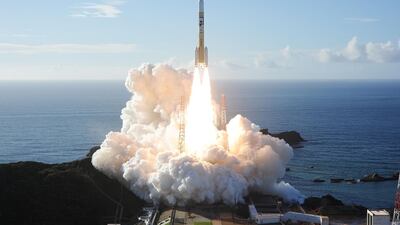
The Hope probe launches from Japan's Tanegashima Space Centre on July 20. AFP -
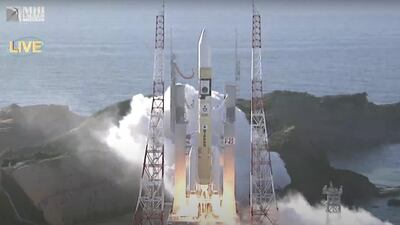
It will take the spacecraft, which later detached from the rocket, about 200 days to reach the Red Planet, arriving in February 2021. Courtesy: Mitsubishi Heavy Industries -

The launch of the rocket is captured on video at Japan's Tanegashima Space Centre. Courtesy: Mitsubishi Heavy Industries -
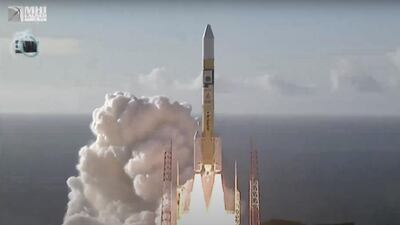
The first homegrown Arab space mission drew in interest from across the globe. Courtesy: Mitsubishi Heavy Industries -
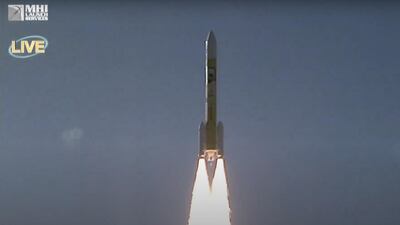
The launch of the rocket from Japan's Tanegashima Space Centre. Courtesy: Mitsubishi Heavy Industries -

Waiting for the launch in the morning light. MHI Launch Services twitter -

Emirati journalists clap as they watch the launch of the Hope space probe at Mohammed bin Rashid Space Centre in Dubai. AP -
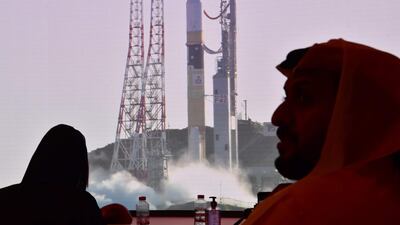
A broadcasting of the launch of the Hope Mars probe at the Mohammed Bin Rashid Space Centre in Dubai. AFP -

An Emirati man wipes a tear away with his face mask while watching the launch of the Hope space probe at Mohammed bin Rashid Space Centre in Dubai. AP -

Mohammed Al Mannaee, an announcer with Dubai TV, reacts as he watches the launch. AP -

Sarah Al Ameeri and the UAE team watch the launch at at the Tanegashima Space Centre -
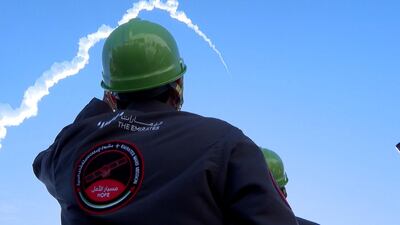
The UAE team watch the launch of the Mars Hope probe at at the Tanegashima Space Centre. -

Sarah Al Ameeri and the UAE team watch the launch at at the Tanegashima Space Centre -
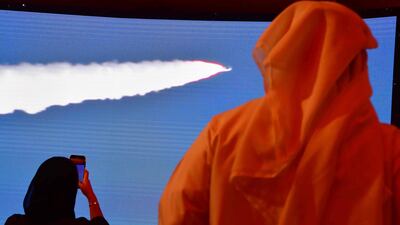
A screen broadcasts the launch of the Mars probe at Mohammed bin Rashid Space Centre in Dubai. AFP -
Solid rocket booster (SRB-A) was separated after burnout during the launch of the H-2A rocket carrying the Hope Probe, developed by the Mohammed Bin Rashid Space Centre (MBRSC) in the United Arab Emirates (UAE) for the Mars explore, are recorded by cameras onboard the rocket after the lauch from Tanegashima Space Center on the island of Tanegashima, Japan. REUTERS -
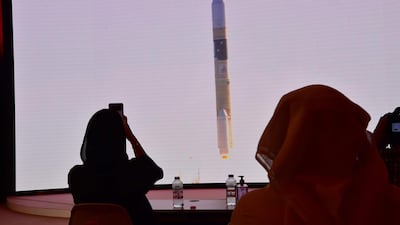
A screen broadcasts the launch of the Mars probe at Mohammed bin Rashid Space Centre in Dubai. AFP -
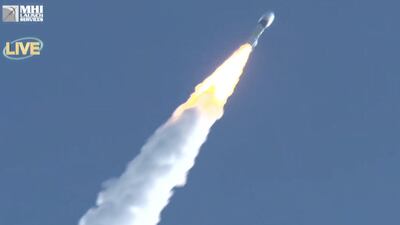
The launch of the rocket from Japan's Tanegashima Space Centre. Courtesy: MHI Launch Services -
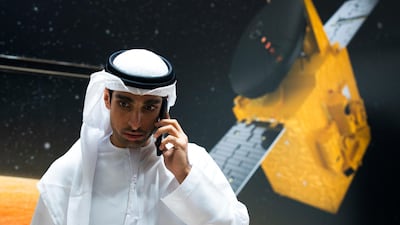
Omran Sharaf, the project director for the Hope space probe, speaks on his mobile phone at Mohammed bin Rashid Space Centre in Dubai. AP -
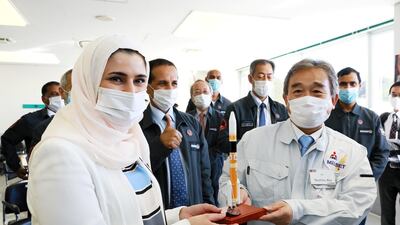
Sarah Al Ameeri, Minister of State for Advanced Sciences of United Arab Emirates, celebrates with Naohiko Abe, Mitsubishi Heavy Industries (MHI) Senior Vice President, Head of Integrated Defence and Space Systems, after the successful launch of the H-2A rocket carrying the Hope Probe, developed by the Mohammed Bin Rashid Space Centre (MBRSC) in the United Arab Emirates (UAE) for the Mars explore, at Tanegashima Space Center on the island of Tanegashima, Japan. REUTERS -
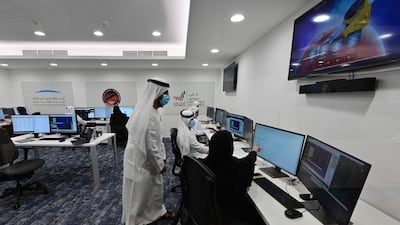
Emiratis are pictured at the Mohammed Bin Rashid Space Centre in Dubai ahead of the expected launch of the "Hope" Mars probe from Japan. AFP -
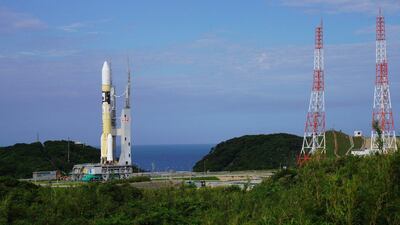
The weather was clear over Tanegashima Island in southern Japan on Sunday after weeks of rain and cloudy conditions. Courtesy: Dubai Media Office -
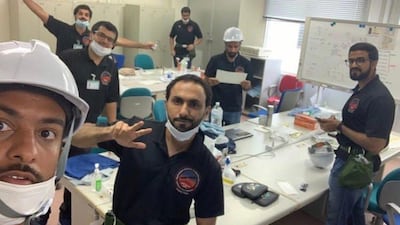
Emirati engineers wave in a picture taken on Sunday from Japan's Tanegashima Space Centre. Courtesy: Emirates Mars Mission / UAE Space Agency -
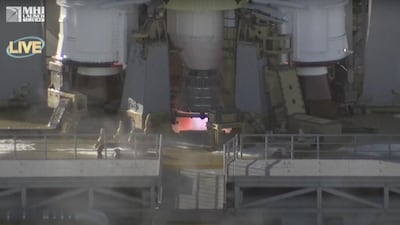
The launch of the rocket from Japan's Tanegashima Space Centre. Screengrab courtesy MHI Launch Services



