


An Abu Dhabi researcher has told of her excitement after helping to shed new light on a distant planet that has striking parallels to Earth, despite dwarfing it in size.
A team of astrophysicists, including Dr Jasmina Blecic, from New York University Abu Dhabi, has revealed in much greater detail what is found in the atmosphere of Wasp-39b.
This massive furnace-like ball of gas — which is 700 light years away — has a diameter about 10 times that of Earth and a temperature estimated to be about 900°C, the result of it being an eighth as far from its star as the planet Mercury is to the Sun.
In newly published research, Dr Blecic and her fellow researchers from around the world revealed that the atmosphere of Wasp-39b — an exoplanet, meaning that it orbits a star outside our solar system — contains sulphur dioxide.
As this gas has been produced by light acting on chemicals in the upper part of the atmosphere of Wasp-39b, the finding means that scientists have detected photochemistry for the first time on an exoplanet.
Planet has own version of ozone layer
Similar to the ozone layer that surrounds Earth, the sulphur dioxide protects the deeper parts of Wasp-39b's atmosphere from high-energy radiation.
“When we saw the first data, how clearly we can see the signals, we were all amazed,” said Dr Blecic, a research associate in NYUAD’s Centre for Astro, Particle and Planetary Physics.
Based on data from Nasa’s James Webb Space Telescope (JWST), the findings are being released in five papers in the journal Nature, regarded as one of the world’s most prestigious scientific publications.
In the past, Dr Blecic and her colleagues interpreted data generated from two other major space telescopes, Hubble and Spitzer.
With data from these two telescopes, researchers were less certain that chemicals that they thought they had detected were really there.
However, the information provided by the James Webb telescope is far higher quality, with much less “noise” and instrumental errors that needs to be filtered out.
As reported by The National in August, previous studies from the James Webb telescope data indicated that the atmosphere of Wasp-39b contains carbon dioxide.
Findings highlight telescope's capabilities

The new discovery of sulphur dioxide in the atmosphere of Wasp-39b has additional significance in that it shows that the James Webb telescope can provide the information necessary to detect the gas.
If the James Webb telescope can detect the sulphur dioxide in the atmosphere of Wasp-39b, it could probably detect it in the atmosphere of smaller, rocky planets, some of which may have produced the gas through volcanic activity.
Finding volcanic activity on planets that exist in the habitable zone of their own star suggests that they may be able to host life, so the latest findings make researchers optimistic about what else they will be able to discover using data from the James Webb telescope.
“If this was a terrestrial rocky planet in the habitable zone, it would tell us it had volcanic mechanisms,” Dr Blecic said.
“We weren’t sure whether JWST would be able to detect chemical species expected to be present in terrestrial rocky planets in the habitable zone. Now we are more confident we can.”
The latest research also showed that Wasp-39b has broken clouds in its atmosphere, which parallels what is seen on Earth.
The orbit of Wasp-39b is observed edge-on, which helps researchers to determine how the atmosphere absorbs light.
This absorption pattern indicates which gases are present in the atmosphere — because different gases absorb wavelengths of light to differing degrees.
In the coming weeks, Dr Blecic will be looking at James Webb telescope data from another exoplanet, Wasp-43b, using the Mid-Infrared Instrument (Miri) on board the James Webb telescope. Miri detects mid to long infrared radiation.
Wasp-43b may yield even more exciting discoveries because researchers will be able to observe both the night and day sides, unlike with Wasp-39b, where only the night side was observed
“We are very excited about this new planet analysis and what it will reveal to us, as this will be the first time that we will have observed a full planet orbit with JWST,” Dr Blecic said.
Startling discoveries by advanced telescope — in pictures
-
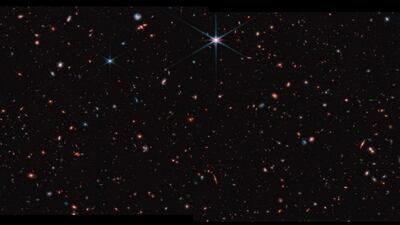
An enormous colour mosaic made up of images captured by the James Webb Space Telescope has been released. This image shows only a small part of the mosiac. All photos: Nasa -

The mosaic is made up 690 individual frames taken with the telescope’s near infrared camera – an instrument that captures radiant energy from objects invisible to the human eye. -

Collectively known as Epoch 1, the image is the largest one yet made using data from the world’s largest space observatory. -
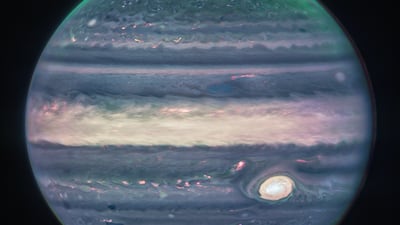
Jupiter as seen by the James Webb telescope. -
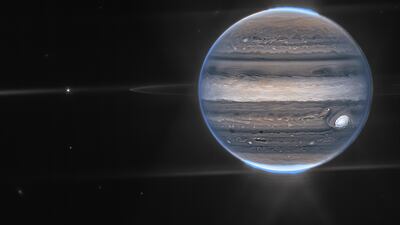
The James Webb telescope captures Jupiter.



