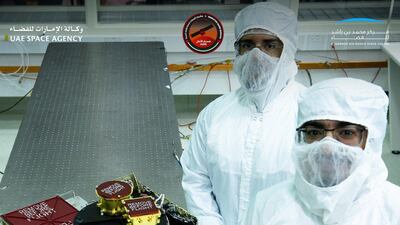
• 'The National' visited mission control at Dubai's Mohammed bin Rashid Space Centre to learn how engineers are preparing for Hope probe's Mars orbit insertion, set for February 9. All photos by Chris Whiteoak / The National
    'The National' visited mission control at Dubai's Mohammed bin Rashid Space Centre to learn how engineers are preparing for Hope probe's Mars orbit insertion, set for February 9. All photos by Chris Whiteoak / The National
  • Omar Abdelrahman Hussain, mission design and navigation lead, said mission team will mostly be observers on the day. There is an 11-minute communication delay because of the distance between the two planets, so live commands will not be sent
    Omar Abdelrahman Hussain, mission design and navigation lead, said mission team will mostly be observers on the day. There is an 11-minute communication delay because of the distance between the two planets, so live commands will not be sent
  • The Hope probe is close to completing a distance of 493.5 million kilometres. It launched on July 20, 2020 aboard a Japanese rocket and will study the upper and lower atmosphere of the Red Planet. Emirates Mars Mission
    The Hope probe is close to completing a distance of 493.5 million kilometres. It launched on July 20, 2020 aboard a Japanese rocket and will study the upper and lower atmosphere of the Red Planet. Emirates Mars Mission
  • Pre-programmed manoeuvers have been set into the spacecraft so it can perform an automated entry into orbit
    Pre-programmed manoeuvers have been set into the spacecraft so it can perform an automated entry into orbit
  • The programming includes firing the probe's six thrusters for 28 minutes to slow it down from about 100,000 kph to 18,000 kph to get captured into Mars' orbit
    The programming includes firing the probe's six thrusters for 28 minutes to slow it down from about 100,000 kph to 18,000 kph to get captured into Mars' orbit
  • There will also be a brief period when communication is lost when the spacecraft travels behind Mars, blocking the signal. Engineers will do a full evaluation of how orbit entry went once contact is restored
    There will also be a brief period when communication is lost when the spacecraft travels behind Mars, blocking the signal. Engineers will do a full evaluation of how orbit entry went once contact is restored
  • Khalid Mohammad Badri, instrument science engineer, said the scientific instruments aboard the spacecraft will remain safe during orbit entry and will be tested after completion of this critical stage
    Khalid Mohammad Badri, instrument science engineer, said the scientific instruments aboard the spacecraft will remain safe during orbit entry and will be tested after completion of this critical stage
  • All communication with the probe has been made possible through Nasa's Deep Space Network. Their massive ground radio arrays in California, Spain and Australia are the first to send and receive telemetry from the spacecraft. The antenna in Madrid will be the first to know how orbit entry went
    All communication with the probe has been made possible through Nasa's Deep Space Network. Their massive ground radio arrays in California, Spain and Australia are the first to send and receive telemetry from the spacecraft. The antenna in Madrid will be the first to know how orbit entry went
  • Mahmood Abdulaziz AlNasser, mission operations control development lead, said the team remains confident the orbit entry will go as planned. This stage is equally challenging as the rocket launch stage
    Mahmood Abdulaziz AlNasser, mission operations control development lead, said the team remains confident the orbit entry will go as planned. This stage is equally challenging as the rocket launch stage
  • The probe will spend 40 hours in the capture orbit and then be transferred into the science orbit, where it will spend two years gathering data on the planet's dynamic weather conditions. It is the first time a spacecraft will be positioned so high above the Red Planet, allowing it to capture different weather patterns throughout a single day. Nasa
    The probe will spend 40 hours in the capture orbit and then be transferred into the science orbit, where it will spend two years gathering data on the planet's dynamic weather conditions. It is the first time a spacecraft will be positioned so high above the Red Planet, allowing it to capture different weather patterns throughout a single day. Nasa
  • If orbit entry is successful, the UAE will become the fifth nation worlwide to reach Mars
    If orbit entry is successful, the UAE will become the fifth nation worlwide to reach Mars

Five fascinating facts about the UAE’s Hope Probe Mars Mission


Sarwat Nasir
  • English
  • Arabic

Wednesday, February 9 2022 marks one year since the UAE became just the fifth country in the world to reach Mars.

Missions to the Red Planet have a success rate of only 50 per cent, but a year ago today the UAE wrote its name into the record books when the Hope probe spacecraft successfully entered the Martian orbit.

And over the past year the probe has been beaming back images from the Red Planet, revealing a series of stunning landscapes.

Scientists from the University of Colorado Boulder’s Laboratory for Atmospheric Space Physics worked with the Emirati team to help make the mission a reality. They explained some of the key stages of Hope’s journey. Here are five fascinating facts about the mission.

1. The probe is loaded with highly explosive fuel

Where there are rockets, there are massive amounts of explosive liquids. And the Hope probe is no different.

It was loaded with 800 kilograms of hydrazine, a fuel propellant commonly used in spacecraft, for its journey to space.

According to the Royal Chemistry Society, when hydrazine is mixed with oxidising agents, it creates a mixture so explosive that ignition is not needed. Hydrazine decomposes as fuel burns, forming gases that are released from the spacecraft to create thrust.

Hope used half its fuel reserves during the orbit insertion phase on February 9, 2021.

First, engineers rotated the spacecraft so the thrusters pointed in the right direction. Then, Hope’s six thrusters fired to help slow it down from 120,000 kilometres per hour to 18,000kph.

The thrusters were active for 28 minutes – the longest period during this mission – to help adjust Hope’s velocity so it could be captured by Mars’ gravity.

2. Contact was lost with the probe for almost half an hour

Long-distance relationships are difficult, but having no contact at all is worse.

There is a communication delay between mission control and the spacecraft. This is because of the enormous distance between Earth and Mars.

When Hope entered the Mars orbit, it hid behind the planet for 15-20 minutes (called the occultation period), causing all radio signals to be lost - meaning the team did not know they were successful until contact was reestablished.

The occultation stage was a tense period in the mission control room.

3. Hope orbits Mars like a Moon

What sets the UAE’s mission to Mars apart from any other is the special orbit Hope is placed in.

It is at an elliptical orbit between 22,000km and 44,000km from the planet’s surface – the farthest for a spacecraft to date.

Earth’s Moon orbits the planet near to the equator, similarly, Hope’s orbit will be almost parallel with Mars' equator.

The UAE's mission to Mars. The National

The Moon-like orbit helps Hope visit the planet at every time of day.

Previous missions were carried out in highly inclined orbits that were very polar. This limited spacecraft to observing the planet at the same time of day each time.

Hope observes weather patterns and atmospheric conditions at different times of day and night.

Now in orbit, Hope makes a full circle of Mars every 55 hours, far longer than existing spacecraft.

The Mars Reconnaissance Orbiter currently takes 112 minutes to complete the loop, while Trace Gas Orbiter takes 120 minutes and the Maven takes four and a half hours. This is because each are far closer to the surface of the Red Planet.

4. Hope teamed up with another spacecraft while in deep space

In November 2020, Hope and the European Space Agency’s BepiColombo spacecraft each measured distribution of hydrogen in space together.

The European spacecraft was en route to Mercury, and both BepiColombo and Hope's instruments were facing each other so scientists took the opportunity to measure the amount of hydrogen between them.

Scientists from ESA and Mohammed bin Rashid Space Centre worked together to cross calibrate the instruments and get some extra science out of the mission.

Hope was also able to measure interplanetary dust, which is spread throughout space, some particles of which could predate our solar system.

In 2018, researchers in Hawaii found leftover dust from the birth of our solar system preserved in comets.

Studying these tiny particles could help them to learn more about how our planets and Sun formed.

5. Hope's gadgets include camera filters and ‘heat vision goggles’

Hope has three instruments it will use to perform its scientific tasks – an infrared spectrometer, exploration imager and ultraviolet spectrometer.

The exploration imager will take photos of the planet. It will use specific filters to restrict wavelengths of light and capture images that can help scientists learn about things such as ice in the atmosphere, small water ice particles, ozone and dust storms.

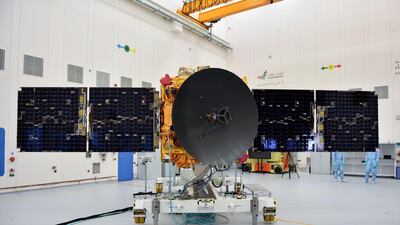
  • The final version of UAE's Hope spacecraft, which launched to space on July 20. Courtesy: Dubai Media Office
    The final version of UAE's Hope spacecraft, which launched to space on July 20. Courtesy: Dubai Media Office
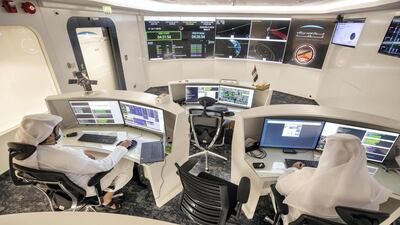
  • The operations control centre at Mohammed bin Rashid Space Centre in Dubai. Antonie Robertson / The National
    The operations control centre at Mohammed bin Rashid Space Centre in Dubai. Antonie Robertson / The National
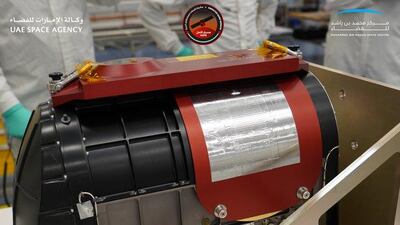
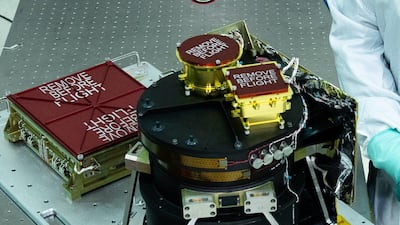
  • The Hope probe has three scientific instruments. This is the Emirates Mars Infrared Spectrometre, which will measure the global distribution of dust, ice clouds, water vapour and the temperature of the Martian atmosphere. All photos courtesy of MBRSC
    The Hope probe has three scientific instruments. This is the Emirates Mars Infrared Spectrometre, which will measure the global distribution of dust, ice clouds, water vapour and the temperature of the Martian atmosphere. All photos courtesy of MBRSC
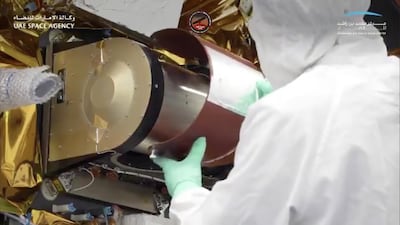
  • Engineers had installed the Mars infrared spectrometre on the Hope probe at Mohammed bin Rashid Space Centre' clean room
    Engineers had installed the Mars infrared spectrometre on the Hope probe at Mohammed bin Rashid Space Centre' clean room
  • The Emirates Eploration Imager will take high-resolution images of Mars and will study its lower atmosphere
    The Emirates Eploration Imager will take high-resolution images of Mars and will study its lower atmosphere
  • The exploration imager has an autonomous digital camera and will send back high-resolution colour images
    The exploration imager has an autonomous digital camera and will send back high-resolution colour images
  • The Emirates Mars Ultraviolet Spectrometer will study the upper atmosphere and traces of oxygen and hydrogen
    The Emirates Mars Ultraviolet Spectrometer will study the upper atmosphere and traces of oxygen and hydrogen
  • Emirati engineers have worked with three American universities for this mission
    Emirati engineers have worked with three American universities for this mission

The infrared spectrometer will build images of the planet at different infrared wavelengths, almost like fancy heat vision goggles for Mars.

Each pixel could contain key information about the atmosphere, including temperature, water vapour, carbon dioxide, dust and water ice and temperature of the surface of the planet.

The ultraviolet spectrometer will help to make ultraviolet observations of the top of the atmosphere, helping measure particles that may escape from the planet.


Brief scoreline:

Liverpool 5

Keita 1', Mane 23', 66', Salah 45' 1, 83'

Huddersfield 0

Napoleon
%3Cp%3E%3Cstrong%3EDirector%3C%2Fstrong%3E%3A%20Ridley%20Scott%3Cbr%3E%3Cstrong%3EStars%3C%2Fstrong%3E%3A%20Joaquin%20Phoenix%2C%20Vanessa%20Kirby%2C%20Tahar%20Rahim%3Cbr%3E%3Cstrong%3ERating%3C%2Fstrong%3E%3A%202%2F5%3Cbr%3E%3Cbr%3E%3C%2Fp%3E%0A
Why%20all%20the%20lefties%3F
%3Cp%3ESix%20of%20the%20eight%20fast%20bowlers%20used%20in%20the%20ILT20%20match%20between%20Desert%20Vipers%20and%20MI%20Emirates%20were%20left-handed.%20So%2075%20per%20cent%20of%20those%20involved.%0D%3Cbr%3EAnd%20that%20despite%20the%20fact%2010-12%20per%20cent%20of%20the%20world%E2%80%99s%20population%20is%20said%20to%20be%20left-handed.%0D%3Cbr%3EIt%20is%20an%20extension%20of%20a%20trend%20which%20has%20seen%20left-arm%20pacers%20become%20highly%20valued%20%E2%80%93%20and%20over-represented%2C%20relative%20to%20other%20formats%20%E2%80%93%20in%20T20%20cricket.%0D%3Cbr%3EIt%20is%20all%20to%20do%20with%20the%20fact%20most%20batters%20are%20naturally%20attuned%20to%20the%20angles%20created%20by%20right-arm%20bowlers%2C%20given%20that%20is%20generally%20what%20they%20grow%20up%20facing%20more%20of.%0D%3Cbr%3EIn%20their%20book%2C%20%3Cem%3EHitting%20Against%20the%20Spin%3C%2Fem%3E%2C%20cricket%20data%20analysts%20Nathan%20Leamon%20and%20Ben%20Jones%20suggest%20the%20advantage%20for%20a%20left-arm%20pace%20bowler%20in%20T20%20is%20amplified%20because%20of%20the%20obligation%20on%20the%20batter%20to%20attack.%0D%3Cbr%3E%E2%80%9CThe%20more%20attacking%20the%20batsman%2C%20the%20more%20reliant%20they%20are%20on%20anticipation%2C%E2%80%9D%20they%20write.%0D%3Cbr%3E%E2%80%9CThis%20effectively%20increases%20the%20time%20pressure%20on%20the%20batsman%2C%20so%20increases%20the%20reliance%20on%20anticipation%2C%20and%20therefore%20increases%20the%20left-arm%20bowler%E2%80%99s%20advantage.%E2%80%9D%0D%3Cbr%3E%3C%2Fp%3E%0A
The biog

Nickname: Mama Nadia to children, staff and parents

Education: Bachelors degree in English Literature with Social work from UAE University

As a child: Kept sweets on the window sill for workers, set aside money to pay for education of needy families

Holidays: Spends most of her days off at Senses often with her family who describe the centre as part of their life too

COMPANY%20PROFILE
%3Cp%3E%3Cstrong%3EName%3A%20%3C%2Fstrong%3EEjari%3Cbr%3E%3Cstrong%3EBased%3A%20%3C%2Fstrong%3ERiyadh%2C%20Saudi%20Arabia%3Cbr%3E%3Cstrong%3EFounders%3A%20%3C%2Fstrong%3EYazeed%20Al%20Shamsi%2C%20Fahad%20Albedah%2C%20Mohammed%20Alkhelewy%20and%20Khalid%20Almunif%3Cbr%3E%3Cstrong%3ESector%3A%20%3C%2Fstrong%3EPropTech%3Cbr%3E%3Cstrong%3ETotal%20funding%3A%20%3C%2Fstrong%3E%241%20million%3Cbr%3E%3Cstrong%3EInvestors%3A%20%3C%2Fstrong%3ESanabil%20500%20Mena%2C%20Hambro%20Perks'%20Oryx%20Fund%20and%20angel%20investors%3Cbr%3E%3Cstrong%3ENumber%20of%20employees%3A%20%3C%2Fstrong%3E8%3C%2Fp%3E%0A

THE SPECS

Touareg Highline

Engine: 3.0-litre, V6

Transmission: 8-speed automatic

Power: 340hp

Torque: 450Nm

Price: Dh239,312