
At a factory in Abu Dhabi's Khalifa Industrial Zone, cheese products are being made at a brisk pace.
The 20,000-square-metre plant is the first in the UAE to make processed cheese.
It is also the first factory in the country to export processed cheese to countries around the globe.
Launched in November 2019 by Turkish food brand Pinar, the plant has the capacity to produce 30,000 tonnes of processed cheese each year.
Last year, it exported the first "made in UAE" processed cheese products to 17 countries, including the US, Philippines, Pakistan, Thailand and Israel.
-

Bottles of just-filled spreadable cheese on their way to get labelled on the automated production line. Victor Besa / The National -
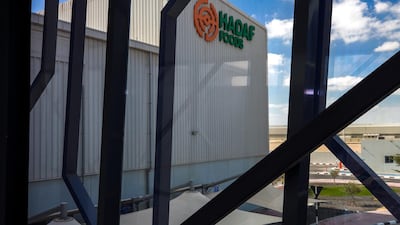
Pinar, the UAE’s first processed cheese factory in Abu Dhabi, produces 30,000 tonnes of product around the world. Victor Besa / The National -
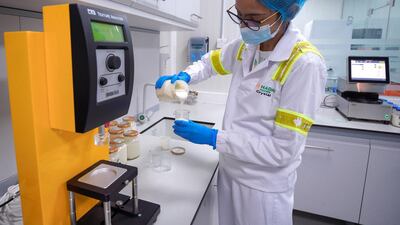
Crystal D'Costa, a microbiologist at the Pinar factory in Abu Dhabi, carries out some tests on the cheese in the lab. Victor Besa / The National -
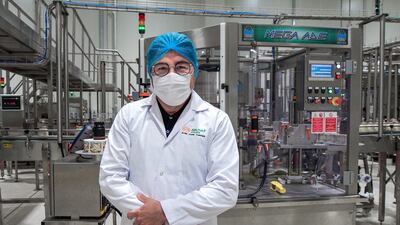
Arda Cenk Tokbas, managing director of Hadaf Foods Industries, at the Pinar factory in Abu Dhabi. Victor Besa / The National -
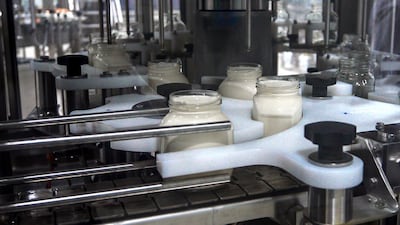
Sterilised glass containers are filled with spreadable cheese on the automated production line. Victor Besa / The National -
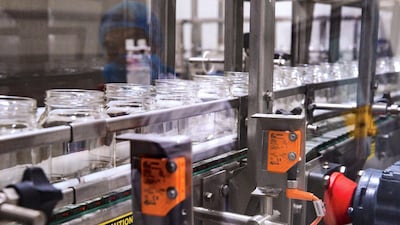
Sterilised glass containers on the automated conveyor system are UV checked before being filled with cheese in the production line. Victor Besa / The National -
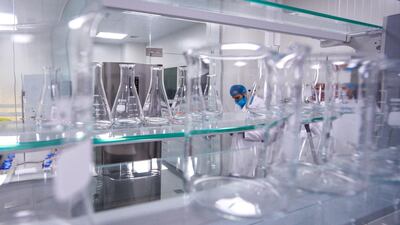
The Pinar laboratory, where quality tests are conducted on the cheese products. Victor Besa / The National -

L-R: Adnan Peynirci, factory director, and Arda Cenk Tokbas, managing director of Hadaf Foods Industries. Victor Besa / The National -
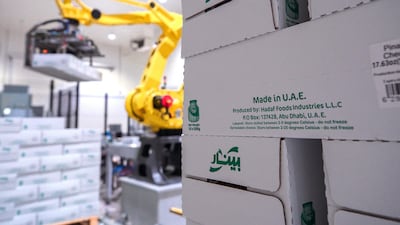
A robotic arm lifts boxes of processed cheese from the automated conveyor system at Pinar and loads them to crates to be delivered. Victor Besa / The National Reporter : Nilanjana Gupta -
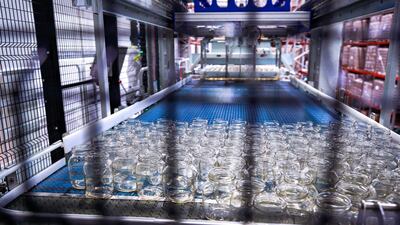
Sterilised glass containers on the automated conveyor system are UV checked before being filled with cheese in the production line. Victor Besa / The National -
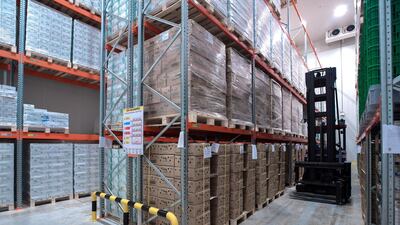
The temperature-controlled stockroom at the Pinar factory in Abu Dhabi. Victor Besa / The National


Arda Cenk Tokbas, managing director at Hadaf Foods Industries, Pinar’s regional office, said: “All our cheese is prepared using cow’s milk which is locally sourced from farms in the UAE.
"With this facility, we hope to contribute to the country’s goal of becoming one of the most food secure countries in the world.”
He said the company was planning to double the factory’s annual production, to more than 60,000 tonnes, in the next few years.
The production centre is fully automated with more than 50 machines that can process and pack cheese in different forms and sizes. Products include spreadable cream cheese and cheddar cheese in jars, and mozzarella cheese, in shredded form and as mozzarella balls. Some of the ingredients, such as milk proteins and butter, are imported from Europe.
Adnan Peynirci, the factory director at Hadaf Foods Industries, said there were three production lines.
"The first step is to process the cheese and the second is packaging," Mr Peynirci said.
"We use dozens of machines imported from Germany, Turkey and Italy that can work efficiently with minimum human interference."
The factory employs about 70 people who work in production, maintenance, logistics quality assurance, research and supply chain management.
Mr Peynirci said the aim is to turn it into a ‘smart factory’, a completely digitised system that continuously collects and shares data through connected machines, by 2023.

