


When Sheikh Zayed, the Founding Father, sought to unite the emirates in 1971, the scale of the task was immense.
One of his biggest challenges was to unite the Bedouins and it took a man such as Sheikh Zayed to convince the tribes to abandon decades of nomadic living, commit to belonging to one place and believe in the dream of the UAE.
Although most had barely spoken to him, the first President of the UAE was such a formidable force that his ideas were enough to bring together camel herders, pearl divers and so many more from all corners of the emirates.
He built houses for them, schools to educate their children and hospitals to treat their sick.
Although many could barely read or write and were so set in their ways, they believed in a man they barely knew.
He was younger than most of them but his strength of leadership made him instantly known as "Baba Zayed".
To mark the UAE's 49th National Day, and as the country enters its 50th year, The National interviewed six people who lived through these days of change.
Buti Al Mazrouei remembers his first job as though it were yesterday. As a 12-year-old he spent summers on the diving fleets taking pearls from oysters.
Leaving their wives and children at home in the desert, Emiratis spent four months diving for pearls. Many of them would never return.
Now 80, Mr Al Mazrouei is not sentimental about those days of dangerous toil on the seas.
"Some people would dive and others would stay on the boat. They would dive with a rope and clamp their noses shut, unlike now where they dive with a cylinder," he says.
“They would take a maximum of four minutes underwater depending on how strong their lungs were. Some would survive while others would die. It was hard.”
By the 1950s, oil exploration increased and more jobs were being created. In 1957, Mr Al Mazrouei, 18 at the time, started working on Das Island, which had become a major base for the offshore oil search.
"First our lives were either sea or desert. Then companies came and we started working for them but only after Sheikh Zayed developed it. Then the petrol came and everything improved," he says.
Sheikh Zayed immediately grasped the importance of education. Schools were established to educate young Emiratis, including at Das.
"They asked me if I wanted to go to school and I said 'yes' immediately," Mr Al Mazrouei says.
“We would go to school twice a week for an hour and a half and we learnt. We learnt English. One of my teachers was British – Mr Daley – and the other Indian, Mr Nareen.
“The English notebooks were printed in India: primer 1, primer 2 and primer 3 were the stages.
"I studied until primer 3 and then they sent the teachers back to Abu Dhabi. From a worker, I became a foreman and then crane operator.”

Mr Al Mazrouei spent 10 years at Das Island.
“I have so much experience and a computer brain in the UAE’s heritage but I never studied Arabic. I am still a Bedouin, though, and after Das I worked in my private business," he says.
"In 1992 I worked for the Education Ministry as a bus driver for 10 years at one of the first schools in Al Ain."
But regular government work meant it was difficult to see the sheikhs who held a daily majlis in the morning.
Mr Al Mazrouei appreciated the decisions Sheikh Zayed made, even though he did not get the chance to meet him.
“Look at the paved roads around you. Sheikh Zayed had said that all the way from Al Ain to Abu Dhabi there will be palm trees and water, and it happened," Mr Al Mazrouei says.
"Look at us now. The difference from before and after is huge but only those who lived in both really know how much of a difference.
“The youths do not know. Before it used to be tiring but now nothing is difficult. People have cars, money and buildings. The difference is huge."
He says "rice was a luxury", in reference to a traditional poem.
“The camel was better than the Lexus," he says. "It used to take seven days to go from Abu Dhabi to Al Ain by camel.”
More than anything, the unification of the UAE in 1971 brought prosperity.
"I do not miss the old days. It was crowded and tiring. Now it is comfort," he says.
"I am the generation who persevered, diving at sea in the summer and in the winter we were with our families.
"If you did not go to sea then you wouldn’t earn anything unless you had camels, sheep or palm trees with dates. Only then, you survived.
“After the union, the country opened up and prospered. Now all the way to Abu Dhabi there is water and houses and schools."
______________
Sheikh Zayed and the story of a nation
-
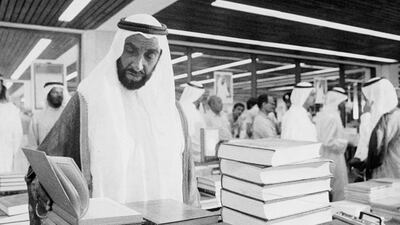
Sheikh Zayed, seen here attending an early book fair in Abu Dhabi. Courtesy: Al Ittihad -
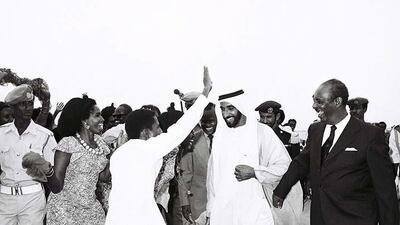
The true genius of a culture and a society lay, Sheikh Zayed believed, in their capacity to adopt and thrive in a changing world. Courtesy: Al Ittihad -

Sheikh Zayed raising the flag at Union House in Dubai. December 2, 1971. Courtesy: Al Ittihad -

Sheikh Zayed attending the first UAE National Day celebrations on December 2, 1972. Courtesy: Al Ittihad -

Sheikh Zayed attending the first session of the National Consultative Council in Abu Dhabi in October 1971. Courtesy: Al Ittihad -
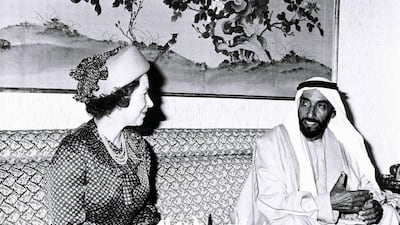
Sheikh Zayed meets Queen Elizabeth II during a state visit 40 years ago. Courtesy: Al Ittihad -
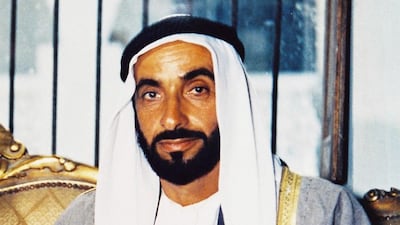
Sheikh Zayed, the founding father of the UAE. Courtesy: Al Ittihad -
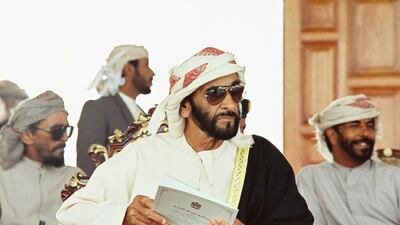
Sheikh Zayed was a man of the people. Courtesy: Al Ittihad -
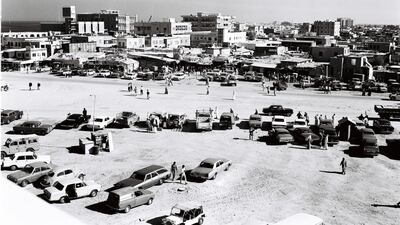
The old souq in Abu Dhabi shot at some point in the 1970s. Courtesy Al Ittihad -
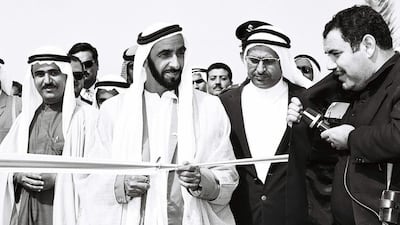
Sheikh Zayed's leadership is not just remembered for all that he built, but for all he did for others. Courtesy: Al Ittihad -
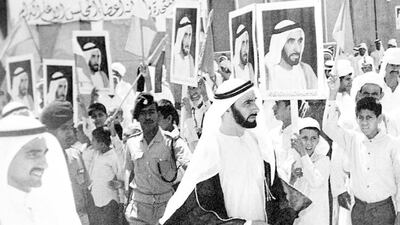
Sheikh Zayed walking past supporters Fujairah during his in January 1972. Wam -
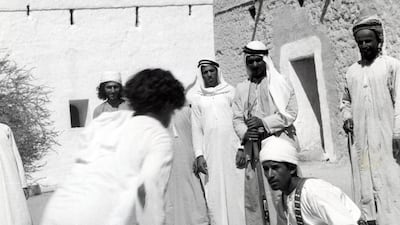
Men dance while holding khanjars in Al Ain, 1959. Getty Images -
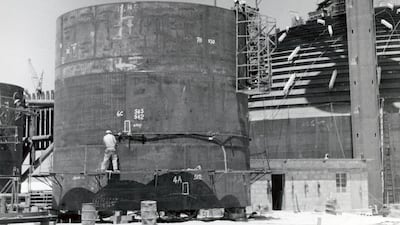
Oil sustained the development of the UAE. And this, a petroleum tank being built in Dubai Creek in 1970, was a familiar sight. Getty Images -
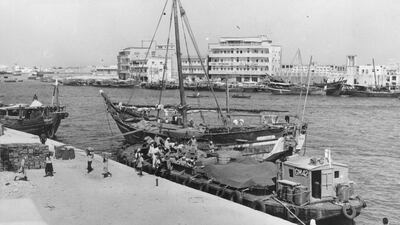
Ships unloading their goods on the creek for the Customs Department in Dubai in 1967. Getty Images



