• The UAE celebrates its second Union Day, then known as National Day, in 1973, with a parade along the old Corniche in Abu Dhabi. Photo: Peter Alves
    The UAE celebrates its second Union Day, then known as National Day, in 1973, with a parade along the old Corniche in Abu Dhabi. Photo: Peter Alves
  • A float of Al Maqta bridge passes along Abu Dhabi's old Corniche as part of Union Day celebrations in 1973. Photo: Peter Alves
    A float of Al Maqta bridge passes along Abu Dhabi's old Corniche as part of Union Day celebrations in 1973. Photo: Peter Alves
  • The UAE celebrates its second Union Day, in 1973, with a parade along the old Corniche in Abu Dhabi. Photo: Peter Alves
    The UAE celebrates its second Union Day, in 1973, with a parade along the old Corniche in Abu Dhabi. Photo: Peter Alves
  • A vehicle stuck in the sand is pushed along on the sidelines of the UAE's second Union Day celebrations, in 1973. Photo: Peter Alves
    A vehicle stuck in the sand is pushed along on the sidelines of the UAE's second Union Day celebrations, in 1973. Photo: Peter Alves
  • Marchers create the UAE flag as part of the parade along Abu Dhabi's old Corniche in 1973. Photo: Peter Alves
    Marchers create the UAE flag as part of the parade along Abu Dhabi's old Corniche in 1973. Photo: Peter Alves
  • Crowds gather on a building that is under construction to watch the UAE's second Union Day parade go by along the old Corniche. Photo: Peter Alves
    Crowds gather on a building that is under construction to watch the UAE's second Union Day parade go by along the old Corniche. Photo: Peter Alves
  • The UAE celebrates its second Union Day, in 1973, with a parade along the old Corniche in Abu Dhabi. Photo: Peter Alves
    The UAE celebrates its second Union Day, in 1973, with a parade along the old Corniche in Abu Dhabi. Photo: Peter Alves
  • Armed forces personnel march along Abu Dhabi's old Corniche as part of Union Day celebrations in 1973. Photo: Peter Alves
    Armed forces personnel march along Abu Dhabi's old Corniche as part of Union Day celebrations in 1973. Photo: Peter Alves
  • The unique 1973 set of notes denominated 1, 5, 10, 50 and 100 dirhams, all with matching serial 000002, turned up in the US recently. Each note is lightly folded and it is clear that on the day of issue someone with foresight thought to save a complete set of the Emirate's first national money.
    The unique 1973 set of notes denominated 1, 5, 10, 50 and 100 dirhams, all with matching serial 000002, turned up in the US recently. Each note is lightly folded and it is clear that on the day of issue someone with foresight thought to save a complete set of the Emirate's first national money.

UAE Union Day: The day the Emirates came of age


James Langton
  • English
  • Arabic

By Union Day 1973, the UAE, born just two years earlier, was well on the way to maturity as a country.

Many of the symbols and institutions familiar today arrived over 50 years ago, from currency and postage stamps to the legal system.

Pride in what had been achieved in such a short period of time was expressed in the Union Day parade along the Abu Dhabi Corniche which featured floats honouring health workers, and milestones like the Maqta Bridge as well as massed marchers in the colours of the UAE flag.

The year ended with the formation of the country’s second Cabinet, which would serve for three years.

Sheikh Maktoum bin Rashid remained Prime Minister, but was joined by Sheikh Khalifa bin Zayed, later second President of the UAE, as Deputy Prime Minister.

The number of Cabinet posts was increased by four to 30, with new responsibilities including Islamic Affairs and Water.

In November 1973 the creation of another institution further formalised the status of the union. The Federal Supreme Court established the supremacy of the Constitution and gave it priority over laws and decisions made by individual emirates.

These landmark decisions gave the new country stability in a year of turmoil on the international stage, dominated by the October War and the oil embargo by Arab states.

With the world at one point apparently brought to the brink of nuclear war by the conflict, the US was increasingly distracted by the Watergate scandal, which would bring down President Richard Nixon the following year.

What could you buy with a dirham in 1973 - in pictures

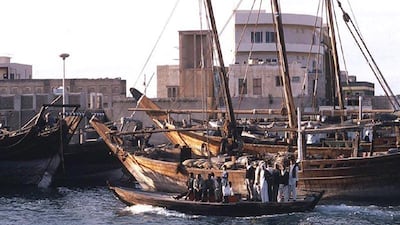
  • Dubai port in 1973, the year the dirham was introduced.
    Dubai port in 1973, the year the dirham was introduced.
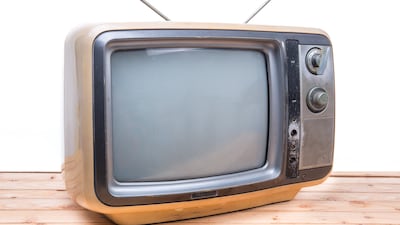
  • Much has changed in 50 years, with the televisions of yesteryear far less sophisticated than those in 2023. A 21-inch set new to Dubai in 1974 would cost the equivalent of Dh7,500 today.
    Much has changed in 50 years, with the televisions of yesteryear far less sophisticated than those in 2023. A 21-inch set new to Dubai in 1974 would cost the equivalent of Dh7,500 today.
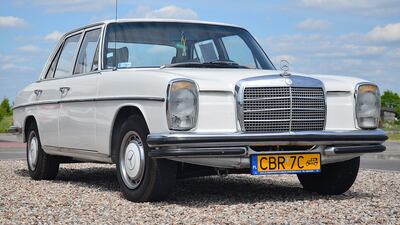
  • A 1973 Mercedes would have cost Dh36,000 when it first hit the road. Photo: Wikipedia
    A 1973 Mercedes would have cost Dh36,000 when it first hit the road. Photo: Wikipedia
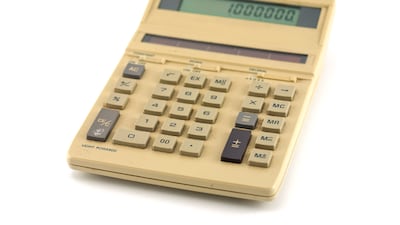
  • Although many items have rocketed in price, the trusty calculator is inexpensive compared to its 1970s debut, when it retailed at close to Dh400.
    Although many items have rocketed in price, the trusty calculator is inexpensive compared to its 1970s debut, when it retailed at close to Dh400.
  • A morning coffee can set you back Dh20 today - ten times more than in 1973.
    A morning coffee can set you back Dh20 today - ten times more than in 1973.
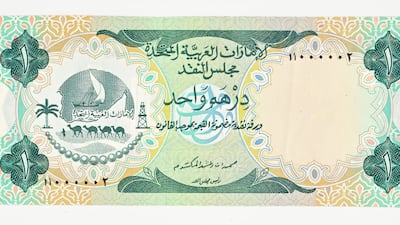
  • The front of the 1973 dirham note.
    The front of the 1973 dirham note.
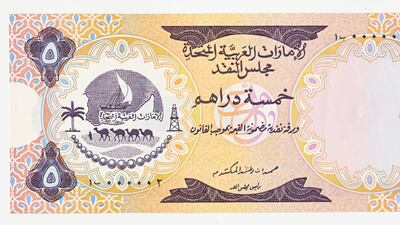
  • The front of the 1973 five dirham note.
    The front of the 1973 five dirham note.
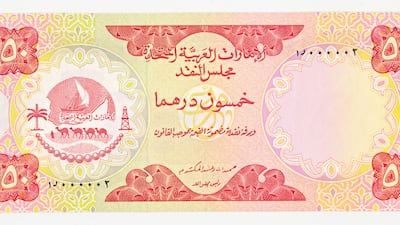
  • The front of the 1973 50 dirham note.
    The front of the 1973 50 dirham note.

For most people, though, life went on, enjoying films like The Sting, and American Graffiti starring a youthful Harrison Ford or humming tunes such as Crocodile Rock by Elton John or Steve Wonder’s You Are the Sunshine of My Life.

In the shops, people were able to buy their Union Day flags and badges with the new dirham currency, which had replaced the previously used Bahrain dinar and Qatar riyal.

Introduced in May 1973, the currency used the notes and coins familiar today, although with different designs. There were six banknotes, ranging from Dh1 to Dh1,000.

The single dirham was also issued as a coin, albeit a larger and heavier version than those used today. The Dh1 note would be phased out several years later.

What has changed is the purchasing power of the dirham. As a result of inflation, a Dh100 purchase then would require Dh700 today.

The year began with another significant step towards national unity. On January 1, 1973, the first federal postage stamps arrived, ending the issue of stamps by individual emirates, a practice in place since the early 1960s.

The first five fils stamp featured the UAE flag in a circular sweeping design superimposed over the country’s outline.

Others from the first issue pictured landmarks from each of the seven emirates, while the Dh10 and highest value honoured UAE Founding Father, the late Sheikh Zayed bin Sultan Al Nahyan, the First President.

During the year, more series would be issued, marking everything from the Ninth Arab Petroleum Conference, to International Literacy Day, and the National Youth Festival in March.

Union Day 1973, previously known as National Day, included another now-familiar symbol of the UAE for the first time. The golden Hawk of Quraish was adopted as the country’s official symbol in December, featuring seven tail feathers representing the seven emirates.

It appears on official documents and passports, with only one amendment in 50 years, when the original badge on the hawk’s breast was changed in 2008 from a sailing dhow to the UAE flag.


Racecard

6pm: The Pointe - Conditions (TB) Dh82,500 (Turf) 1,400m

6.35pm: Palm West Beach - Maiden (TB) Dh82,500 (T) 1,800m

7.10pm: The View at the Palm - Handicap (TB) Dh85,000 (Dirt) 1,400m

7.45pm: Nakeel Graduate Stakes - Conditions (TB) Dh100,000 (T) 1,600m

8.20pm: Club Vista Mare - Handicap (TB) Dh95,000 (D) 1,900m

8.55pm: The Palm Fountain - Handicap (TB) Dh95,000 (D) 1,200m

9.30pm: The Palm Tower - Handicap (TB) Dh87,500 (T) 1,600m

3%20Body%20Problem
%3Cp%3E%3Cstrong%3ECreators%3A%3C%2Fstrong%3E%20David%20Benioff%2C%20D%20B%20Weiss%2C%20Alexander%20Woo%3C%2Fp%3E%0A%3Cp%3E%3Cstrong%3EStarring%3A%20%3C%2Fstrong%3EBenedict%20Wong%2C%20Jess%20Hong%2C%20Jovan%20Adepo%2C%20Eiza%20Gonzalez%2C%20John%20Bradley%2C%20Alex%20Sharp%3C%2Fp%3E%0A%3Cp%3E%3Cstrong%3ERating%3A%3C%2Fstrong%3E%203%2F5%3C%2Fp%3E%0A
Company profile

Name: Back to Games and Boardgame Space

Started: Back to Games (2015); Boardgame Space (Mark Azzam became co-founder in 2017)

Founder: Back to Games (Mr Azzam); Boardgame Space (Mr Azzam and Feras Al Bastaki)

Based: Dubai and Abu Dhabi 

Industry: Back to Games (retail); Boardgame Space (wholesale and distribution) 

Funding: Back to Games: self-funded by Mr Azzam with Dh1.3 million; Mr Azzam invested Dh250,000 in Boardgame Space  

Growth: Back to Games: from 300 products in 2015 to 7,000 in 2019; Boardgame Space: from 34 games in 2017 to 3,500 in 2019

Updated: December 02, 2023, 2:59 PM