


The UAE is gradually returning to normal life as more restrictions are being eased, while some measures remain in place to prevent the spread of Covid-19.
In Dubai, residents can visit the gym and most public beaches. Cinemas and parks have opened and nightly restrictions have been pushed back to 11pm. Restrictions on leaving the home technically end at 6am - though people are allowed out to exercise after Fajr prayer at 4.30am.
In Abu Dhabi and the other emirates, nightly restrictions are in place from 10pm to 6am, while the national disinfection programme is carried out.
The capital has also imposed temporary movement restrictions in and out of the emirate and within its regions, until Tuesday, June 23. Permits are required to travel between the regions and for anyone who wishes to enter the capital.
Authorities recently announced that some people will be able to travel out of the UAE from June 23. The possible destinations and procedures for travel are still due to be released.
Mandatory use of masks when outside the home has not changed in Abu Dhabi and the rest of the Emirates but measures have eased slightly in Dubai.
So what can I do in each emirate?
The National explains.
Which restrictions have lifted in Dubai?
Dubai has slowly returned to normal with the easing of almost all restrictions, however, safety measures remain in place to protect the public.
Dubai's Covid-19 Command and Control Centre said the emirate was "on track" to curb the spread of the disease, after reporting a decrease in the number of suspected cases visiting hospitals in the past few weeks.
Dr Amer Sharif, head of the centre, said several hospitals in Dubai are not handling any Covid-19 cases.
People in Dubai are allowed to move freely from 6am to 11pm but anyone who wishes to exercise as early as 4.30am can do so provided no more than five people gather.
Rules on wearing face masks in public have also eased slightly with exceptions made for those alone, exercising or have an illness that makes it difficult to breathe with a mask on.
Read about all the exemptions here: Dubai updates rules on wearing face masks in public
Businesses have also reopened, including gyms, sports academies and fitness clubs, as well as cinemas, with continued social distancing and regular disinfection.
Shopping malls, which initially opened at 30 per cent capacity, are now back up to full speed, as are all other private sector businesses. Children under 12 and adults over 60, who had been barred from entering, are now allowed.
Both age groups can now go to swimming pools, play areas, cinemas and shopping malls.
They are also allowed to visit museums, arts and galleries, beaches and public parks.
Salons have completely reopened, as have public libraries and gyms are back to 100 per cent capacity.
Entertainment and leisure attractions, such as The Green Planet, Dubai Aquarium, Burj Khalifa's viewing deck and waterparks, are all now also welcoming visitors again.
Dubai's museums have also begun reopening in a phased manner.
Major parks and public beaches have also reopened, including Jumeirah Beach Residence, Al Mamzar, Jumeirah and Umm Suqeim beaches. Last week, officials in Dubai fined more than 100 beachgoers for failing to abide by the strict precautionary measures in place. They include a ban on gathering in groups of more than five, and mandatory masks if they are not in the water.
Marine and water sports competitions have also been given the go ahead to resume.
Gloves are not required at beaches but must be worn at parks and in indoor public areas.
Non-essential medical services, such as routine trips to the dentist, are now allowed again and elective surgery lasting 2.5 hours or less will be permitted.
However, schools and universities will remain closed to pupils and students and run e-learning programmes until September at least.
Dubai International Airport will return to full operation after final approval from authorities. Transit flights operated by national carriers and passing through the country's three international airports will resume this month. Etihad and Emirates' schedules have been announced.
Outsourced government service centres, such as those processing visas, will also resume work.
Which restrictions remain across the Emirates?
Social-distancing guidelines, requiring people to keep a two-metre distance from others outside homes, must be followed at all times, and masks remain mandatory outdoors but for the aforementioned exceptions.
Over Eid Al Fitr, people were told they should avoid meeting family and friends, especially elderly people and those suffering from chronic diseases. That has not changed.
Children below 12, adults above 70, and people with chronic diseases or who are prone to infection are still not allowed to enter malls, cinemas or sports facilities in every emirate but Dubai, where there is no longer an age restriction.
-
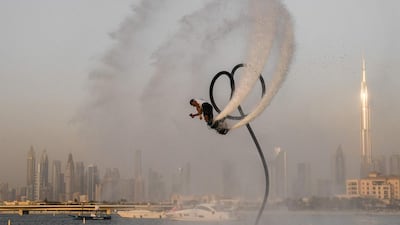
An athlete performs stunts with a water jet pack on the first day of the Dubai watersport festival, organised by the Dubai International Marine Club (DIMC), in the Gulf emirate on June 25, 2020. / AFP / KARIM SAHIB -
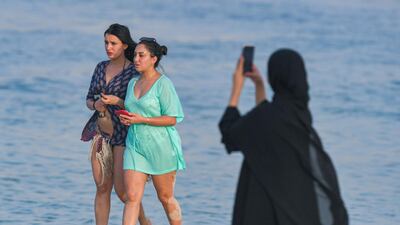
An Emirati woman uses her phone to take a picture as women in bathing suits walk past along a beach in the Gulf Emirate of Dubai on June 25, 2020. / AFP / KARIM SAHIB -
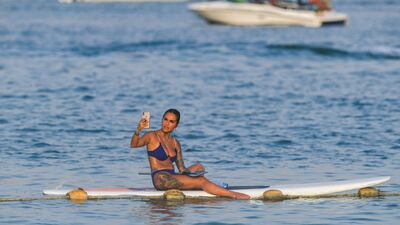
A woman athlete uses a phone as she sits on a surfboard during the Dubai watersport festival, organised by the Dubai International Marine Club (DIMC), near the Burj Khalifa skyscraper in the Gulf emirate on June 25, 2020. / AFP / KARIM SAHIB -
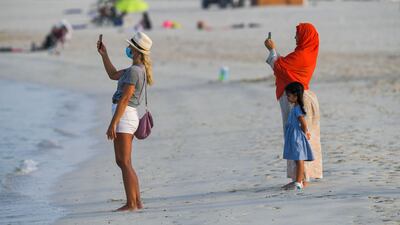
An Emirati woman and a foreign resident, clad in mask due to the COVID-19 coronavirus pandemic, use their phones to take a picture as they stand along a beach in the Gulf Emirate of Dubai on June 25, 2020. / AFP / KARIM SAHIB -
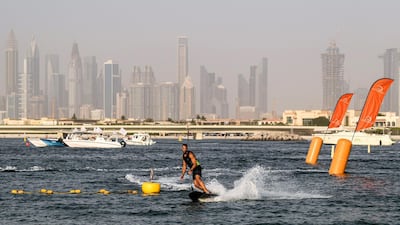
An athlete rides a jet-powered surfboard on the first day of the Dubai watersport festival, organised by the Dubai International Marine Club (DIMC), near the Burj Khalifa skyscraper in the Gulf emirate on June 25, 2020. / AFP / KARIM SAHIB -
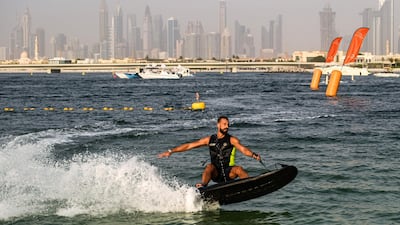
An athlete rides a jet-powered surfboard on the first day of the Dubai watersport festival, organised by the Dubai International Marine Club (DIMC), near the Burj Khalifa skyscraper in the Gulf emirate on June 25, 2020. / AFP / KARIM SAHIB -
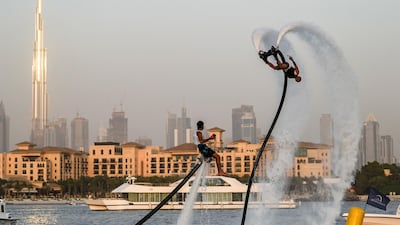
Athletes perform stunts with water jet packs on the first day of the Dubai watersport festival, organised by the Dubai International Marine Club (DIMC), near the Burj Khalifa skyscraper in the Gulf emirate on June 25, 2020. / AFP / KARIM SAHIB -
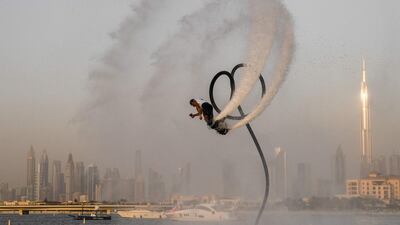
TOPSHOT - An athlete performs stunts with a water jet pack on the first day of the Dubai watersport festival, organised by the Dubai International Marine Club (DIMC), near the Burj Khalifa skyscraper in the Gulf emirate on June 25, 2020. / AFP / KARIM SAHIB -
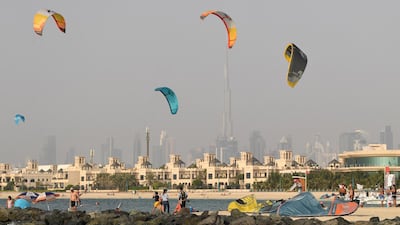
People kite-surf during the Dubai watersport festival, organised by the Dubai International Marine Club (DIMC), in the Gulf emirate on June 26, 2020. / AFP / KARIM SAHIB -
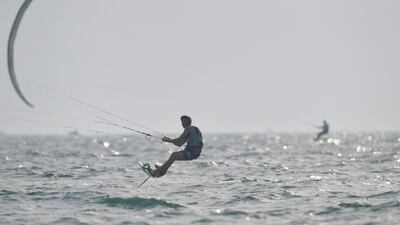
An athlete kite-surfs during the Dubai watersport festival, organised by the Dubai International Marine Club (DIMC), in the Gulf emirate on June 26, 2020. / AFP / KARIM SAHIB -
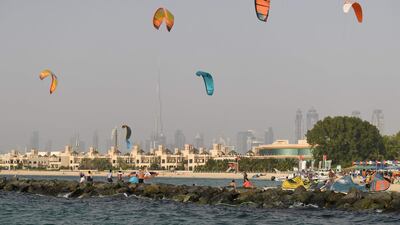
People kite-surf during the Dubai watersport festival, organised by the Dubai International Marine Club (DIMC), in the Gulf emirate on June 26, 2020. / AFP / KARIM SAHIB -
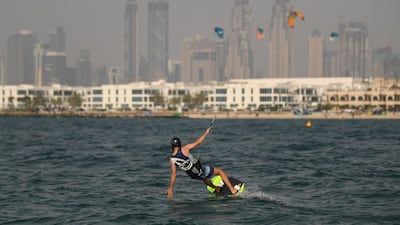
An athlete kite-surfs during the Dubai watersport festival, organised by the Dubai International Marine Club (DIMC), in the Gulf emirate on June 26, 2020. / AFP / KARIM SAHIB


And all residents returning from abroad, which will be permitted from June 1, must adhere to a 14-day quarantine at home.
In restaurants, disinfection must be carried out continuously and only single-use cutlery is allowed unless the outlet has a dishwasher that can subject crockery to high enough heat.
Mosques remain shut. Public beaches and major parks have reopened, as have hotel beaches.
What is allowed in Abu Dhabi?
On June 2, Abu Dhabi announced it would impose a travel ban on entering and exiting the emirate to stem the spread of the coronavirus.
Initially announced for seven days, but subsequently extended until June 23, residents of Abu Dhabi city, Al Ain and Al Dhafra can travel within their cities but not elsewhere in the emirate without first obtaining a permit.
Anyone wishing to leave is now free to do so, but a permit is required to reenter the emirate.
The travel restrictions were brought in to ensure Abu Dhabi's major testing drive worked effectively in containing the spread of Covid-19.
Officials in the emirate are currently screening all workers living in Mussaffah, an industrial area on the outskirts of the capital, to curb the spread of the coronavirus.
Testing is also being carried out in high density areas.
The nightly restriction on movement remains in place inside the emirate from 10pm to 6am. Masks are compulsory and mosques remain shut.
People can step out of their houses to exercise for up to two hours a day.
All members of the public are required to wear masks in public, with those failing to adhere to the measure risking a Dh3,000 fine.
Police have warned they could also be hit with hefty fines if they dump their masks or gloves.
During Eid, visits to first-degree relatives were allowed, except for those who are pregnant or have chronic illnesses, senior citizens and children.

People aged above 70 and those with chronic conditions were not allowed to leave their homes.
Malls, restaurants, and cafes have reopened, with restrictions on the number of people they can admit. Hotels are also welcoming guests again. But masks and gloves must be worn inside the hotel and its facilities.
Restaurants and cafes have reopened with new safety guidelines increasing the capacity limit from 30 per cent to 40 per cent.
The capital's museums and cultural places have been given permission to reopen at 40 per cent capacity, and with safety measures in place.
Dog walkers, runners and cyclists have returned to the Corniche, which had been off-limits for months, however, play areas remain cordoned off.
Authorities have not yet allowed gyms and pools in residential buildings and compounds in Abu Dhabi to restart.
Under guidelines announced by the Department of Government Support, 35 per cent of employees have returned to Abu Dhabi Government offices.
They must follow a series of rules, which include a ban on handshaking and the use of mandatory masks and gloves at all times. They must also check their temperature before they leave the house and scan QR code on their phone, among other regulations.
Half of federal government employees returned to offices on June 7.
In late May, the Department of Culture and Tourism Abu Dhabi set out an extensive list of rules that lounges, bars, beaches, pools and gyms must meet before they can resume operations.

How about the Northern Emirates?
The nightly restriction on movement is from 10pm until 6am.
Ras Al Khaimah opened public beaches, malls, barber shops and beauty salons on Thursday.
Cinemas, gyms, car washes, and prayer rooms in malls will remain closed and restaurants will operate at 30 per cent capacity.
Malls will operate from 10am to 8pm at 30 per cent capacity and deny entry to visitors aged above 60 or below 12.
Smoking, campfire and barbecues are prohibited on beaches and gatherings of more than five people are banned.
Salons will operate by appointment only and must place barriers between chairs.
Barber shops can give haircuts but other grooming services, including shaving, are banned.
Ajman opened cinemas, gyms and car washes on Saturday, May 30. They must operate at half capacity.
Children aged 12 or younger and adults 60 and above can visit health centres and clinics inside shopping malls if they have a prior appointment and have informed mall security.
Gloves and masks are required.
All employees will have a medical test before returning to work, said the Ajman Department of Economic Development.
In some of the Northern Emirates, hotels and bars began trading two weeks ago to capitalise on staycations for residents.
In Ras Al Khaimah, 45 hotels were granted permission to restart at 75 per cent capacity – higher than the other emirates.
Fujairah and Ajman have allowed hotel facilities and bars and restaurants to open, with some restrictions, along with water sports and other activities.
However, on June 13, Umm Al Quwain shut all public beaches until further notice to stem the spread of the coronavirus.
Beaches of hotels and resorts are excluded from the order, which was made to prevent gatherings.

