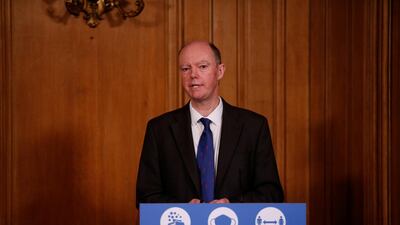
England's Chief Medical Officer Professor Chris Whitty has warned of a fresh surge of Covid-19 next winter. Reuters

Chris Whitty: UK must brace for a difficult Covid winter


Paul Carey
  • English
  • Arabic

A fresh surge of Covid is due this winter, with the potential for a troublesome flu season as well, England’s chief medical officer has warned.

Prof Sir Chris Whitty said there was minimal flu last winter but warned it will be back this year “unless the Covid situation is so bad that everybody has started to go back to essentially minimising their social contacts again”.

He told an NHS Confed Conference: “So, either we will have a very significant Covid surge, people will minimise their contacts and we will have less respiratory viruses, or people will be back to a more normal life, there will be some Covid but on top of that we will go back to having a flu surge, an RSV surge in children, and so on.

“I think we need to be aware of and brace for the fact that the coming winter may well be quite a difficult one.”

Prof Whitty said it probably will not be on the scale of last winter but that the NHS still has to brace itself.

He said the current surge of the virus will "definitely" translate into hospital admissions and "undoubtedly" further deaths.

There were 11,007 new cases and 19 deaths within 28 days of a positive test reported across the UK today.

The figure compares with 9,055 cases and nine deaths reported yesterday. Today’s tally is the highest reported since February 19 when just over 12,000 cases were recorded.

It comes as the latest weekly surveillance report from Public Health England (PHE) shows that Covid-19 case rates in all regions of England are continuing to increase.

PHE said case rates in England among all age groups are continuing to rise and the highest rate is among 20 to 29-year-olds, with 195.9 cases per 100,000 people in the seven days to June 13, up week-on-week from 123.6.

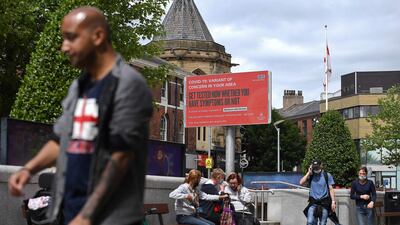
  • Pedestrians walk past an electronic board displaying information relating to a 'variant of concern in the area' in Blackburn, north-west England. AFP
    Pedestrians walk past an electronic board displaying information relating to a 'variant of concern in the area' in Blackburn, north-west England. AFP
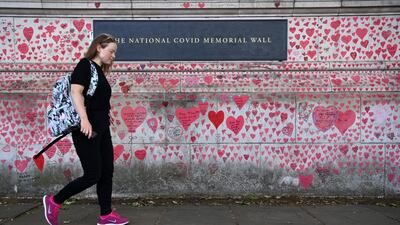
  • A member of the public walks past the Covid-19 Memorial Wall in London. EPA
    A member of the public walks past the Covid-19 Memorial Wall in London. EPA
  • People sit inside a restaurant in Covent Garden, in London. Reuters
    People sit inside a restaurant in Covent Garden, in London. Reuters
  • Dancers from the English National Ballet rehearse, as the country prepares to reopen, inside the Royal Festival Hall in London. Reuters
    Dancers from the English National Ballet rehearse, as the country prepares to reopen, inside the Royal Festival Hall in London. Reuters
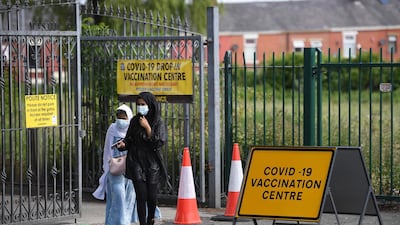
  • People leave a vaccination centre set up at the Masjid-e-Saliheen mosque in Blackburn. AFP
    People leave a vaccination centre set up at the Masjid-e-Saliheen mosque in Blackburn. AFP
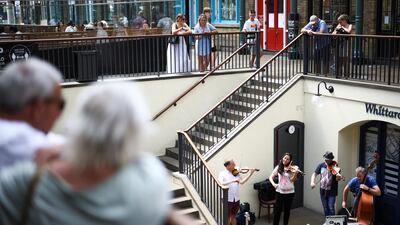
  • People watch a string quartet play in Covent Garden, London. Reuters
    People watch a string quartet play in Covent Garden, London. Reuters
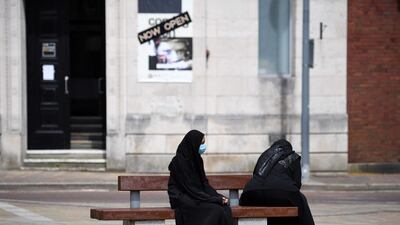
  • Women wearing a face covering sit on a bench in Blackburn. AFP
    Women wearing a face covering sit on a bench in Blackburn. AFP
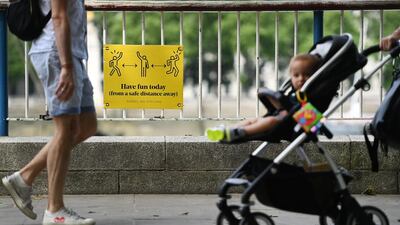
  • Pedestrians pass a social-distancing sign along the Southbank in London. EPA
    Pedestrians pass a social-distancing sign along the Southbank in London. EPA
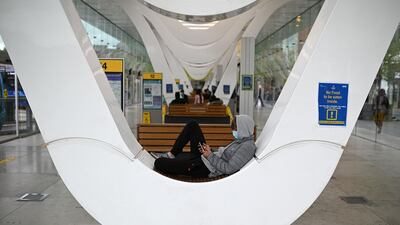
  • A man wearing a face covering waits for a bus in Blackburn. AFP
    A man wearing a face covering waits for a bus in Blackburn. AFP

This is also the age group to see the biggest week-on-week increase.

Prof Whitty said he is anticipating that case rates will continue to go up in the next few weeks due to the Delta variant being "significantly more transmissible" than the Alpha variant.

“In terms of the medium term, my expectation is that we will get a further winter surge, late autumn/winter surge, and that is because we know that winter and autumn favour respiratory viruses, and therefore it’d be very surprising if this particular highly transmissible respiratory virus was not also favoured,” he said.

Prof Whitty said most people think there will be “further problems over the winter”, adding: “How big they’ll be I think is uncertain, and that partly depends on do we get new variants which can evade vaccines better, and partly depends on how the current wave passes through the UK.

“Then in terms of the medium to longer term, if I look five years out, I would expect us to have polyvalent vaccines which will hold the line to a very large degree against even new variants as they come in and an ability to respond with vaccination to new variants.

“But the period over the next two or three years, I think, new variants may well lead to us having to revaccinate or consider boosting vaccination as they come through.

“So, I think we have to just be aware that Covid has not thrown its last surprise at us and there will be several more over the next period.”

He said there is currently a “further surge” of the virus, adding: “I think the height of that surge is still uncertain and we’ll have to see how this goes over the next several weeks.

“But that will definitely translate into further hospitalisations and, unfortunately, it will undoubtedly translate into further deaths.”

He said there are areas of deprivation which have been repeatedly impacted by Covid-19.

Prof Whitty said: “The geographical areas where Covid has hit have been extremely defined, where the biggest problems have been repeated.

“So, you see in situations in Bradford, in Leicester, in bits of London for example, in bits of the North West, you see repeated areas where places have been hit over and over again in areas of deprivation.

“Indeed in many of them, if you had a map of Covid’s biggest effects now and a map of child deaths in 1850, they look remarkably similar.

“These are areas where deprivation has been prolonged and deeply entrenched.”

Mercer, the investment consulting arm of US services company Marsh & McLennan, expects its wealth division to at least double its assets under management (AUM) in the Middle East as wealth in the region continues to grow despite economic headwinds, a company official said.

Mercer Wealth, which globally has $160 billion in AUM, plans to boost its AUM in the region to $2-$3bn in the next 2-3 years from the present $1bn, said Yasir AbuShaban, a Dubai-based principal with Mercer Wealth.

Within the next two to three years, we are looking at reaching $2 to $3 billion as a conservative estimate and we do see an opportunity to do so,” said Mr AbuShaban.

Mercer does not directly make investments, but allocates clients’ money they have discretion to, to professional asset managers. They also provide advice to clients.

“We have buying power. We can negotiate on their (client’s) behalf with asset managers to provide them lower fees than they otherwise would have to get on their own,” he added.

Mercer Wealth’s clients include sovereign wealth funds, family offices, and insurance companies among others.

From its office in Dubai, Mercer also looks after Africa, India and Turkey, where they also see opportunity for growth.

Wealth creation in Middle East and Africa (MEA) grew 8.5 per cent to $8.1 trillion last year from $7.5tn in 2015, higher than last year’s global average of 6 per cent and the second-highest growth in a region after Asia-Pacific which grew 9.9 per cent, according to consultancy Boston Consulting Group (BCG). In the region, where wealth grew just 1.9 per cent in 2015 compared with 2014, a pickup in oil prices has helped in wealth generation.

BCG is forecasting MEA wealth will rise to $12tn by 2021, growing at an annual average of 8 per cent.

Drivers of wealth generation in the region will be split evenly between new wealth creation and growth of performance of existing assets, according to BCG.

Another general trend in the region is clients’ looking for a comprehensive approach to investing, according to Mr AbuShaban.

“Institutional investors or some of the families are seeing a slowdown in the available capital they have to invest and in that sense they are looking at optimizing the way they manage their portfolios and making sure they are not investing haphazardly and different parts of their investment are working together,” said Mr AbuShaban.

Some clients also have a higher appetite for risk, given the low interest-rate environment that does not provide enough yield for some institutional investors. These clients are keen to invest in illiquid assets, such as private equity and infrastructure.

“What we have seen is a desire for higher returns in what has been a low-return environment specifically in various fixed income or bonds,” he said.

“In this environment, we have seen a de facto increase in the risk that clients are taking in things like illiquid investments, private equity investments, infrastructure and private debt, those kind of investments were higher illiquidity results in incrementally higher returns.”

The Abu Dhabi Investment Authority, one of the largest sovereign wealth funds, said in its 2016 report that has gradually increased its exposure in direct private equity and private credit transactions, mainly in Asian markets and especially in China and India. The authority’s private equity department focused on structured equities owing to “their defensive characteristics.”

What is blockchain?

Blockchain is a form of distributed ledger technology, a digital system in which data is recorded across multiple places at the same time. Unlike traditional databases, DLTs have no central administrator or centralised data storage. They are transparent because the data is visible and, because they are automatically replicated and impossible to be tampered with, they are secure.

The main difference between blockchain and other forms of DLT is the way data is stored as ‘blocks’ – new transactions are added to the existing ‘chain’ of past transactions, hence the name ‘blockchain’. It is impossible to delete or modify information on the chain due to the replication of blocks across various locations.

Blockchain is mostly associated with cryptocurrency Bitcoin. Due to the inability to tamper with transactions, advocates say this makes the currency more secure and safer than traditional systems. It is maintained by a network of people referred to as ‘miners’, who receive rewards for solving complex mathematical equations that enable transactions to go through.

However, one of the major problems that has come to light has been the presence of illicit material buried in the Bitcoin blockchain, linking it to the dark web.

Other blockchain platforms can offer things like smart contracts, which are automatically implemented when specific conditions from all interested parties are reached, cutting the time involved and the risk of mistakes. Another use could be storing medical records, as patients can be confident their information cannot be changed. The technology can also be used in supply chains, voting and has the potential to used for storing property records.

LAST-16 EUROPA LEAGUE FIXTURES

Wednesday (Kick-offs UAE)

FC Copenhagen (0) v Istanbul Basaksehir (1) 8.55pm

Shakhtar Donetsk (2) v Wolfsburg (1) 8.55pm

Inter Milan v Getafe (one leg only) 11pm

Manchester United (5) v LASK (0) 11pm 

Thursday

Bayer Leverkusen (3) v Rangers (1) 8.55pm

Sevilla v Roma  (one leg only)  8.55pm

FC Basel (3) v Eintracht Frankfurt (0) 11pm 

Wolves (1) Olympiakos (1) 11pm 

Our legal consultant

Name: Dr Hassan Mohsen Elhais

Position: legal consultant with Al Rowaad Advocates and Legal Consultants.

HOW TO WATCH

Facebook: TheNationalNews  

Twitter: @thenationalnews  

Instagram: @thenationalnews.com  

TikTok: @thenationalnews 

BABYLON
%3Cp%3EDirector%3A%20Damien%20Chazelle%3C%2Fp%3E%0A%3Cp%3EStars%3A%20Brad%20Pitt%2C%20Margot%20Robbie%2C%20Jean%20Smart%3C%2Fp%3E%0A%3Cp%3ERating%3A%204%2F5%3C%2Fp%3E%0A

Ammar 808:
Maghreb United

Sofyann Ben Youssef
Glitterbeat 

Ten tax points to be aware of in 2026

1. Domestic VAT refund amendments: request your refund within five years

If a business does not apply for the refund on time, they lose their credit.

2. E-invoicing in the UAE

Businesses should continue preparing for the implementation of e-invoicing in the UAE, with 2026 a preparation and transition period ahead of phased mandatory adoption. 

3. More tax audits

Tax authorities are increasingly using data already available across multiple filings to identify audit risks. 

4. More beneficial VAT and excise tax penalty regime

Tax disputes are expected to become more frequent and more structured, with clearer administrative objection and appeal processes. The UAE has adopted a new penalty regime for VAT and excise disputes, which now mirrors the penalty regime for corporate tax.

5. Greater emphasis on statutory audit

There is a greater need for the accuracy of financial statements. The International Financial Reporting Standards standards need to be strictly adhered to and, as a result, the quality of the audits will need to increase.

6. Further transfer pricing enforcement

Transfer pricing enforcement, which refers to the practice of establishing prices for internal transactions between related entities, is expected to broaden in scope. The UAE will shortly open the possibility to negotiate advance pricing agreements, or essentially rulings for transfer pricing purposes. 

7. Limited time periods for audits

Recent amendments also introduce a default five-year limitation period for tax audits and assessments, subject to specific statutory exceptions. While the standard audit and assessment period is five years, this may be extended to up to 15 years in cases involving fraud or tax evasion. 

8. Pillar 2 implementation 

Many multinational groups will begin to feel the practical effect of the Domestic Minimum Top-Up Tax (DMTT), the UAE's implementation of the OECD’s global minimum tax under Pillar 2. While the rules apply for financial years starting on or after January 1, 2025, it is 2026 that marks the transition to an operational phase.

9. Reduced compliance obligations for imported goods and services

Businesses that apply the reverse-charge mechanism for VAT purposes in the UAE may benefit from reduced compliance obligations. 

10. Substance and CbC reporting focus

Tax authorities are expected to continue strengthening the enforcement of economic substance and Country-by-Country (CbC) reporting frameworks. In the UAE, these regimes are increasingly being used as risk-assessment tools, providing tax authorities with a comprehensive view of multinational groups’ global footprints and enabling them to assess whether profits are aligned with real economic activity. 

Contributed by Thomas Vanhee and Hend Rashwan, Aurifer

How to apply for a drone permit
  • Individuals must register on UAE Drone app or website using their UAE Pass
  • Add all their personal details, including name, nationality, passport number, Emiratis ID, email and phone number
  • Upload the training certificate from a centre accredited by the GCAA
  • Submit their request
What are the regulations?
  • Fly it within visual line of sight
  • Never over populated areas
  • Ensure maximum flying height of 400 feet (122 metres) above ground level is not crossed
  • Users must avoid flying over restricted areas listed on the UAE Drone app
  • Only fly the drone during the day, and never at night
  • Should have a live feed of the drone flight
  • Drones must weigh 5 kg or less
PSA DUBAI WORLD SERIES FINALS LINE-UP

Men’s: 
Mohamed El Shorbagy (EGY)
Ali Farag (EGY)
Simon Rosner (GER)
Tarek Momen (EGY)
Miguel Angel Rodriguez (COL)
Gregory Gaultier (FRA)
Karim Abdel Gawad (EGY)
Nick Matthew (ENG)

Women's: 
Nour El Sherbini (EGY)
Raneem El Welily (EGY)
Nour El Tayeb (EGY)
Laura Massaro (ENG)
Joelle King (NZE)
Camille Serme (FRA)
Nouran Gohar (EGY)
Sarah-Jane Perry (ENG)