• A health worker administers polio vaccine drops to a child during a door-to-door campaign in Karachi, Pakistan. AFP
    A health worker administers polio vaccine drops to a child during a door-to-door campaign in Karachi, Pakistan. AFP
  • A girl gets her finger marked after she is administered polio vaccine drops at a civil dispensary in Peshawar. Reuters
    A girl gets her finger marked after she is administered polio vaccine drops at a civil dispensary in Peshawar. Reuters
  • A girl receives vaccine drops during an anti-polio campaign in a low-income neighbourhood in Karachi. Reuters
    A girl receives vaccine drops during an anti-polio campaign in a low-income neighbourhood in Karachi. Reuters
  • A health worker administers polio vaccine drops to a child during a polio vaccination campaign at a slum area in Lahore. AFP
    A health worker administers polio vaccine drops to a child during a polio vaccination campaign at a slum area in Lahore. AFP
  • Security officials offer funeral prayers for a slain policeman killed in an attack on polio vaccination workers in Karak, a town in Khyber Pakhtunkhwa province. AFP
    Security officials offer funeral prayers for a slain policeman killed in an attack on polio vaccination workers in Karak, a town in Khyber Pakhtunkhwa province. AFP
  • A boy gets his finger marked after he is administered polio vaccine drops in Karachi. Reuters
    A boy gets his finger marked after he is administered polio vaccine drops in Karachi. Reuters
  • A health worker administers polio vaccine drops in Lahore. AFP
    A health worker administers polio vaccine drops in Lahore. AFP
  • A boy receives polio vaccine drops in Karachi. Reuters
    A boy receives polio vaccine drops in Karachi. Reuters
  • Policemen escort health workers during a polio vaccination door-to-door campaign in a slum area in Islamabad. AFP
    Policemen escort health workers during a polio vaccination door-to-door campaign in a slum area in Islamabad. AFP

Will the world ever eradicate polio?


Daniel Bardsley
  • English
  • Arabic

As society marks World Polio Day on Monday, this debilitating and sometimes fatal disease is tantalisingly close to being eliminated.

However, recent outbreaks demonstrate that consigning it to the history books will be no easy task.

The disease remains endemic in Pakistan and Afghanistan, where instability and resistance to vaccination programmes make it harder to control.

Meanwhile, polio has recently re-emerged in developed nations, with New York recently recording the first case in the US for nearly 10 years.

“Although the vaccination campaign has pushed it to very low numbers, it certainly hasn’t been eradicated,” said Prof Ian Jones, a professor of virology at the University of Reading in southern England, who researches new approaches to polio vaccination.

Poliomyelitis, to use the full name, is an infectious viral disease mostly affecting young children. In a minority of cases, it causes paralysis and even death, although highly effective vaccines have massively reduced the condition’s global impact.

Vaccine paved way for progress

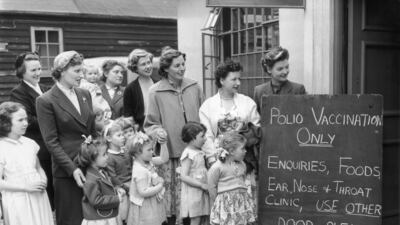
  • A group of mothers with their children wait outside Middlesex County Council Clinic for the first polio vaccinations in May 1956. All photos: Getty Images
    A group of mothers with their children wait outside Middlesex County Council Clinic for the first polio vaccinations in May 1956. All photos: Getty Images
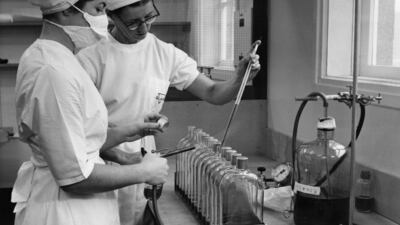
  • A polio vaccine being tested at the Glaxo Laboratories in Sefton Park, Buckinghamshire, in 1956.
    A polio vaccine being tested at the Glaxo Laboratories in Sefton Park, Buckinghamshire, in 1956.
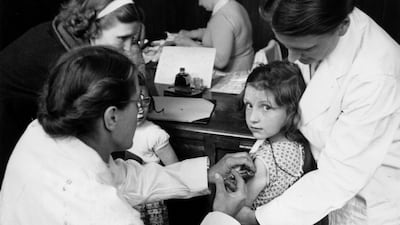
  • A child is injected with a vaccine against polio in 1956, the first stage of the biggest vaccination programme ever undertaken in Britain at the time.
    A child is injected with a vaccine against polio in 1956, the first stage of the biggest vaccination programme ever undertaken in Britain at the time.
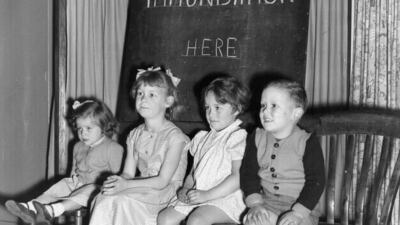
  • Four young children wait for injections against polio at the Fairfield Welfare Clinic in Wandsworth, south London, in 1956.
    Four young children wait for injections against polio at the Fairfield Welfare Clinic in Wandsworth, south London, in 1956.
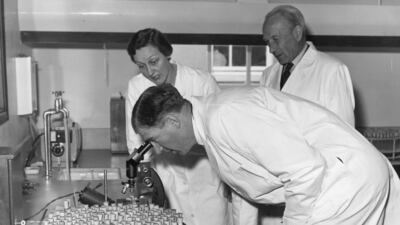
  • Health minister Dennis Vosper examining the polio virus in 1957, during the production of Polivirin, Britain's anti-poliomyletis vaccine, at Glaxo's Virus Research Laboratories in Stoke Poges.
    Health minister Dennis Vosper examining the polio virus in 1957, during the production of Polivirin, Britain's anti-poliomyletis vaccine, at Glaxo's Virus Research Laboratories in Stoke Poges.
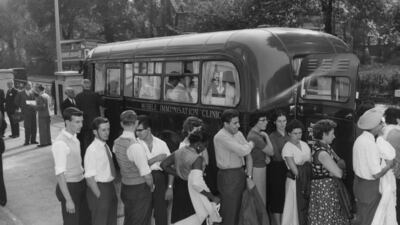
  • A queue of factory workers waiting to receive polio vaccinations in one of the new London Mobile Immunisation Clinics at Highbury Grove in 1959.
    A queue of factory workers waiting to receive polio vaccinations in one of the new London Mobile Immunisation Clinics at Highbury Grove in 1959.
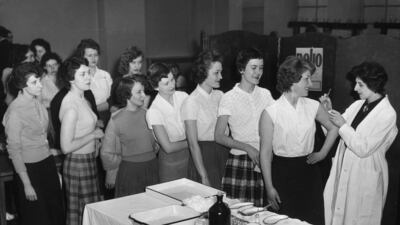
  • Junior members of staff at the Ministry of Health on Saville Row, London, line up to receive their inoculation against polio in 1959.
    Junior members of staff at the Ministry of Health on Saville Row, London, line up to receive their inoculation against polio in 1959.
  • Nurses in one of the many emergency polio vaccination clinics in Hull read the latest reports on the health scare in 1961.
    Nurses in one of the many emergency polio vaccination clinics in Hull read the latest reports on the health scare in 1961.

After polio became a greater public health threat in western nations in the first half of the 20th century, when improved sanitation had limited people’s exposure to the virus and reduced their immunity, the inactivated polio vaccine was introduced in 1955.

Given by injection, this vaccine was followed in 1961 by the oral polio vaccine, which is cheaper and easier to roll out, being administered as drops in the mouth.

By 1988, the threat of polio had fallen away significantly in western nations but, with the disease still endemic in 125 countries, there were about 350,000 cases caused by wild poliovirus, according to the World Health Organisation.

New drive to eliminate disease

The Global Polio Eradication Initiative was launched that year. Involving the deployment of both vaccines, it has also entailed surveillance campaigns to detect the disease and immunisation drives when outbreaks have happened.

Huge progress has been made: last year, the wild poliovirus remained endemic only in Pakistan and Afghanistan, and wild poliovirus resulted in just six reported cases.

In these nations, efforts are hampered by poor healthcare infrastructure and anti-vaccine sentiment, with health workers and the police guarding them having been murdered by extremists.

Separately, this year polio has been detected in cities in developed nations, including in New York, London and Jerusalem.

The pathogen that has been detected is not the wild poliovirus found in Pakistan and Afghanistan, but instead it is circulating vaccine-derived poliovirus (cVDPV).

This is a virus that derives from the oral polio vaccine, which contains a weakened or attenuated form of poliovirus that can sometimes mutate into a form that causes disease.

Among populations with low immunisation rates, cVDPV can spread from person to person, and in rare instances cause disease.

  • A Yemeni health worker visits homes during a polio vaccination campaign in Yemen's third city of Taez. All photos: AFP
    A Yemeni health worker visits homes during a polio vaccination campaign in Yemen's third city of Taez. All photos: AFP
  • She marks a child's hand to show the girl has been given the polio vaccine.
    She marks a child's hand to show the girl has been given the polio vaccine.
  • It is part of a widespread immunisation campaign in Taez.
    It is part of a widespread immunisation campaign in Taez.
  • Another Yemeni child receives a polio vaccination during a home visit by health workers.
    Another Yemeni child receives a polio vaccination during a home visit by health workers.
  • Cases of polio were reported in Yemen in late 2020 for the first time since the disease was eradicated in 2006.
    Cases of polio were reported in Yemen in late 2020 for the first time since the disease was eradicated in 2006.
  • Then, health officials said 16 cases were recorded after the Houthi rebels denied vaccination teams access to some areas for more than two years.
    Then, health officials said 16 cases were recorded after the Houthi rebels denied vaccination teams access to some areas for more than two years.
  • Low levels of immunity in children were identified as one of the main causes of polio outbreaks in Yemen.
    Low levels of immunity in children were identified as one of the main causes of polio outbreaks in Yemen.
  • Health authorities now hope vaccination campaigns, such as this one in Taez, will rid Yemen of polio once again.
    Health authorities now hope vaccination campaigns, such as this one in Taez, will rid Yemen of polio once again.

In Israel, which administers both the inactivated polio vaccine and the oral polio vaccine, an unvaccinated child of 3 in Jerusalem suffered paralysis because of cVDPV in a case reported to the WHO in March.

A few months later in the US, an unvaccinated man in Rockland County, just north of New York City, became infected and suffered paralysis.

New York’s governor declared a state of emergency last month, when monitoring of wastewater samples — the virus can be detected in the faeces of infected individuals — indicated cVDPV was still present.

It has also been detected this year in wastewater samples in London.

Both the US and the UK use a form of inactivated polio vaccine, so experts say cVDPV is likely to have been brought in from outside each country.

“What it tells us, as it’s vaccine derived virus in the sewage waters, is that someone in the US or London has been in a part of the world where they still use live attenuated virus,” said Dr Bharat Pankhania, a senior consultant on communicable disease control and senior clinical lecturer at the University of Exeter in south-west England.

“The risk is low because most people in developed parts of the world are already immune … and I marvel at our ability to find it in wastewater. It’s a new addition that can be used to pick up things and act on it if we have to.”

UK vigilant over threat

The UK’s National Health Service has said the number of children vaccinated against polio in London “is lower than it should be”, which could aid the virus’s spread. In response, officials are redoubling vaccination efforts.

Other outbreaks of cVDPV, such as one in Syria in 2017 and one in Somalia in 2018 — which resulted in seven children becoming paralysed — were eliminated through surveillance and vaccination.

Genetic analysis has found links between the cVDPV in the US, UK and Israel, potentially suggesting widescale circulation of the virus over time, which may mean outbreaks will be harder to control.

Despite the enormous strides made in reducing cases, experts say that it is not a given that the wild poliovirus will be eliminated.

Prof Jones says that eradication is not impossible scientifically. Unlike some other diseases, polio does not have an animal “reservoir”, meaning that there is no animal that continues to harbour the parasite and risks spreading it to people.

However, political turmoil that disrupts efforts to stamp out the disease will continue to affect certain parts of the world, Prof Jones said, and in these areas polio is likely to remain.

“There will always be pockets where the vaccine coverage is not what it should be and there will be breakouts,” he said.

In these areas there is often a “helicopter” approach of blanket vaccination, but Prof Jones said the disease typically then “pops up somewhere else”.

“I personally think control to keep it at the minimum level possible is the most realistic outcome. I don’t think eradication is going to happen any time soon,” he said.


Labour dispute

The insured employee may still file an ILOE claim even if a labour dispute is ongoing post termination, but the insurer may suspend or reject payment, until the courts resolve the dispute, especially if the reason for termination is contested. The outcome of the labour court proceedings can directly affect eligibility.


- Abdullah Ishnaneh, Partner, BSA Law 

Email sent to Uber team from chief executive Dara Khosrowshahi

From: Dara

To: Team@

Date: March 25, 2019 at 11:45pm PT

Subj: Accelerating in the Middle East

Five years ago, Uber launched in the Middle East. It was the start of an incredible journey, with millions of riders and drivers finding new ways to move and work in a dynamic region that’s become so important to Uber. Now Pakistan is one of our fastest-growing markets in the world, women are driving with Uber across Saudi Arabia, and we chose Cairo to launch our first Uber Bus product late last year.

Today we are taking the next step in this journey—well, it’s more like a leap, and a big one: in a few minutes, we’ll announce that we’ve agreed to acquire Careem. Importantly, we intend to operate Careem independently, under the leadership of co-founder and current CEO Mudassir Sheikha. I’ve gotten to know both co-founders, Mudassir and Magnus Olsson, and what they have built is truly extraordinary. They are first-class entrepreneurs who share our platform vision and, like us, have launched a wide range of products—from digital payments to food delivery—to serve consumers.

I expect many of you will ask how we arrived at this structure, meaning allowing Careem to maintain an independent brand and operate separately. After careful consideration, we decided that this framework has the advantage of letting us build new products and try new ideas across not one, but two, strong brands, with strong operators within each. Over time, by integrating parts of our networks, we can operate more efficiently, achieve even lower wait times, expand new products like high-capacity vehicles and payments, and quicken the already remarkable pace of innovation in the region.

This acquisition is subject to regulatory approval in various countries, which we don’t expect before Q1 2020. Until then, nothing changes. And since both companies will continue to largely operate separately after the acquisition, very little will change in either teams’ day-to-day operations post-close. Today’s news is a testament to the incredible business our team has worked so hard to build.

It’s a great day for the Middle East, for the region’s thriving tech sector, for Careem, and for Uber.

Uber on,

Dara

%3Cp%3E%3Cstrong%3EEngine%3A%20%3C%2Fstrong%3E4-litre%20twin-turbo%20V8%0D%3Cbr%3E%3Cstrong%3ETransmission%3A%3C%2Fstrong%3E%208-speed%20auto%0D%3Cbr%3E%3Cstrong%3EPower%3A%20%3C%2Fstrong%3E470hp%2C%20338kW%0D%3Cbr%3E%3Cstrong%3ETorque%3A%3C%2Fstrong%3E%20620Nm%0D%3Cbr%3E%3Cstrong%3EPrice%3A%3C%2Fstrong%3E%20From%20Dh491%2C500%20(estimate)%0D%3Cbr%3E%3Cstrong%3EOn%20sale%3A%20%3C%2Fstrong%3Enow%3C%2Fp%3E%0A
Mountain%20Boy
%3Cp%3E%3Cstrong%3EDirector%3A%3C%2Fstrong%3E%20Zainab%20Shaheen%3C%2Fp%3E%0A%3Cp%3E%3Cstrong%3EStarring%3A%3C%2Fstrong%3E%20Naser%20Al%20Messabi%3C%2Fp%3E%0A%3Cp%3E%3Cstrong%3ERating%3C%2Fstrong%3E%3A%203%2F5%3C%2Fp%3E%0A
FIXTURES

All kick-off times UAE ( 4 GMT)
Brackets denote aggregate score

Tuesday:
Roma (1) v Shakhtar Donetsk (2), 11.45pm
Manchester United (0) v Sevilla (0), 11.45pm

Wednesday:
Besiktas (0) v Bayern Munich (5), 9pm
Barcelona (1) v Chelsea (1), 11.45pm

TO A LAND UNKNOWN

Director: Mahdi Fleifel

Starring: Mahmoud Bakri, Aram Sabbah, Mohammad Alsurafa

Rating: 4.5/5

2025 Fifa Club World Cup groups

Group A: Palmeiras, Porto, Al Ahly, Inter Miami.

Group B: Paris Saint-Germain, Atletico Madrid, Botafogo, Seattle.

Group C: Bayern Munich, Auckland City, Boca Juniors, Benfica.

Group D: Flamengo, ES Tunis, Chelsea, (Leon banned).

Group E: River Plate, Urawa, Monterrey, Inter Milan.

Group F: Fluminense, Borussia Dortmund, Ulsan, Mamelodi Sundowns.

Group G: Manchester City, Wydad, Al Ain, Juventus.

Group H: Real Madrid, Al Hilal, Pachuca, Salzburg.

Our legal consultants

Name: Hassan Mohsen Elhais

Position: legal consultant with Al Rowaad Advocates and Legal Consultants.

The%20specs%20
%3Cp%3E%3Cstrong%3EEngine%3A%20%3C%2Fstrong%3E2.0-litre%204cyl%20turbo%0D%3Cbr%3E%3Cstrong%3EPower%3A%20%3C%2Fstrong%3E261hp%20at%205%2C500rpm%0D%3Cbr%3E%3Cstrong%3ETorque%3A%20%3C%2Fstrong%3E400Nm%20at%201%2C750-4%2C000rpm%0D%3Cbr%3E%3Cstrong%3ETransmission%3A%20%3C%2Fstrong%3E7-speed%20dual-clutch%20auto%0D%3Cbr%3E%3Cstrong%3EFuel%20consumption%3A%20%3C%2Fstrong%3E10.5L%2F100km%0D%3Cbr%3E%3Cstrong%3EOn%20sale%3A%20%3C%2Fstrong%3ENow%0D%3Cbr%3E%3Cstrong%3EPrice%3A%20%3C%2Fstrong%3EFrom%20Dh129%2C999%20(VX%20Luxury)%3B%20from%20Dh149%2C999%20(VX%20Black%20Gold)%3C%2Fp%3E%0A
Where to donate in the UAE

The Emirates Charity Portal

You can donate to several registered charities through a “donation catalogue”. The use of the donation is quite specific, such as buying a fan for a poor family in Niger for Dh130.

The General Authority of Islamic Affairs & Endowments

The site has an e-donation service accepting debit card, credit card or e-Dirham, an electronic payment tool developed by the Ministry of Finance and First Abu Dhabi Bank.

Al Noor Special Needs Centre

You can donate online or order Smiles n’ Stuff products handcrafted by Al Noor students. The centre publishes a wish list of extras needed, starting at Dh500.

Beit Al Khair Society

Beit Al Khair Society has the motto “From – and to – the UAE,” with donations going towards the neediest in the country. Its website has a list of physical donation sites, but people can also contribute money by SMS, bank transfer and through the hotline 800-22554.

Dar Al Ber Society

Dar Al Ber Society, which has charity projects in 39 countries, accept cash payments, money transfers or SMS donations. Its donation hotline is 800-79.

Dubai Cares

Dubai Cares provides several options for individuals and companies to donate, including online, through banks, at retail outlets, via phone and by purchasing Dubai Cares branded merchandise. It is currently running a campaign called Bookings 2030, which allows people to help change the future of six underprivileged children and young people.

Emirates Airline Foundation

Those who travel on Emirates have undoubtedly seen the little donation envelopes in the seat pockets. But the foundation also accepts donations online and in the form of Skywards Miles. Donated miles are used to sponsor travel for doctors, surgeons, engineers and other professionals volunteering on humanitarian missions around the world.

Emirates Red Crescent

On the Emirates Red Crescent website you can choose between 35 different purposes for your donation, such as providing food for fasters, supporting debtors and contributing to a refugee women fund. It also has a list of bank accounts for each donation type.

Gulf for Good

Gulf for Good raises funds for partner charity projects through challenges, like climbing Kilimanjaro and cycling through Thailand. This year’s projects are in partnership with Street Child Nepal, Larchfield Kids, the Foundation for African Empowerment and SOS Children's Villages. Since 2001, the organisation has raised more than $3.5 million (Dh12.8m) in support of over 50 children’s charities.

Noor Dubai Foundation

Sheikh Mohammed bin Rashid Al Maktoum launched the Noor Dubai Foundation a decade ago with the aim of eliminating all forms of preventable blindness globally. You can donate Dh50 to support mobile eye camps by texting the word “Noor” to 4565 (Etisalat) or 4849 (du).

Updated: June 07, 2023, 9:20 AM