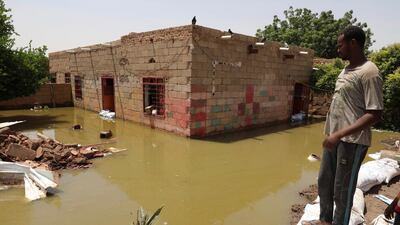
UAE sends aid to Sudan as floods leave thousands homeless


  • English
  • Arabic

Two aircraft carrying vital aid were sent from the UAE to Sudan to provide relief to the thousands who were made homeless by extreme flooding.

An Emirates Sky Cargo B777 left Dubai International Airport for Khartoum on Saturday morning, while a second plane was sent on Sunday.

Each carried about 100 tonnes of relief cargo supplied by the International Federation of Red Cross and Red Crescent Societies.

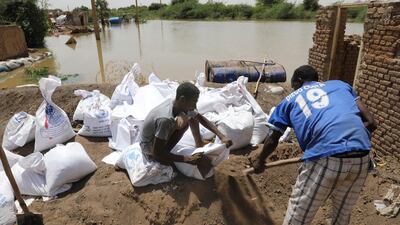
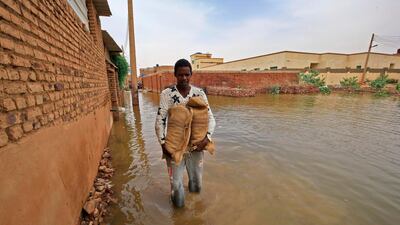
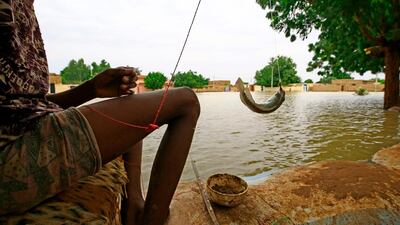
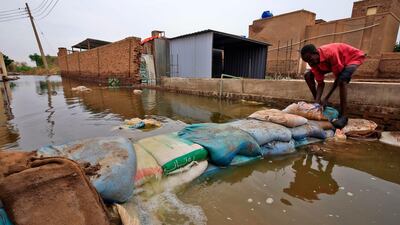
Sudan is suffering its worst flooding in decades, and in September authorities there declared a three-month state of emergency.

As of October 4, more than 860,000 people were affected by the floods, about 166,000 houses were damaged or destroyed, and more than 100 people died.

Soaring inflation led to jumps in the cost of food, a situation made worse by damage to food crops and livestock just before harvest season.

Water sources have also been destroyed or contaminated, and stagnant water could spread diseases. As the rainy season continues, the risk of more damage is high.

"Sudan is the in midst of a major humanitarian emergency. Thousands of families are homeless, hundreds of thousands of lives have been devastated. About half of the affected population are children," said Jagan Chapagain, secretary general of IFRC.

He said each aid flight would provide emergency shelter and household items to support about 5,000 families who have lost their homes and livelihoods, as well as sanitation equipment to reduce the risk of waterborne diseases.

IFRC is working with Sudanese Red Crescent to distribute food and emergency items. SRC is also providing psychosocial support and helping families move to higher ground.

The aid delivery was organised from Dubai's International Humanitarian City.

Who's who in Yemen conflict

Houthis: Iran-backed rebels who occupy Sanaa and run unrecognised government

Yemeni government: Exiled government in Aden led by eight-member Presidential Leadership Council

Southern Transitional Council: Faction in Yemeni government that seeks autonomy for the south

Habrish 'rebels': Tribal-backed forces feuding with STC over control of oil in government territory

The President's Cake

Director: Hasan Hadi

Starring: Baneen Ahmad Nayyef, Waheed Thabet Khreibat, Sajad Mohamad Qasem 

Rating: 4/5

Arabian Gulf League fixtures:

Friday:

  • Emirates v Hatta, 5.15pm
  • Al Wahda v Al Dhafra, 5.25pm
  • Al Ain v Shabab Al Ahli Dubai, 8.15pm

Saturday:

  • Dibba v Ajman, 5.15pm
  • Sharjah v Al Wasl, 5.20pm
  • Al Jazira v Al Nasr, 8.15pm
Saudi Cup race day

Schedule in UAE time

5pm: Mohamed Yousuf Naghi Motors Cup (Turf), 5.35pm: 1351 Cup (T), 6.10pm: Longines Turf Handicap (T), 6.45pm: Obaiya Arabian Classic for Purebred Arabians (Dirt), 7.30pm: Jockey Club Handicap (D), 8.10pm: Samba Saudi Derby (D), 8.50pm: Saudia Sprint (D), 9.40pm: Saudi Cup (D)

Dengue%20fever%20symptoms
%3Cp%3EHigh%20fever%20(40%C2%B0C%2F104%C2%B0F)%3Cbr%3ESevere%20headache%3Cbr%3EPain%20behind%20the%20eyes%3Cbr%3EMuscle%20and%20joint%20pains%3Cbr%3ENausea%3Cbr%3EVomiting%3Cbr%3ESwollen%20glands%3Cbr%3ERash%26nbsp%3B%3C%2Fp%3E%0A

Mercer, the investment consulting arm of US services company Marsh & McLennan, expects its wealth division to at least double its assets under management (AUM) in the Middle East as wealth in the region continues to grow despite economic headwinds, a company official said.

Mercer Wealth, which globally has $160 billion in AUM, plans to boost its AUM in the region to $2-$3bn in the next 2-3 years from the present $1bn, said Yasir AbuShaban, a Dubai-based principal with Mercer Wealth.

Within the next two to three years, we are looking at reaching $2 to $3 billion as a conservative estimate and we do see an opportunity to do so,” said Mr AbuShaban.

Mercer does not directly make investments, but allocates clients’ money they have discretion to, to professional asset managers. They also provide advice to clients.

“We have buying power. We can negotiate on their (client’s) behalf with asset managers to provide them lower fees than they otherwise would have to get on their own,” he added.

Mercer Wealth’s clients include sovereign wealth funds, family offices, and insurance companies among others.

From its office in Dubai, Mercer also looks after Africa, India and Turkey, where they also see opportunity for growth.

Wealth creation in Middle East and Africa (MEA) grew 8.5 per cent to $8.1 trillion last year from $7.5tn in 2015, higher than last year’s global average of 6 per cent and the second-highest growth in a region after Asia-Pacific which grew 9.9 per cent, according to consultancy Boston Consulting Group (BCG). In the region, where wealth grew just 1.9 per cent in 2015 compared with 2014, a pickup in oil prices has helped in wealth generation.

BCG is forecasting MEA wealth will rise to $12tn by 2021, growing at an annual average of 8 per cent.

Drivers of wealth generation in the region will be split evenly between new wealth creation and growth of performance of existing assets, according to BCG.

Another general trend in the region is clients’ looking for a comprehensive approach to investing, according to Mr AbuShaban.

“Institutional investors or some of the families are seeing a slowdown in the available capital they have to invest and in that sense they are looking at optimizing the way they manage their portfolios and making sure they are not investing haphazardly and different parts of their investment are working together,” said Mr AbuShaban.

Some clients also have a higher appetite for risk, given the low interest-rate environment that does not provide enough yield for some institutional investors. These clients are keen to invest in illiquid assets, such as private equity and infrastructure.

“What we have seen is a desire for higher returns in what has been a low-return environment specifically in various fixed income or bonds,” he said.

“In this environment, we have seen a de facto increase in the risk that clients are taking in things like illiquid investments, private equity investments, infrastructure and private debt, those kind of investments were higher illiquidity results in incrementally higher returns.”

The Abu Dhabi Investment Authority, one of the largest sovereign wealth funds, said in its 2016 report that has gradually increased its exposure in direct private equity and private credit transactions, mainly in Asian markets and especially in China and India. The authority’s private equity department focused on structured equities owing to “their defensive characteristics.”

JUDAS AND THE BLACK MESSIAH

Directed by: Shaka King

Starring: Daniel Kaluuya, Lakeith Stanfield, Jesse Plemons

Four stars