The UAE's National Day show will be inspired by nature as the country's majestic mangroves take centre stage.
The sprawling forestry of the water is estimated to cover more than 150 square kilometres of the UAE coastline and is heralded as the green lung of the Emirates' cosmopolitan cities of Abu Dhabi and Dubai.
Now the vital role played in the country's delicate ecosystem by the lush greenery will be celebrated in front of a global audience.
The 49th National Day show will be beamed to homes across all seven emirates and beyond on December 2 as Covid-19 restrictions mean this year's spectacular event in Abu Dhabi will go on without crowds.
In a year like no other, organisers have got creative to ensure the elaborate visual production lives long in the memory.
Khalfan Al Mazrouei, member of the organising committee for the 49th National Day celebrations, said the show will celebrate the UAE's rich natural resources.
“The mangroves are a big piece of our heritage and are part of our country’s natural beauty and it was decided that they would aesthetically be a wonderful inspiration for the visuals of the event," he said.
"The title of the show is Seeds of the Union and our mangroves represent the growth of the UAE – from a seed at the formation in 1971 into a full bloom we see 49 years later.
“We do not want to give away too much of the story, but we are extremely excited to share a truly beautiful production that reflects the UAE’s natural environment, history, values and hopes.”
Mangroves, small trees that grow in salt water, are an important part of the UAE’s ecosystem.
They protect the coastlines from erosion, provide a breeding ground for various fish species, and remove carbon dioxide from the atmosphere.
They have long been viewed as a crown jewel in the nation's heritage.
In the 1970s, large-scale mangrove plantation programmes were iniated by the UAE's Founding Father, Sheikh Zayed.
-
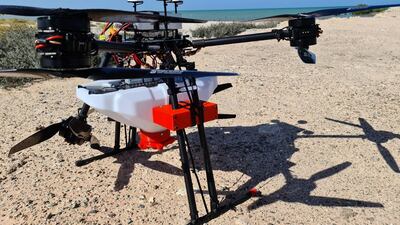
One of the drones that drops mangrove seed balls. Mangrove seed balls dropped on among mangrove seedlings in Al Dhafra. Courtesy: Environment Agency Abu Dhabi -

Underwater mangrove seedlings. Courtesy: Environment Agency Abu Dhabi -
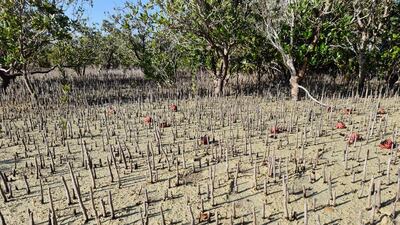
Mangrove seed balls dropped on among mangrove seedlings in Al Dhafra. Courtesy: Environment Agency Abu Dhabi -
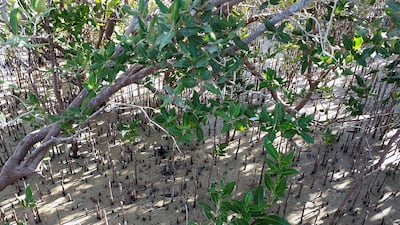
Mangrove seed balls dropped on the shoreline in Al Dhafra. Courtesy: Environment Agency Abu Dhabi
Abu Dhabi's Environment Agency continues to work to rehabilitate and protect mangrove forests.
In the past decade, the authority has overseen the planting of
3.1 million mangrove saplings on the coasts of Al Gharbia, Saadiyat, Jubail and Habitat island.
Historically, mangrove trees were used by local populations as a source of fuel and building materials for houses and ships, because of their durability.
National Day marks the forming of the UAE on December 2, 1971.
Each year, it unites the country's multicultural melting pot of residents drawn from more than 200 nationalities.
"This year more than ever we have seen a spirit of togetherness in line with the UAE's long-held values and we want to make sure everybody can be a part of National Day despite the challenges the world is facing," Mr Al Mazrouei said.
Alongside the live show will be a tribute to the UAE's founding fathers as the country gears up for its Golden Jubilee celebrations in 2021.
Strict Covid-19 measures will be followed to allow the show to be held safely.
Protocols will include a Covid-19 testing policy for all teams and cast members involved in the show.

Company Profile
Company name: OneOrder
Started: October 2021
Founders: Tamer Amer and Karim Maurice
Based: Cairo, Egypt
Industry: technology, logistics
Investors: A15 and self-funded
While you're here
Michael Young: Where is Lebanon headed?
Kareem Shaheen: I owe everything to Beirut
Raghida Dergham: We have to bounce back
AL%20BOOM
8 UAE companies helping families reduce their carbon footprint
Greenheart Organic Farms
This Dubai company was one of the country’s first organic farms, set up in 2012, and it now delivers a wide array of fruits and vegetables grown regionally or in the UAE, as well as other grocery items, to both Dubai and Abu Dhabi doorsteps.
Modibodi
Founded in Australia, Modibodi is now in the UAE with waste-free, reusable underwear that eliminates the litter created by a woman’s monthly cycle, which adds up to approximately 136kgs of sanitary waste over a lifetime.
The Good Karma Co
From brushes made of plant fibres to eco-friendly storage solutions, this company has planet-friendly alternatives to almost everything we need, including tin foil and toothbrushes.
www.instagram.com/thegoodkarmaco
Re:told
One Dubai boutique, Re:told, is taking second-hand garments and selling them on at a fraction of the price, helping to cut back on the hundreds of thousands of tonnes of clothes thrown into landfills each year.
Lush
Lush provides products such as shampoo and conditioner as package-free bars with reusable tins to store.
Bubble Bro
Offering filtered, still and sparkling water on tap, Bubble Bro is attempting to ensure we don’t produce plastic or glass waste. Founded in 2017 by Adel Abu-Aysha, the company is on track to exceeding its target of saving one million bottles by the end of the year.
Coethical
This company offers refillable, eco-friendly home cleaning and hygiene products that are all biodegradable, free of chemicals and certifiably not tested on animals.
Eggs & Soldiers
This bricks-and-mortar shop and e-store, founded by a Dubai mum-of-four, is the place to go for all manner of family products – from reusable cloth diapers to organic skincare and sustainable toys.
How%20I%20connect%20with%20my%20kids%20when%20working%20or%20travelling
The%20specs
Ten tax points to be aware of in 2026
1. Domestic VAT refund amendments: request your refund within five years
If a business does not apply for the refund on time, they lose their credit.
2. E-invoicing in the UAE
Businesses should continue preparing for the implementation of e-invoicing in the UAE, with 2026 a preparation and transition period ahead of phased mandatory adoption.
3. More tax audits
Tax authorities are increasingly using data already available across multiple filings to identify audit risks.
4. More beneficial VAT and excise tax penalty regime
Tax disputes are expected to become more frequent and more structured, with clearer administrative objection and appeal processes. The UAE has adopted a new penalty regime for VAT and excise disputes, which now mirrors the penalty regime for corporate tax.
5. Greater emphasis on statutory audit
There is a greater need for the accuracy of financial statements. The International Financial Reporting Standards standards need to be strictly adhered to and, as a result, the quality of the audits will need to increase.
6. Further transfer pricing enforcement
Transfer pricing enforcement, which refers to the practice of establishing prices for internal transactions between related entities, is expected to broaden in scope. The UAE will shortly open the possibility to negotiate advance pricing agreements, or essentially rulings for transfer pricing purposes.
7. Limited time periods for audits
Recent amendments also introduce a default five-year limitation period for tax audits and assessments, subject to specific statutory exceptions. While the standard audit and assessment period is five years, this may be extended to up to 15 years in cases involving fraud or tax evasion.
8. Pillar 2 implementation
Many multinational groups will begin to feel the practical effect of the Domestic Minimum Top-Up Tax (DMTT), the UAE's implementation of the OECD’s global minimum tax under Pillar 2. While the rules apply for financial years starting on or after January 1, 2025, it is 2026 that marks the transition to an operational phase.
9. Reduced compliance obligations for imported goods and services
Businesses that apply the reverse-charge mechanism for VAT purposes in the UAE may benefit from reduced compliance obligations.
10. Substance and CbC reporting focus
Tax authorities are expected to continue strengthening the enforcement of economic substance and Country-by-Country (CbC) reporting frameworks. In the UAE, these regimes are increasingly being used as risk-assessment tools, providing tax authorities with a comprehensive view of multinational groups’ global footprints and enabling them to assess whether profits are aligned with real economic activity.
Contributed by Thomas Vanhee and Hend Rashwan, Aurifer
Juliot Vinolia’s checklist for adopting alternate-day fasting
- Don’t do it more than once in three days
- Don’t go under 700 calories on fasting days
- Ensure there is sufficient water intake, as the body can go in dehydration mode
- Ensure there is enough roughage (fibre) in the food on fasting days as well
- Do not binge on processed or fatty foods on non-fasting days
- Complement fasting with plant-based foods, fruits, vegetables, seafood. Cut out processed meats and processed carbohydrates
- Manage your sleep
- People with existing gastric or mental health issues should avoid fasting
- Do not fast for prolonged periods without supervision by a qualified expert
Match info
Premier League
Manchester United 2 (Martial 30', Lingard 69')
Arsenal 2 (Mustafi 26', Rojo 68' OG)
Company profile
Date started: 2015
Founder: John Tsioris and Ioanna Angelidaki
Based: Dubai
Sector: Online grocery delivery
Staff: 200
Funding: Undisclosed, but investors include the Jabbar Internet Group and Venture Friends
What the law says
Micro-retirement is not a recognised concept or employment status under Federal Decree Law No. 33 of 2021 on the Regulation of Labour Relations (as amended) (UAE Labour Law). As such, it reflects a voluntary work-life balance practice, rather than a recognised legal employment category, according to Dilini Loku, senior associate for law firm Gateley Middle East.
“Some companies may offer formal sabbatical policies or career break programmes; however, beyond such arrangements, there is no automatic right or statutory entitlement to extended breaks,” she explains.
“Any leave taken beyond statutory entitlements, such as annual leave, is typically regarded as unpaid leave in accordance with Article 33 of the UAE Labour Law. While employees may legally take unpaid leave, such requests are subject to the employer’s discretion and require approval.”
If an employee resigns to pursue micro-retirement, the employment contract is terminated, and the employer is under no legal obligation to rehire the employee in the future unless specific contractual agreements are in place (such as return-to-work arrangements), which are generally uncommon, Ms Loku adds.
COMPANY%20PROFILE
Specs
Engine: 51.5kW electric motor
Range: 400km
Power: 134bhp
Torque: 175Nm
Price: From Dh98,800
Available: Now
What is Diwali?
The Hindu festival is at once a celebration of the autumn harvest and the triumph of good over evil, as outlined in the Ramayana.
According to the Sanskrit epic, penned by the sage Valmiki, Diwali marks the time that the exiled king Rama – a mortal with superhuman powers – returned home to the city of Ayodhya with his wife Sita and brother Lakshman, after vanquishing the 10-headed demon Ravana and conquering his kingdom of Lanka. The people of Ayodhya are believed to have lit thousands of earthen lamps to illuminate the city and to guide the royal family home.
In its current iteration, Diwali is celebrated with a puja to welcome the goodness of prosperity Lakshmi (an incarnation of Sita) into the home, which is decorated with diyas (oil lamps) or fairy lights and rangoli designs with coloured powder. Fireworks light up the sky in some parts of the word, and sweetmeats are made (or bought) by most households. It is customary to get new clothes stitched, and visit friends and family to exchange gifts and greetings.
Islamophobia definition
A widely accepted definition was made by the All Party Parliamentary Group on British Muslims in 2019: “Islamophobia is rooted in racism and is a type of racism that targets expressions of Muslimness or perceived Muslimness.” It further defines it as “inciting hatred or violence against Muslims”.
Favourite book: ‘The Art of Learning’ by Josh Waitzkin
Favourite film: Marvel movies
Favourite parkour spot in Dubai: Residence towers in Jumeirah Beach Residence
WHAT IS A BLACK HOLE?
1. Black holes are objects whose gravity is so strong not even light can escape their pull
2. They can be created when massive stars collapse under their own weight
3. Large black holes can also be formed when smaller ones collide and merge
4. The biggest black holes lurk at the centre of many galaxies, including our own
5. Astronomers believe that when the universe was very young, black holes affected how galaxies formed
Mercer, the investment consulting arm of US services company Marsh & McLennan, expects its wealth division to at least double its assets under management (AUM) in the Middle East as wealth in the region continues to grow despite economic headwinds, a company official said.
Mercer Wealth, which globally has $160 billion in AUM, plans to boost its AUM in the region to $2-$3bn in the next 2-3 years from the present $1bn, said Yasir AbuShaban, a Dubai-based principal with Mercer Wealth.
“Within the next two to three years, we are looking at reaching $2 to $3 billion as a conservative estimate and we do see an opportunity to do so,” said Mr AbuShaban.
Mercer does not directly make investments, but allocates clients’ money they have discretion to, to professional asset managers. They also provide advice to clients.
“We have buying power. We can negotiate on their (client’s) behalf with asset managers to provide them lower fees than they otherwise would have to get on their own,” he added.
Mercer Wealth’s clients include sovereign wealth funds, family offices, and insurance companies among others.
From its office in Dubai, Mercer also looks after Africa, India and Turkey, where they also see opportunity for growth.
Wealth creation in Middle East and Africa (MEA) grew 8.5 per cent to $8.1 trillion last year from $7.5tn in 2015, higher than last year’s global average of 6 per cent and the second-highest growth in a region after Asia-Pacific which grew 9.9 per cent, according to consultancy Boston Consulting Group (BCG). In the region, where wealth grew just 1.9 per cent in 2015 compared with 2014, a pickup in oil prices has helped in wealth generation.
BCG is forecasting MEA wealth will rise to $12tn by 2021, growing at an annual average of 8 per cent.
Drivers of wealth generation in the region will be split evenly between new wealth creation and growth of performance of existing assets, according to BCG.
Another general trend in the region is clients’ looking for a comprehensive approach to investing, according to Mr AbuShaban.
“Institutional investors or some of the families are seeing a slowdown in the available capital they have to invest and in that sense they are looking at optimizing the way they manage their portfolios and making sure they are not investing haphazardly and different parts of their investment are working together,” said Mr AbuShaban.
Some clients also have a higher appetite for risk, given the low interest-rate environment that does not provide enough yield for some institutional investors. These clients are keen to invest in illiquid assets, such as private equity and infrastructure.
“What we have seen is a desire for higher returns in what has been a low-return environment specifically in various fixed income or bonds,” he said.
“In this environment, we have seen a de facto increase in the risk that clients are taking in things like illiquid investments, private equity investments, infrastructure and private debt, those kind of investments were higher illiquidity results in incrementally higher returns.”
The Abu Dhabi Investment Authority, one of the largest sovereign wealth funds, said in its 2016 report that has gradually increased its exposure in direct private equity and private credit transactions, mainly in Asian markets and especially in China and India. The authority’s private equity department focused on structured equities owing to “their defensive characteristics.”
COMPANY%20PROFILE
Know your cyber adversaries
Cryptojacking: Compromises a device or network to mine cryptocurrencies without an organisation's knowledge.
Distributed denial-of-service: Floods systems, servers or networks with information, effectively blocking them.
Man-in-the-middle attack: Intercepts two-way communication to obtain information, spy on participants or alter the outcome.
Malware: Installs itself in a network when a user clicks on a compromised link or email attachment.
Phishing: Aims to secure personal information, such as passwords and credit card numbers.
Ransomware: Encrypts user data, denying access and demands a payment to decrypt it.
Spyware: Collects information without the user's knowledge, which is then passed on to bad actors.
Trojans: Create a backdoor into systems, which becomes a point of entry for an attack.
Viruses: Infect applications in a system and replicate themselves as they go, just like their biological counterparts.
Worms: Send copies of themselves to other users or contacts. They don't attack the system, but they overload it.
Zero-day exploit: Exploits a vulnerability in software before a fix is found.


