
Private sector companies need to do more to integrate women into the workforce if gender parity is to be achieved across the Emirates, said Sheikha Manal bint Mohammed, president of the UAE Gender Balance Council.
Describing Emirati women as “highly educated, ambitious and equal partners in the country’s development”, Sheikha Manal said the onus should not be on the public sector alone to improve gender equality in the workplace.
"The active participation of women in both public and private sectors is essential to achieving the UAE's gender balance objectives," she told The National.
“Progress in enhancing gender balance in the workplace and providing quality jobs for women will require not only the commitment of governments but also the active participation of the private sector.”
Speaking as the Global Women’s Forum is held in Dubai, Sheikha Manal said new legislation was in the pipeline to help the UAE achieve its target of ranking among the top 25 counties for gender balance by next year.
“In the future, we will implement more progressive legislation and policies, fostering dialogue, working with local and international partners and developing new initiatives to create positive, lasting change which will help women fulfil their aspirations.
“[We are] also currently working towards the implementation of gender responsive budgeting on a federal level, which will play an important role in furthering gender balance across the country,” she said.
Sheikha Manal said the country was grooming a new generation of independent women.
“I believe we will see more women assuming leadership positions, starting their own businesses and ultimately shaping their own future.”
She said the UAE’s economic strategies are focused on giving women an important role in the country’s development and government initiatives have paved the way for more inclusive work environments for Emirati women.
“Government policies can lead to transformative change. The 2019 directive to increase the representation of women in the Federal National Council to 50 per cent has placed the UAE among leading countries in terms of equality in parliamentary representation,” she said.
“I strongly believe that more women in ministerial positions and board leadership will facilitate the creation of policies that promote gender parity.”
Sheikha Manal, who is also president of Dubai Women Establishment, said the UAE had much to be proud of. The Emirates has one of the world’s highest female literacy rates, at 95.8 per cent, and 70 per cent of the country’s university graduates are women.
“Over 95 per cent of female high school graduates pursue further education at tertiary-level institutions, while 56 per cent of the UAE’s science, technology, engineering and mathematics graduates at government universities are women.”
With nine female ministers, women represent almost a third of the UAE Cabinet — one of the highest rates of representation in the region.
-

Ivanka Trump, Sheikh Mohammed bin Rashid and Sheikh Hamdan bin Mohammed attend the Global Women's Forum in Dubai on Sunday. Also pictured on the right is Sheikh Mansour bin Mohammed. Courtesy: Dubai Media Office -
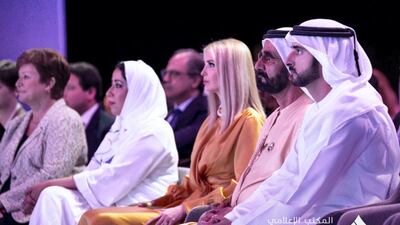
Mona Al Marri, Ivanka Trump, Sheikh Mohammed and Sheikh Hamdan at the Madinat Jumeirah forum Courtesy: Dubai Media Office -

Ms Trump said she would 'like to commend Emirati leaders for removing barriers to women joining the workforce'. Courtesy: Dubai Media Office -
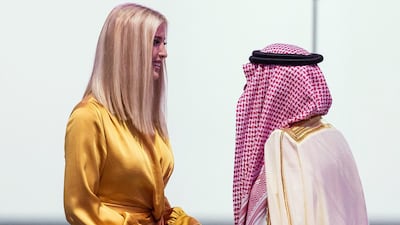
Ivanka Trump gave a key note speech at the two-day forum. Reem Mohammed / The National -

Ms Trump on stage at the forum. Reem Mohammed / The National -

Capt Brenda Berkman, whose legal challenge against the New York fire department in 1982 allowed her and many more women become firefighters, talks to the audience. Reem Mohammed / The National -
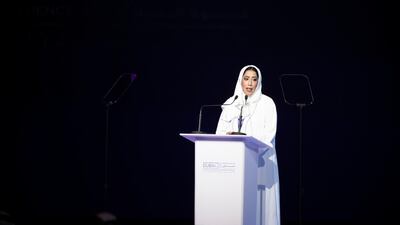
Mona Al Marri, managing director of Dubai Women's Establishment, speaks on the first day. Reem Mohammed / The National -

Chiara Marcati, partner at McKinsey, presents the findings of the Middle East Women at Work report that showed women freelancers earn much less than their male counterparts. Reem Mohammed / The National -

Carla Harris, managing director of Morgan Stanley in the US, on stage on Sunday. Reem Mohammed / The National -
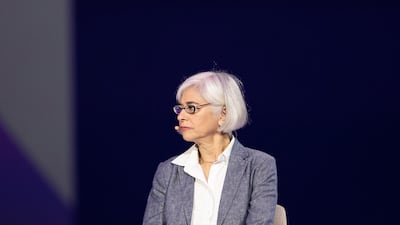
Caren Grown, senior director for Gender at World Bank Group; speaks on a panel. Reem Mohammed / The National -

Hessa Buhumaid, Minister of Community Development. Reem Mohammed / The National -
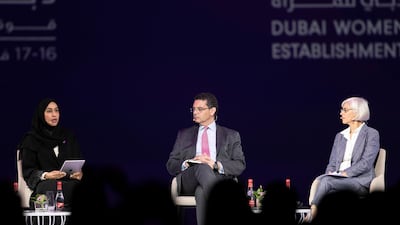
Hessa Buhumaid, Pedro Conceicao, director of Human Development Report Office at the UNDP, and Caren Grown on stage. Reem Mohammed / The National -

Dan Murphy, correspondent at CNBC, interviews Hessa Buhumaid. Reem Mohammed / The National -

Saida Mirziyoyeva, member of the Commission on Gender Equality, Republic of Uzbekistan, addresses the audience on Sunday. Reem Mohammed / The National -

The Global Women’s Forum is held over two days in Dubai. Reem Mohammed/The National


“Two thirds of public sector workers in the UAE are also women, 30 per cent whom are in leadership roles and 15 per cent in technical and academic roles,” she said.
“The country has firmly established itself as a role model for gender balance across the region and the world.”
At present, around 23,000 women manage investments and projects worth Dh50 billion in the UAE.
To increase the representation of women on boards of directors, DWE launched the ‘Women on Boards’ initiative in 2012. This led to the UAE Cabinet’s decision to make female representation on the boards of directors of all
corporations and government entities mandatory.
The UAE was also one of the first countries to implement the gender balance index in the banking and finance sector.
“This gave us clear insights into women’s participation levels in the private sector and helped identify key gaps in order to develop a road map for enhancing female participation in this vital sector,” she said.
These efforts saw the UAE jump 23 ranks in the United Nations Development Programme’s 2019 Gender Inequality Index (GII), ranking first in the Arab world and 26th globally.
But more can be done to achieve the gender parity in the UAE.
“Government policies can of course lead to transformative change,” said Sheikha Manal, citing a directive from President Sheikh Khalifa that called for women to occupy half of the country’s Federal National Council last year.
“Many other new legislations, together with innovative government initiatives, have paved the way for more inclusive work environments for Emirati women.”
The Gender Balance Council, dedicated to reducing the gender gap in the Emirates, was formed by Sheikh Mohammed bin Rashid, Vice President and Ruler of Dubai, in 2015.
As its president, Sheikha Manal — who is also wife of Sheikh Mansour bin Zayed, UAE’s Deputy Prime Minister and Minister of Presidential Affairs — led a review of the UAE’s maternity law, influencing the decision to extend paid maternity leave for public sector employees from two to three months, in 2017.
Under Sheikha Manal, the council has also launched a gender balance guide to serve as a comprehensive resource to advance gender equality across public and private entities in the UAE.
“We also helped introduce policies that support greater representation of women in decision making roles in vital sectors.
“We have advocated for the adoption of policies that seek to enhance the work-life balance for women,” she said.
The council is now working on implementing gender responsive budgeting on a federal level, which will play an important role in furthering gender balance across the country.
“Throughout its history, the UAE has demonstrated a clear commitment to enhance women’s participation and elevate their status. I have no doubt that progress in the field of gender balance will continue in years to come.”

