Cinemas in Abu Dhabi malls have been permitted to reopen at limited capacity.
Authorities on Monday said they can now welcome cinema-goers again, subject to a series of rules designed to protect staff and visitors.
Operators must not book more than 30 per cent of available seats.
Social distancing will be in force in ticket queues and inside the cinema itself, while no adjacent seats will be used, except by members of the same family.
All seats must be sanitised after each show and cinemas must allow at least 20 minutes between screenings to ensure there is enough time for this.
Theatres across the country shut in March to stem the spread of Covid-19. But they have been gradually reopening in other emirates.
Now Abu Dhabi's Department of Economic Development has set down strict new guidelines governing their reopening.
Other rules stipulate the cinema must be disinfected at the end of each day.
There will be no tickets or pamphlets issued and touch screens will be removed.
Masks will be mandatory and all staff must be tested for coronavirus before cinemas reopen.
No set date has been given for their reopening. However, it is believed operators can open their doors once all requirements are met.
“The recent circular directs cinema owners to resume their activities at only 30 per cent capacity of their halls while continuously sanitising and cleaning all their service facilities and common areas where food and beverage products are sold," said Rashed Al Balooshi, undersecretary at the department.
"They also should apply social distancing measures between visitors inside and outside the cinema halls; comply with wearing masks; and conduct Covid-19 tests for all their staff members. Granting the cinema reopening permit is subject to the fulfilment of all the set of requirements,” he said.
Abu Dhabi has been home to a drive-through cinema located in Yas Marina for the past several weeks.
Tickets cost Dh160 per vehicle and there is a limit of three people per car if guests are not from the same family. If they are from the same family, there can be up to five guests in a vehicle.
__________
Gallery: Life returns to Abu Dhabi streets
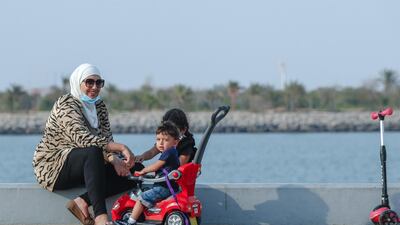
Abu Dhabi's Corniche is slowly getting busier as residents brave the summer heat to stretch their legs. Victor Besa / The National
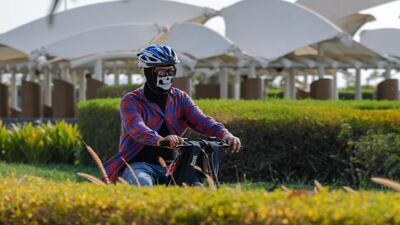
Bicycle riding is becoming more popular on the city's quieter streets. Victor Besa / The National
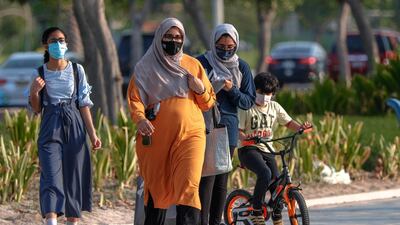
A family goes for a stroll on Abu Dhabi's Corniche. Victor Besa / The National
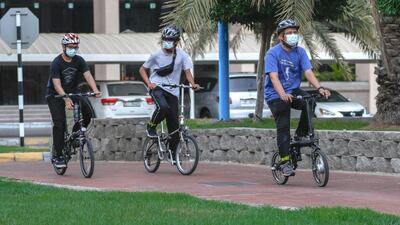
Cyclists on foldable bikes make their way through Abu Dhabi's downtown. Victor Besa / The National
Workers get on their shuttle home in downtown Abu Dhabi on Friday evening. Victor Besa / The National
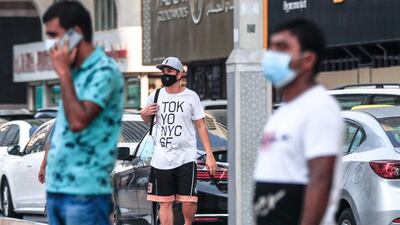
People wear face masks as they wait for a bus in downtown Abu Dhabi. Victor Besa / The National
Pedestrians cross the street in downtown Abu Dhabi on a hot summer evening. Victor Besa / The National
Jet skiers pictured off Abu Dhabi's Corniche at sunset on Friday. Victor Besa / The National
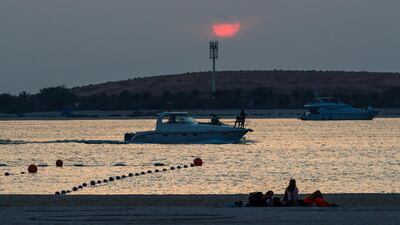
The sun sets over Abu Dhabi on Friday evening. Victor Besa / The National
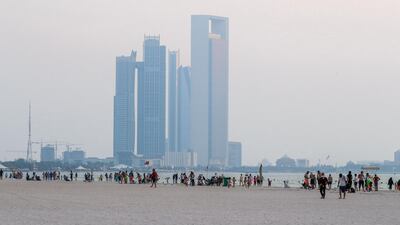
Families enjoy the beach as the sun sets over Abu Dhabi. Victor Besa / The National
Explainer: Tanween Design Programme
Non-profit arts studio Tashkeel launched this annual initiative with the intention of supporting budding designers in the UAE. This year, three talents were chosen from hundreds of applicants to be a part of the sixth creative development programme. These are architect Abdulla Al Mulla, interior designer Lana El Samman and graphic designer Yara Habib.
The trio have been guided by experts from the industry over the course of nine months, as they developed their own products that merge their unique styles with traditional elements of Emirati design. This includes laboratory sessions, experimental and collaborative practice, investigation of new business models and evaluation.
It is led by British contemporary design project specialist Helen Voce and mentor Kevin Badni, and offers participants access to experts from across the world, including the likes of UK designer Gareth Neal and multidisciplinary designer and entrepreneur, Sheikh Salem Al Qassimi.
The final pieces are being revealed in a worldwide limited-edition release on the first day of Downtown Designs at Dubai Design Week 2019. Tashkeel will be at stand E31 at the exhibition.
Lisa Ball-Lechgar, deputy director of Tashkeel, said: “The diversity and calibre of the applicants this year … is reflective of the dynamic change that the UAE art and design industry is witnessing, with young creators resolute in making their bold design ideas a reality.”
October 26: Bahrain withdraws from a proposal to create a federation of nine with the seven Trucial States and Qatar.
December: Ahmed Al Suwaidi visits New York to discuss potential UN membership.
1971
March 1: Alex Douglas Hume, Conservative foreign secretary confirms that Britain will leave the Gulf and “strongly supports” the creation of a Union of Arab Emirates.
July 12: Historic meeting at which Sheikh Zayed and Sheikh Rashid make a binding agreement to create what will become the UAE.
July 18: It is announced that the UAE will be formed from six emirates, with a proposed constitution signed. RAK is not yet part of the agreement.
August 6: The fifth anniversary of Sheikh Zayed becoming Ruler of Abu Dhabi, with official celebrations deferred until later in the year.
August 15: Bahrain becomes independent.
September 3: Qatar becomes independent.
November 23-25: Meeting with Sheikh Zayed and Sheikh Rashid and senior British officials to fix December 2 as date of creation of the UAE.
November 29: At 5.30pm Iranian forces seize the Greater and Lesser Tunbs by force.
November 30: Despite a power sharing agreement, Tehran takes full control of Abu Musa.
November 31: UK officials visit all six participating Emirates to formally end the Trucial States treaties
December 2: 11am, Dubai. New Supreme Council formally elects Sheikh Zayed as President. Treaty of Friendship signed with the UK. 11.30am. Flag raising ceremony at Union House and Al Manhal Palace in Abu Dhabi witnessed by Sheikh Khalifa, then Crown Prince of Abu Dhabi.
December 6: Arab League formally admits the UAE. The first British Ambassador presents his credentials to Sheikh Zayed.
David Einhorn closed out 2018 with his biggest annual loss ever for the 22-year-old Greenlight Capital.
The firm’s main hedge fund fell 9 per cent in December, extending this year’s decline to 34 percent, according to an investor update viewed by Bloomberg.
Greenlight posted some of the industry’s best returns in its early years, but has stumbled since losing more than 20 per cent in 2015.
Other value-investing managers have also struggled, as a decade of historically low interest rates and the rise of passive investing and quant trading pushed growth stocks past their inexpensive brethren. Three Bays Capital and SPO Partners & Co., which sought to make wagers on undervalued stocks, closed in 2018. Mr Einhorn has repeatedly expressed his frustration with the poor performance this year, while remaining steadfast in his commitment to value investing.
Greenlight, which posted gains only in May and October, underperformed both the broader market and its peers in 2018. The S&P 500 Index dropped 4.4 per cent, including dividends, while the HFRX Global Hedge Fund Index, an early indicator of industry performance, fell 7 per cent through December. 28.
At the start of the year, Greenlight managed $6.3 billion in assets, according to a regulatory filing. By May, the firm was down to $5.5bn.