Mariam Al Mheiri speaks to The National during the president's state visit to Paris. It is inevitable that oil and gas will remain part of the energy mix for now, she said. Chris Whiteoak / The National
Mariam Al Mheiri speaks to The National during the president's state visit to Paris. It is inevitable that oil and gas will remain part of the energy mix for now, she said. Chris Whiteoak / The Nation

UAE minister says climate goals need to be pragmatic and sustainable


  • English
  • Arabic

Climate change goals must be sustainable if governments are to stick to them, the UAE's environment minister said, at a time when the energy crisis has led to a scramble for new sources of oil and gas.

Mariam Al Mheiri, Minister of Climate Change and Environment, said there must be a realism about the transition to clean energy.

The current energy crisis, linked to sanctions on Russia and the post-coronavirus boom, shows how little progress has been made in energy diversity.

“The world is knocking on our door and asking us to produce more oil and gas, because they are not ready with the new energy systems,” she told The National in an interview in Paris.

The world is knocking on our door and asking us to produce more oil and gas, because they are not ready with the new energy systems
Mariam Al Mheiri,
Minister of Climate Change and Environment

“Oil and gas [are] still going to be a part of the energy mix for a few years to come.”

Admitting the scale of the task does not mean the UAE, or other nations, will falter in the mission to tackle rising planet temperatures, said Ms Al Mheiri.

The Emirates aims to achieve net zero emissions by 2050, with billions being ploughed into alternative sources of clean energy.

Record temperatures in Europe and the Indian subcontinent in recent weeks have shown the risk of failing to act.

“We need to be responsible. We need to decarbonise as much as possible, which is what the UAE is doing,” Ms Al Mheiri said.

“And we need to use that energy to build the future energy systems for tomorrow.”

At the UN Cop 26 climate change conference in Glasgow last autumn, the UAE committed to its net zero plan, and to investing in other nations to aid them in their transition.

“We will be investing another $50 billion in the next decade, knowing that we have already invested about $40bn in the country on clean and renewables and about $17bn in over 70 countries.”

Mixing up the energy pie

A key part of the UAE's goal is to shrink the slice of an energy pie that is dominated by fossil fuels. Adding solar energy and nuclear power into the mix is a key part of that.

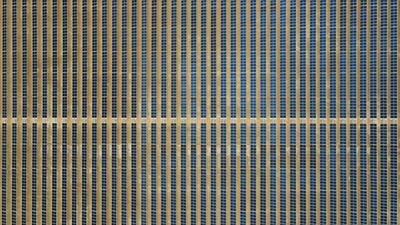
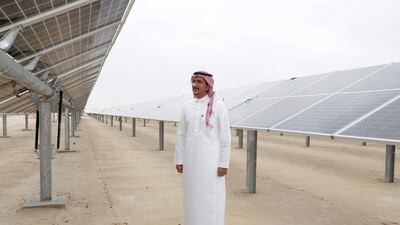
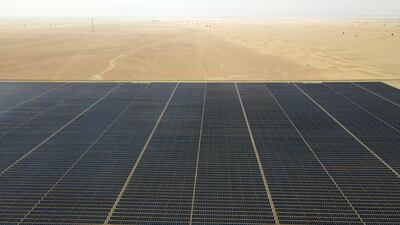
  • An aerial view of Mohammed bin Rashid Solar Park in Dubai in January 2022. Solar is essential to the UAE's new energy mix. All photos by Pawan Singh / The National
    An aerial view of Mohammed bin Rashid Solar Park in Dubai in January 2022. Solar is essential to the UAE's new energy mix. All photos by Pawan Singh / The National
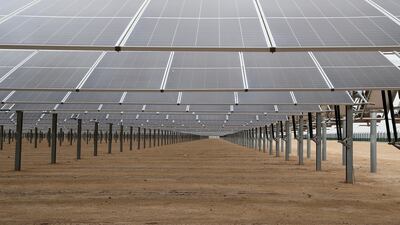
  • The fifth phase of a clean energy project at the Mohammed bin Rashid Solar Park will further help reduce carbon emissions.
    The fifth phase of a clean energy project at the Mohammed bin Rashid Solar Park will further help reduce carbon emissions.
  • An aerial view of the Solar Park in the Dubai desert.
    An aerial view of the Solar Park in the Dubai desert.
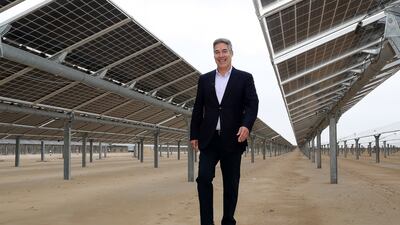
  • Marco Garcia, chief commercial officer of Nextracker, a US company which has provided photovoltaic technology used in the project.
    Marco Garcia, chief commercial officer of Nextracker, a US company which has provided photovoltaic technology used in the project.
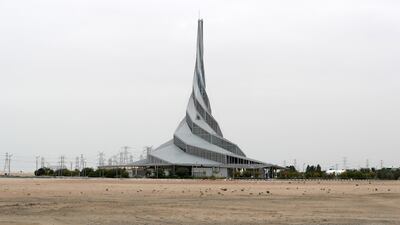
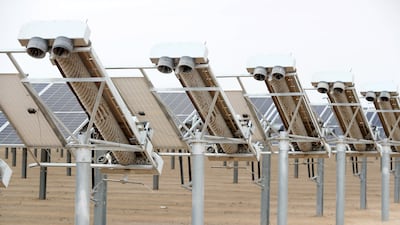
  • The Innovation Centre at the MBR Solar Park in Dubai, where machine learning is being utilised to track direct sunlight to maximise efficient energy capture, storage and transmission.
    The Innovation Centre at the MBR Solar Park in Dubai, where machine learning is being utilised to track direct sunlight to maximise efficient energy capture, storage and transmission.
  • The solar powered panels follow the path of the sun to help the emirate reach its clean energy transition goals.
    The solar powered panels follow the path of the sun to help the emirate reach its clean energy transition goals.
  • Omar Al Hassan, chief executive of Shuaa Energy 3, the company operating the scheme, says the vast project will ultimately create clean energy to power more than 250,000 houses in Dubai.
    Omar Al Hassan, chief executive of Shuaa Energy 3, the company operating the scheme, says the vast project will ultimately create clean energy to power more than 250,000 houses in Dubai.
  • Robotic cleaning systems are installed on the solar panels.
    Robotic cleaning systems are installed on the solar panels.
  • More than 2.5 million photovoltaic modules have been fitted during phase 5 of the project.
    More than 2.5 million photovoltaic modules have been fitted during phase 5 of the project.

Ms Al Mheiri said solar parks in the Emirates now generate about 2,400 megawatts of energy, with a goal of reaching 8,500 megawatts by 2030.

The Barakah nuclear plant will further add to the “clean energy” mix, eventually meeting 25 per cent of the country's energy needs and halving Abu Dhabi's energy and carbon footprint by 2025.

“So, we have clear targets on our renewables, on the oil and gas,” Ms Al Mheiri said, using the example of Abu Dhabi's Adnoc.

“Adnoc have already committed to reducing their greenhouse gas emissions by 25 per cent by 2030. As of January 1st, Adnoc sources 100 per cent of its grid power from nuclear and solar energy,” she said.

“So, they have really decarbonised the oil and gas, making it one of the most lowest carbon-intensive oil and gas in the world. And I want you to think about this when you build equipment for renewables, you need energy to do that. So, you need the oil and gas to make your new energy systems.

“We are going to be one of the first countries in the world … to transition to the new energy system. We can definitely say that we are — how'd you say — on the crest of the wave.”

Away from energy generation, Ms Al Mheiri said the UAE wants to help countries to plant more mangroves — which Abu Dhabi is famous for. Mangroves are considered to be one of nature's best “carbon sinks”.

“They tick off so many boxes when it comes to mitigation and adaptation for climate action,” she said. “These are some examples of what the UAE is leading.”

Food, crops, and what it means to be 'self-sufficient'

Ms Al Mheiri has visited countries around the world to look for new partnerships, suppliers and to source the best technology that will allow the Emirates to grow more of its own food.

The pandemic put the spotlight on food security in many nations, particularly in the Gulf, where harsh desert conditions make it difficult to grow much produce.

However, that is changing at pace. Vertical farms and crops that require less water are leading to more locally grown produce on supermarket shelves.

From importing 80 per cent to 90 per cent of its food before the pandemic, there are now plans to produce 30 per cent to 40 per cent of the food needed in the UAE within 10 years.

Ms Al Mheiri said the aim was to grow the right foods here while importing what could never be feasibly grown in the desert.

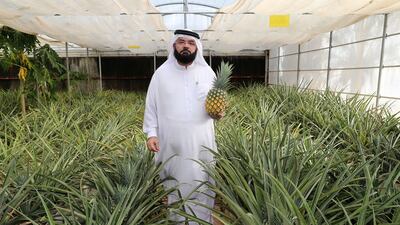
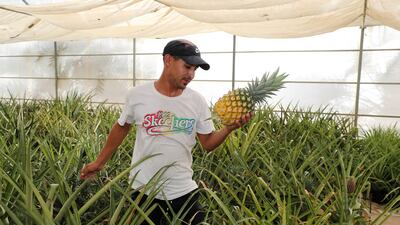
  • Abdullatif Al Banna grows thousands of pineapples without soil at greenhouses at his farm in Al Aweer. All photos: Pawan Singh / The National
    Abdullatif Al Banna grows thousands of pineapples without soil at greenhouses at his farm in Al Aweer. All photos: Pawan Singh / The National
  • The forward-thinking farmer uses hydroponic methods to help pineapples grow
    The forward-thinking farmer uses hydroponic methods to help pineapples grow
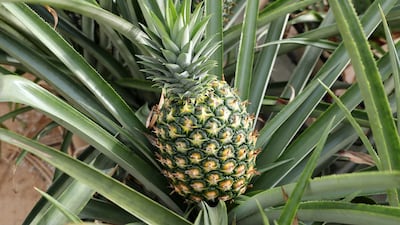
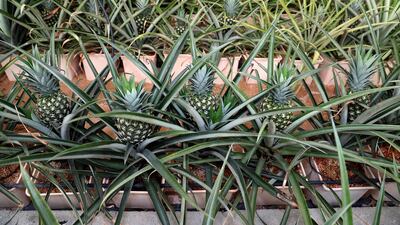
  • One of the 4,000 pineapples grown at the farm over the past year
    One of the 4,000 pineapples grown at the farm over the past year
  • Mr Al Banna shares a love of agriculture with his father
    Mr Al Banna shares a love of agriculture with his father
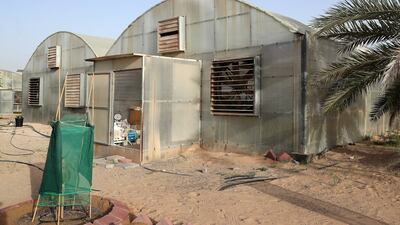
  • Inside one of the greenhouses at the Al Aweer farm.
    Inside one of the greenhouses at the Al Aweer farm.
  • Mr Al Banna’s farm in the Dubai desert is proving fruitful for himself and his family
    Mr Al Banna’s farm in the Dubai desert is proving fruitful for himself and his family
  • He tried a number of farming methods to find the best way to grow the tropical fruit in the UAE
    He tried a number of farming methods to find the best way to grow the tropical fruit in the UAE
  • Thousands of pineapples have been grown in greenhouses at the farm in Al Aweer
    Thousands of pineapples have been grown in greenhouses at the farm in Al Aweer

“We need to be careful with the words self-sufficient. Self-sufficiency means you are completely independent of any outside inputs,” she said.

“For me, the important part is the food security part. A country is food secure when it ensures the access of nutritious and affordable food for all.”

At a time of inflation and rising food costs around the world, choosing the right foods to grow and sell at a decent price is crucial.

“It is not about being able to grow everything the UAE; it doesn't make sense for us,” she said.

Growing grains — of which there is a huge shortage due to the war in Ukraine — takes a lot of water, which needs to be desalinated from the Gulf.

That means selling the produce at a high price, and being undercut by imports.

“And that's why we develop the 'UAE food basket',” she said.

“What we found was it is usually the perishable items that make sense to grow in the UAE. Bringing lettuce from a long way away, you can imagine it has to be stored in a cool container. In a few days, it will start to wilt and not look fresh any more.

“But if you grow that in the UAE, it is fresher, it tastes better. It is nutritious, whereas something like rice, you can keep rice for a longer period. And then you look at countries that grow rice at scale and have a lot of rain falling.

“And that is a much more sustainable source than growing it in the desert.”

Ten tax points to be aware of in 2026

1. Domestic VAT refund amendments: request your refund within five years

If a business does not apply for the refund on time, they lose their credit.

2. E-invoicing in the UAE

Businesses should continue preparing for the implementation of e-invoicing in the UAE, with 2026 a preparation and transition period ahead of phased mandatory adoption. 

3. More tax audits

Tax authorities are increasingly using data already available across multiple filings to identify audit risks. 

4. More beneficial VAT and excise tax penalty regime

Tax disputes are expected to become more frequent and more structured, with clearer administrative objection and appeal processes. The UAE has adopted a new penalty regime for VAT and excise disputes, which now mirrors the penalty regime for corporate tax.

5. Greater emphasis on statutory audit

There is a greater need for the accuracy of financial statements. The International Financial Reporting Standards standards need to be strictly adhered to and, as a result, the quality of the audits will need to increase.

6. Further transfer pricing enforcement

Transfer pricing enforcement, which refers to the practice of establishing prices for internal transactions between related entities, is expected to broaden in scope. The UAE will shortly open the possibility to negotiate advance pricing agreements, or essentially rulings for transfer pricing purposes. 

7. Limited time periods for audits

Recent amendments also introduce a default five-year limitation period for tax audits and assessments, subject to specific statutory exceptions. While the standard audit and assessment period is five years, this may be extended to up to 15 years in cases involving fraud or tax evasion. 

8. Pillar 2 implementation 

Many multinational groups will begin to feel the practical effect of the Domestic Minimum Top-Up Tax (DMTT), the UAE's implementation of the OECD’s global minimum tax under Pillar 2. While the rules apply for financial years starting on or after January 1, 2025, it is 2026 that marks the transition to an operational phase.

9. Reduced compliance obligations for imported goods and services

Businesses that apply the reverse-charge mechanism for VAT purposes in the UAE may benefit from reduced compliance obligations. 

10. Substance and CbC reporting focus

Tax authorities are expected to continue strengthening the enforcement of economic substance and Country-by-Country (CbC) reporting frameworks. In the UAE, these regimes are increasingly being used as risk-assessment tools, providing tax authorities with a comprehensive view of multinational groups’ global footprints and enabling them to assess whether profits are aligned with real economic activity. 

Contributed by Thomas Vanhee and Hend Rashwan, Aurifer

MATCH INFO

Uefa Champions League semi-final, first leg
Bayern Munich v Real Madrid

When: April 25, 10.45pm kick-off (UAE)
Where: Allianz Arena, Munich
Live: BeIN Sports HD
Second leg: May 1, Santiago Bernabeu, Madrid

The Perfect Couple

Starring: Nicole Kidman, Liev Schreiber, Jack Reynor

Creator: Jenna Lamia

Rating: 3/5

Jetour T1 specs

Engine: 2-litre turbocharged

Power: 254hp

Torque: 390Nm

Price: From Dh126,000

Available: Now

The five pillars of Islam

1. Fasting

2. Prayer

3. Hajj

4. Shahada

5. Zakat 

COMPANY PROFILE
Name: HyperSpace
 
Started: 2020
 
Founders: Alexander Heller, Rama Allen and Desi Gonzalez
 
Based: Dubai, UAE
 
Sector: Entertainment 
 
Number of staff: 210 
 
Investment raised: $75 million from investors including Galaxy Interactive, Riyadh Season, Sega Ventures and Apis Venture Partners
Who's who in Yemen conflict

Houthis: Iran-backed rebels who occupy Sanaa and run unrecognised government

Yemeni government: Exiled government in Aden led by eight-member Presidential Leadership Council

Southern Transitional Council: Faction in Yemeni government that seeks autonomy for the south

Habrish 'rebels': Tribal-backed forces feuding with STC over control of oil in government territory

ARGYLLE
%3Cp%3EDirector%3A%20Matthew%20Vaughn%3C%2Fp%3E%0A%3Cp%3EStarring%3A%20Bryce%20Dallas%20Howard%2C%20Sam%20Rockwell%2C%20John%20Cena%3C%2Fp%3E%0A%3Cp%3ERating%3A%203%2F5%3C%2Fp%3E%0A
The years Ramadan fell in May

1987

1954

1921

1888

Try out the test yourself

Q1 Suppose you had $100 in a savings account and the interest rate was 2 per cent per year. After five years, how much do you think you would have in the account if you left the money to grow?
a) More than $102
b) Exactly $102
c) Less than $102
d) Do not know
e) Refuse to answer

Q2 Imagine that the interest rate on your savings account was 1 per cent per year and inflation was 2 per cent per year. After one year, how much would you be able to buy with the money in this account?
a) More than today
b) Exactly the same as today
c) Less than today
d) Do not know
e) Refuse to answer

Q4 Do you think that the following statement is true or false? “Buying a single company stock usually provides a safer return than a stock mutual fund.”
a) True
b) False
d) Do not know
e) Refuse to answer

The “Big Three” financial literacy questions were created by Professors Annamaria Lusardi of the George Washington School of Business and Olivia Mitchell, of the Wharton School of the University of Pennsylvania. 

Answers: Q1 More than $102 (compound interest). Q2 Less than today (inflation). Q3 False (diversification).

Company%C2%A0profile
%3Cp%3E%3Cstrong%3ECompany%20name%3A%20%3C%2Fstrong%3Eamana%3Cbr%3E%3Cstrong%3EStarted%3A%20%3C%2Fstrong%3E2010%3Cbr%3E%3Cstrong%3EFounders%3A%3C%2Fstrong%3E%20Karim%20Farra%20and%20Ziad%20Aboujeb%3Cbr%3E%3Cstrong%3EBased%3A%20%3C%2Fstrong%3EUAE%3Cbr%3E%3Cstrong%3ERegulator%3A%20%3C%2Fstrong%3EDFSA%3Cbr%3E%3Cstrong%3ESector%3A%20%3C%2Fstrong%3EFinancial%20services%3Cbr%3E%3Cstrong%3ECurrent%20number%20of%20staff%3A%20%3C%2Fstrong%3E85%3Cbr%3E%3Cstrong%3EInvestment%20stage%3A%20%3C%2Fstrong%3ESelf-funded%3Cbr%3E%3C%2Fp%3E%0A
AI traffic lights to ease congestion at seven points to Sheikh Zayed bin Sultan Street

The seven points are:

Shakhbout bin Sultan Street

Dhafeer Street

Hadbat Al Ghubainah Street (outbound)

Salama bint Butti Street

Al Dhafra Street

Rabdan Street

Umm Yifina Street exit (inbound)

While you're here
Updated: July 21, 2022, 8:19 AM