


Abu Dhabi is to launch a dedicated artificial intelligence research centre to help cement the UAE's growing status as a global centre for technological innovation.
The state-of-the-art complex will be central to the work of the capital's Technology Innovation Institute, which already is home to the Middle East's first quantum computer and to teams of researchers developing advanced materials, drones and robots for commercial use.
The centre aims to bridge the gap between the research centre's seven labs and the spreading field of AI, providing oversight and technical know-how.
Take, for example, an autonomous boat under development at TII's robotics lab, which is being designed to self-navigate to the site of an oil spill, send out dozens of robotic “fish” to assess the damage to marine life, all while sending information to drones hovering above to determine a course for clean-up.
This scenario relies heavily on AI capabilities and is one of dozens of commercial projects being developed at TII's Masdar City campus. The new AI Research Centre will assist on gathering the relevant data to support machine learning and develop algorithms to push such projects forward, with plans to grow to a workforce of 50 in 2022.
Attracting talent and tackling projects that have commercial potential in the region is critical to Dr Ray Johnson, who joined TII in August as the centre's first chief executive.
Before coming to Abu Dhabi, he was the chief technology officer at US defence company Lockheed Martin from 2006 to 2015, then a partner at Bessemer Ventures, one of the longest-running venture capital firms in the US.
"I came from overseeing a team of 70,000 people working on 4,000 projects, and so I'm very accustomed to seeing top talent," Dr Johnson told The National in an interview, speaking about his time at Lockheed Martin. "I was delighted when I got here to see that the level of talent that TII has already attracted, is equal to or greater than the talent that I was used to working with in very large organisations."
Autonomous robots are "a major focus area" for TII, Dr Johnson said, and are likely to be among the first products sold to paying customers.

"You can hardly pick up a newspaper or magazine without reading about Amazon using them for delivery or nation states developing capabilities that need to be watched," he said.
The security, energy, transportation and construction industries are of particular interest to TII, he said.
TII, the applied research arm of Abu Dhabi's Advanced Technology Research Council, is a critical part of the UAE's efforts to diversify from a reliance on oil exports and develop a knowledge-based economy.
At the same time, the advent of AI, quantum computing and more sophisticated cybersecurity threats means that nations around the world are concerned with developing independent technology.
"One of the things the pandemic did was remind nations that this global supply chain, and dependence on others, brings risk," Dr Johnson said.
Technical independence is certainly important, he said, but the ambition is to develop world-class research labs that are producing commercially viable solutions that can "scale beyond" the UAE and ultimately be exported.
"We've taken a nice portfolio approach, whereby some products, some of the innovations, will make their way to products sooner, some innovations will take longer," Dr Johnson said.
-
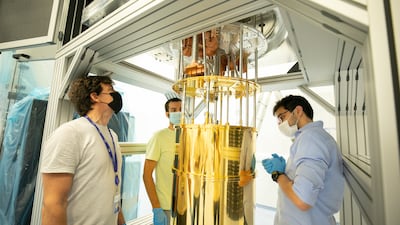
A quantum computer has arrived at the Technology Innovation Institute in Abu Dhabi. -
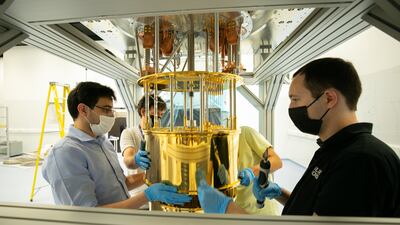
The institute’s Quantum Research Centre team opens the outer shields of the refrigerator housing the machine to reveal the chandelier. The device enables the temperature to be lowered in stages. -

The team prepares to open the box. -
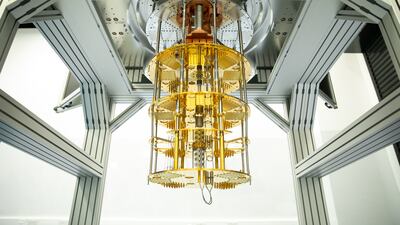
The quantum chandelier, so-called for its resemblance to the light fixture, has looping microwave communication cables that enable other computers to interact with the quantum chip within. -
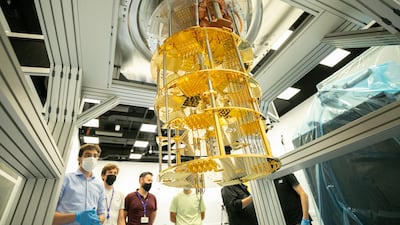
Two helium isotopes are mixed, cooling the chandelier to 10 millikelvin. The looping microwave communication cables enable other computers to interact with the quantum chip. -
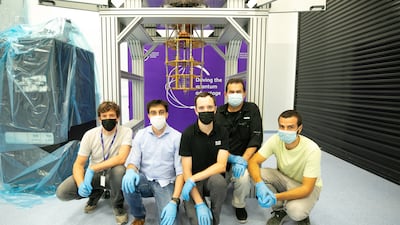
Members of the Quantum Research Centre team. From left to right, Alvaro Orgaz, senior project manager; Boulos Alfakes, postdoctoral researcher; Andrii Torgovkin, technical engineer; Carsten Andrew Lutken, executive director – quantum computing, and David Fuentes, engineer. -
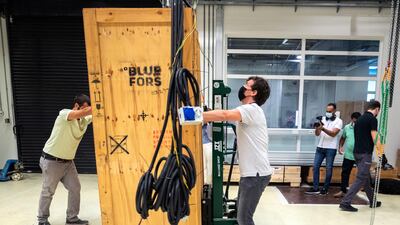
The quantum computer unboxing at Masdar City, Abu Dhabi. -
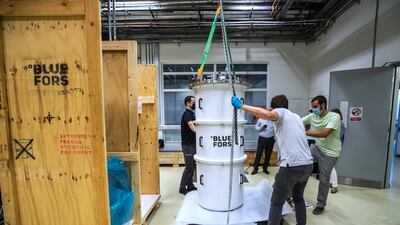
The quantum computer unboxing. -
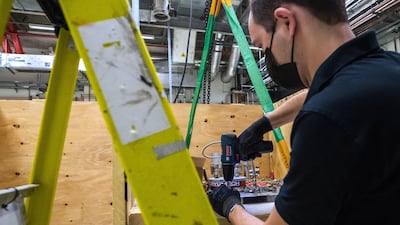
Andrii Torgovkin uses a drill to gain access to quantum computer components. -
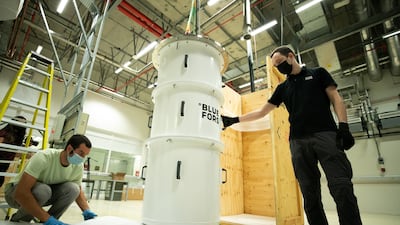
The cryostat is lifted off the shipping crate. This device plays an important role in achieving the extremely low temperature of 10 millikelvin in which the quantum chip must operate. -
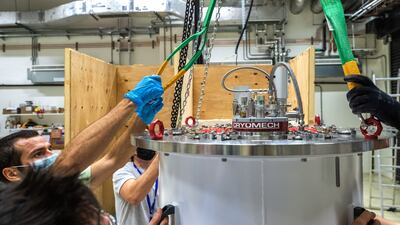
The cryostat being hoisted from its crate. -
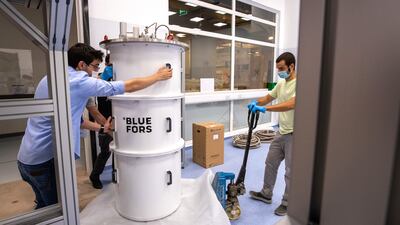
The cryostat is pushed into position. -
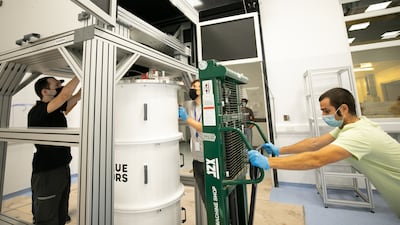
The cryostat is positioned and hung from a frame, enabling it to be opened and closed. The frame contains the helium dilution refrigerator that helps maintain an extremely low temperature using helium isotopes.


"You want to have that portfolio approach so that you always have innovations coming out going through commercialisation and making it out to customers."
Investing in local and international talent
While the robotics lab may be first to market with a product, the quantum research centre has a longer time horizon, he said.
Partnerships are also critical. TII has signed 46 collaborative research partnership agreements with 32 research universities, including Stanford University, Khalifa University, New York University and Purdue.
Dr Johnson emphasised TII would always be an international crossroads for research. While the centre employs 100 Emiratis and wants to increase that number, the ambition is to be multinational and focused on partnerships.
"The kind of talent that is [at TII] today, and that we're attracting, and the situational awareness around the science and the understanding of the environment of their field is the best I've seen," he said. "We're able to build around that."

