



An Emirati architect believes buildings should tell stories, make us pause to think about the past and engage with the present.
Ahmed Bukhash is the only Emirati architect to have designed a pavilion at Expo 2020 Dubai.
Called The Good Place, the white origami folds give a modern twist to a Bedouin tent-like structure tucked away in the Opportunity district of the world’s fair.
Emirati architect
The definitive soaring lines of the facade took shape in Mr Bukhash’s mind when he read about an important 1968 meeting between Sheikh Zayed, the founder of the UAE, and Sheikh Rashid bin Saeed, in the ‘northern tent’ that led to the birth of the UAE three years later.
“The pavilion is oriented to the north. It is similar to the northern tent in which the late founding fathers' Sheikh Zayed and Sheikh Rashid met. And this same breeze is actually felt when you go to the rear side of the building,” Mr Bukhash told The National.
“From design to reality, it gives us a sense of pride that a strong concept has been translated into the pavilion.”
Dwarfed by larger buildings such as the UK and Luxembourg pavilions, the stark white structure still holds its own.
-

A child drawing outside the Saudi Arabia pavilion. All photos: Expo 2020 Dubai -

Children take a stroll through the Opportunity District. -

Touring the Expo 2020 site on a rented bicycle. -

There are many activities designed for children at the world's fair. Image: Expo 2020 Dubai -

A child enjoys the Around The World Carousel in the Mobility District. Expo 2020 Dubai -

Children inside the Monaco pavilion. Expo 2020 Dubai -

Outside the Bolt pavilion during a 'Run The World' family event. -

A girl celebrates Comoros' country day at Al Wasl Plaza. -
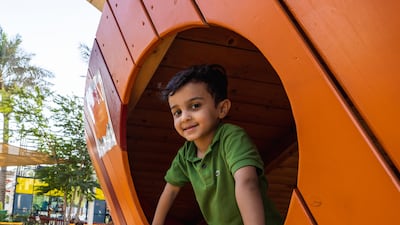
A child plays at Latifa's Adventures playground. -

Expo 2020 mascots Rashid, Latifa and Alif with children at the Earth Plaza. -

Children take part in arts and cultural activities at the China pavilion.


Mr Bukhash speaks enthusiastically about the need for future constructions to be responsive to the climate.
He selected plastic composite fabric material for the outer screen walls to offset the heat and humidity.
“You will notice how the shade is effective because of the outer arcade – you can sense it when the sun is at its highest. This shade provides reflection, is easily recyclable and coloured with light beige and white texture.
“It naturally reflects the light away similar to our traditional kandura,” he said, referring to the garment worn by Emirati men.
Learnings from old courtyard homes without air conditioning and of ancient communities bordered with shaded pathways added to his design process.
“Our design philosophy from the very onset is that we have always believed traditional prototypes are the solution to address global climate change,” the 41 year old said.
“The same way our courtyard houses were a solution to live in an environment that was not air-conditioned.
“Technology should only be there as an addition after you put the core design principles into effect, which should be in response to the climate.”
The aim was to intrigue visitors, draw them in and protect them from the elements.

“When we create architecture, we always want to base it on the climate and context in which it is rooted,” Mr Bukhash said.
“What we can do as architects is add vitality, give it a more dynamic effect. Other projects may put the exhibition as the central focus. One of the unique traits of our pavilion is we place the human being at the centre of the design.”
The pavilion brings together entrepreneurs from across the world whose start-up projects received funding from the Expo Live initiative – the first time such a grant has been rolled out at an Expo.
It has supported more than 5.8 million people around the globe through 140 programmes that cover green companies, farm projects, women’s empowerment and teaching children in remote areas.
Among the exhibits, entrepreneurs show how recycled plastics can be used in construction and technology to help retain water on arid farmland.
“These people and their work play a part in how to resolve global climate change and how to meet Dubai’s initiative to achieve carbon zero by 2050,” he said.
“All these innovators in combination with architecture can solve a lot of issues causing significant stress on our environment.”
His own studio, Archidentity, has designed commercial projects, community centres, residential villas and mosques in the country.
The UAE citizen sees architecture as a living heritage to pass on to the next generation.
“The real solution is how to make our city accessible all year round and this project is a small part of that puzzle we wish to adapt to a larger context,” he said.

