

Jet-ski riders in Dubai have been urged to slow down to help protect marine life after an adult green turtle was found dead.
Experts renewed their call to increase protection for sea creatures after the over 20 year old reptile was found floating upside down near Nessnass Beach in Jumeirah on Saturday.
The turtle was apparently killed by a jet-ski, said kite-surfer Alexandre Juignet, 39, who spotted it in the sea before the current washed it to shore.
The French finance consultant said its shell had been crushed. "The impact must have been messy because the shell was cracked, I would say about 60 per cent completely smashed," he said.
"We called Dubai Municipality, and they came to pick it up."
Sea turtles live most of their lives underwater. They come up for air every four to five minutes, and in those seconds are vulnerable to boat strikes.
Five of the seven turtle species alive today can be found in the UAE. All are listed on the International Union for the Conservation of Nature Red List of vulnerable or critically endangered species.
The hawksbill turtle, loggerhead turtle, and green turtle have settled in the UAE, while the leatherback turtle and olive ridley sea turtle are migratory species.
____________________
Sharjah Sheikh rescues Farah the turtle - in pictures
-
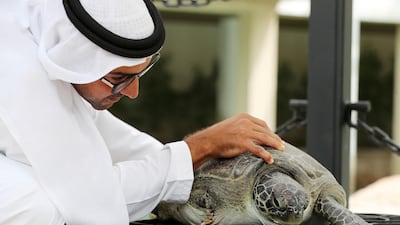
Sheikh Fahim bin Sultan Al Qasimi rescued the turtle 'Farah' in Sharjah and took it to the Burj Al Arab Turtle Rehabilitation Sanctuary for surgery. Chris Whiteoak / The National -
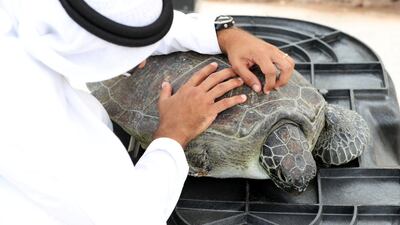
Sadly one flipper had to be amputated after Farah the turtle got tangled up in fishing wire. Staff at the Burj Al Arab Turtle Rehabilitation Sanctuary still hope she might be able to be released back into the wild, if she can still dive. Chris Whiteoak / The National -
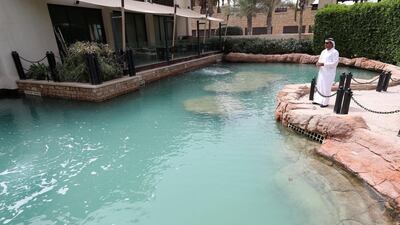
Sheikh Fahim bin Sultan Al Qasimi observes the Turtle Rehabilitation Lagoon at Jumeirah Al Naseem. This is the second stage of the Burj Al Arab Turtle Rehabilitation project. Chris Whiteoak / The National -
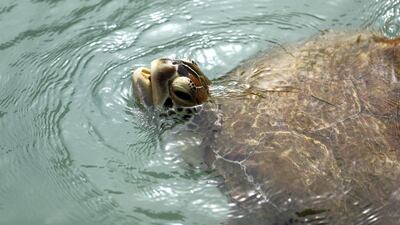
One of the rescued turtles in the Turtle Rehabilitation Lagoon at Jumeirah Al Naseem. This is the second stage of the Burj Al Arab Turtle Rehabilitation project. Chris Whiteoak / The National -
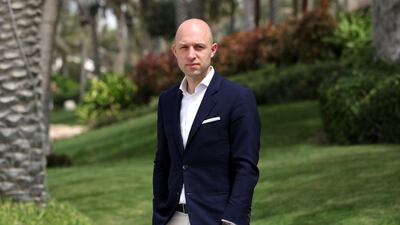
Tristan Delmas, hotel manager at the Burj Al Arab said they have rescued 2,000 turtles since the project started in 2004. Chris Whiteoak / The National -
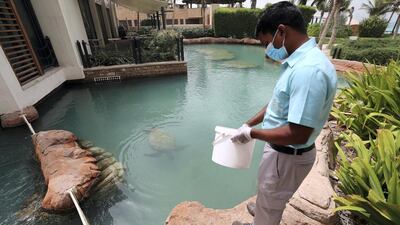
Feeding time at the Turtle Rehabilitation Lagoon at Jumeirah Al Naseem. This is the second stage of the Burj Al Arab Turtle Rehabilitation project. Chris Whiteoak / The National -
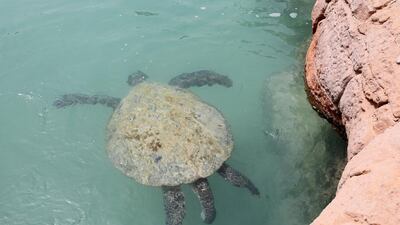
This rescued turtle is over 100 years old. It is currently resident at the Turtle Rehabilitation Lagoon at Jumeirah Al Naseem, but staff hope to release it back into the wild in the summer. Chris Whiteoak / The National -
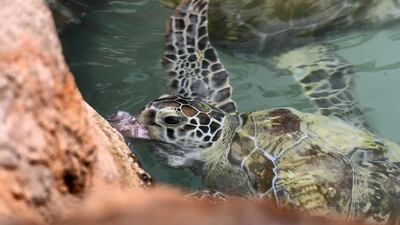
The rescued turtles in the Turtle Rehabilitation Lagoon at Jumeirah Al Naseem are fed squid. Chris Whiteoak / The National -
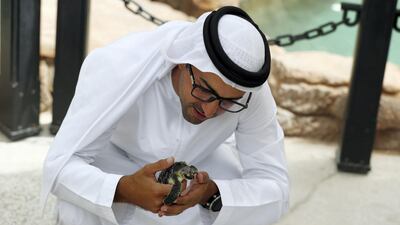
Sheikh Fahim bin Sultan Al Qasimi examines the smaller turtles, who have had barnacles removed from their shells by the team at the Burj Al Arab Turtle Rehabilitation Sanctuary. Chris Whiteoak / The National -
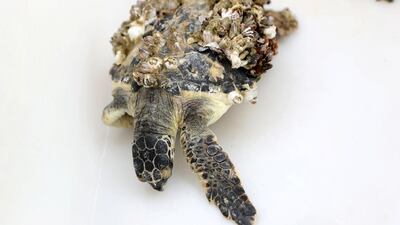
Barnacles slow turtles down, and make it harder to feed. This turtle is halfway through its treatment at the Burj Al Arab Turtle Rehabilitation Sanctuary. Chris Whiteoak / The National -
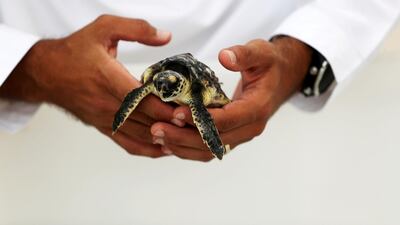
This turtle will be able to be released from the Burj Al Arab Turtle Rehabilitation Sanctuary in the summer, once it is stronger. Chris Whiteoak / The National


Hind Al Ameri leads the Turtle Conservation Programme at the Environment Agency - Abu Dhabi, and is studying the impact of climate change on hawksbill turtles in the emirate for her PhD.
"Vessel strikes unfortunately rank second when it comes to threats to our turtles, after being entangled in abandoned fishing lines, so it's a pretty major reason why we are finding mortality cases," she said.
"The injury like the one in the photo is definitely a vessel strike. They are usually in the middle of a turtle and very sharp, and they come from either a jet-ski or a propeller head from a boat, or maybe the bow of the boat."
All over the world, surface-breathing sea creatures such as dolphins and manatees are also injured or killed by speeding boats and jet-skis when they come up for air.
The solution to saving these sea creatures is simple, Ms Al Ameri said.
"What we're trying to do as much as we can is to ask people to really reduce speeds in the areas where they could hit marine wildlife, for example, in seagrass areas or coral reef areas," she added.

"We try as much as we can to get the message out, but really the decision has to stem from the person who has the boat, or is driving the jet-ski.
"A lot of individuals seem interested and say they care for the environment, but when it comes to actually acting, not much is being done."
The Ministry of Climate Change and Environment has passed several laws to set up and expand protected areas in the UAE, to breed and reintroduce endangered species into their natural habitats.
A three-year National Plan of Action for the Conservation of Marine Turtles that was launched in 2019 aims to expedite local laws to protect turtles and reduce the direct and indirect causes of their deaths.
In some of the UAE's National Parks, motorised vessels are already banned, and the areas are tightly monitored.
Mr Juignet, who has lived in the UAE for four years, hopes to see these zones extended to the Dubai coastline between the Burj Al Arab and Daria Island where the Bulgari Hotel and Resort is located.
"We are on the water almost every day surfing, sailing, kiting, paddling and it is a joy to see the wildlife, rays, fishes, dolphins, turtles and birds," he said.
"Power boats and jet-skis are clearly a threat - motoring around they are dangerous not only for the wildlife but for humans as well.
"I hope that one day this area will become a marine sanctuary."

