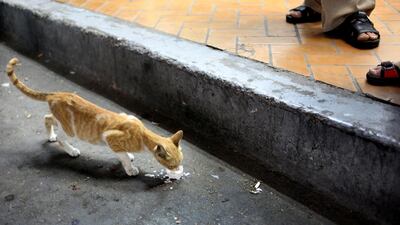

An animal welfare campaigner in Dubai said the introduction of a city-wide feeding station programme could help control the city's population of stray cats.
Manal Al Mansoori, from Yanni Animal Welfare group, said stations would let residents feed strays without breaking municipality rules.
Currently, the feeding of birds and stray animals such as cats and dogs is prohibited in the emirate of Dubai.
However, Dubai Municipality runs a trap, neuter and release programme to control the feral population.
As a licensed rescue group, Yanni is one of few organisations in Dubai that has been granted permission by the emirate's Community Development Authority to feed the animals.
Its feeding team and registered members leave food and water for about 4,000 cats each day.
"We have been communicating with Dubai Municipality for collaboration on the feeding station programme and the trap, neuter and release programme," Ms Al Mansoori told The National.
"The discussion is going on, and we do not give suggestions, we carry out surveys and research, provide evidence through case studies and propose action plans to serve the interests of the animals."
A spokesman from the veterinary services section at Dubai Municipality told The National that a trap, neuter, release programme has been running for several years across the emirate.
It involves three main components: catching cats on the street, surgery to sterilise them, and returning them to their habitat.

"The stray cats are trapped by veterinary control unit staff in the most humane way using special cages," he said.
"The cats are transported immediately for the procedure, keeping the period of captivity as short as possible in vehicles custom-made for this purpose.
"Ear tipping is also carried out to help recognise which cats in a colony have been sterilised."
Dubai residents told not to feed strays
Residents in the city were angered in September when notices telling them not to feed stray animals went out.
“The leftover food attracts pests such as rodents and crawling/flying insects, counteracting the various pest control efforts carried out,” the notice said.
Ms Al Mansoori, who is Emirati, said residents play a key role in ensuring the welfare of stray animals, especially cats.
“Instead of complaining about the presence of cats, they should request the municipality to spay them,” she said.
“Simply removing cats from the streets will never work, and other cats will always show up again because of breeding.”
Join a registered feeding programme
While there are many animal advocates across the city who spend time and money to feed and care for stray cats, many did so without permits. “Residents can place food inside the grounds of their property or in front of the gate,” Ms Al Mansoori said.
“If they intend to branch out into the wider community ... they need several permissions.
“First, from the property management company and, secondly, it is advised they join a licensed and supervised programme to avoid any hassle.”
Ms Al Mansoori, who has been supporting the welfare of animals for many years, said trained volunteers from Yanni regularly go out and feed animals.
“Any property can be part of our programme. They just need to contact us,” she said.
“Feeding in a clean and discreet manner should always be done, along with spaying and vaccination.
“We have helped many cases to mediate between the animal feeder and the property management or municipality.
“But if the feeder is not cooperative and breaks rules then the results will be sad for the animals.”
Strict rules for pet abandonment
For years, the UAE has faced a problem with stray animals.
In 2018, the Ministry of Climate Change and Environment made pet abandonment a punishable offence.
Under the legal amendments, which target animal cruelty, people who dump pets face legal consequences, including fines or a jail sentence.
A similar trap, neuter and release scheme operates in Abu Dhabi but the issues persist across the country.

Samantha Vince, manager of a pet nursery in Dubai, said there was widespread concern about the recent municipality rules on the feeding of strays in Dubai.
"Fines associated with this have caused uproar within our communities, affecting animal lovers and rescuers alike," she said.
“There is no doubt that Dubai has seen a rise in the number of stray dogs and cats over the past few years.
“This has, in turn, resulted in an increased number of complaints from residents, which has prompted further action from the authorities.”
She said simply prohibiting the feeding of strays did not get to the root of the problem.
Instead, education is one of the key points to be addressed.
“There are a lot of individuals and groups who have single-handedly maintained healthy [trap, neuter and release] stray colonies within Dubai using their own finances.
“To impose fines on these people for humanely sustaining cat colonies within our communities seems rather counterproductive.
“We need to turn the current stray population into a healthy and sustainable one on a larger scale.”
______________
A look at Abu Dhabi's trap, neuter and release programme
-
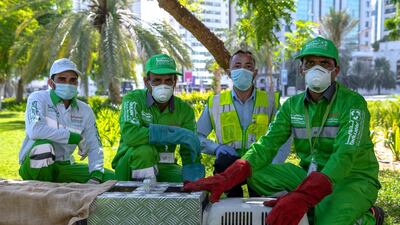
Tadweer workers set about capturing stray cats and dogs at Family Park in central Abu Dhabi. All photos by Victor Besa / The National -
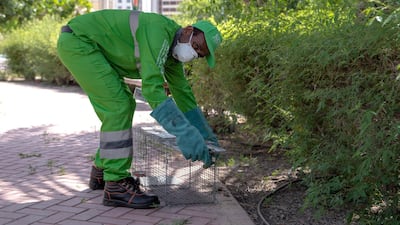
The process is all done by hand and requires patience and skill -
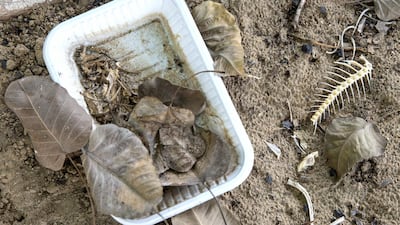
The public are urged not to leave out food for strays as it can quickly spoil in the heat and make animals sick -
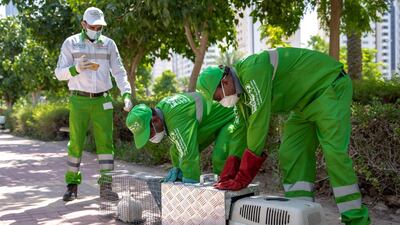
Cats and dogs are caught every day. A trap, neuter and release drive for cats has led to a fall in the number of strays found every day from about 70 to 15 to 30, officials said -
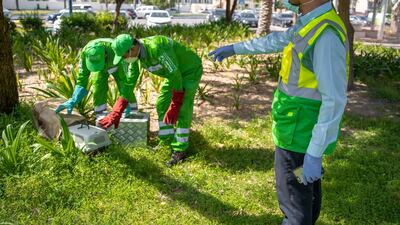
Family Park attracts many strays due to its location in central Abu Dhabi -

Mohamed Al Naqbi, head of pest control projects at Tadweer, said the process was important for public health -

Strays that are caught are taken to Falcon Hospital, where vets and medics have the expertise to treat all kinds of creatures -
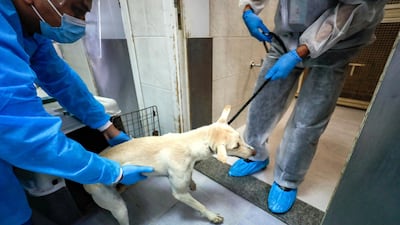
Strays are spayed or neutered to prevent breeding and brought back to good health. -
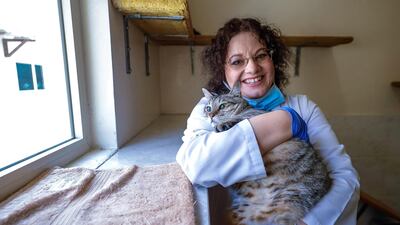
Director Dr Margit Muller said: 'When they come they are so sick, then after a few weeks you get a beautiful animal. Every animal deserves the chance for a happy life' -
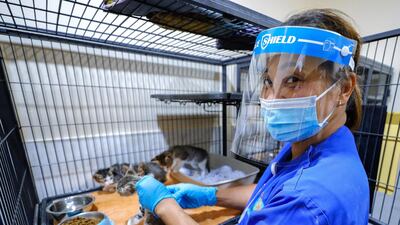
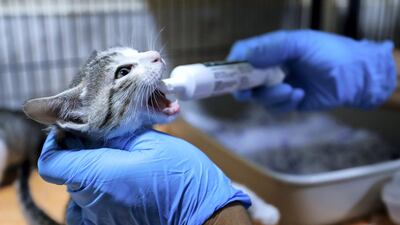
Veterinarian Ronalee Toribio gently injects a deworming solution to kittens at Falcon Hospital -
Animals are carefully nursed back to health -
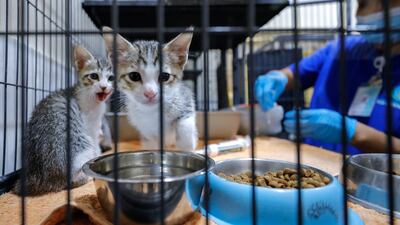
Kittens are given their daily supplements at the Falcon Hospital near Abu Dhabi International Airport -
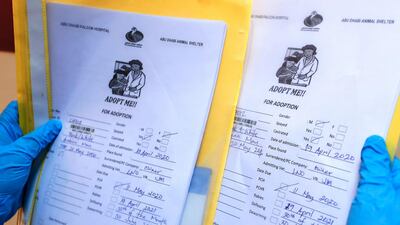
Adoption papers for some of the animals at the clinic -
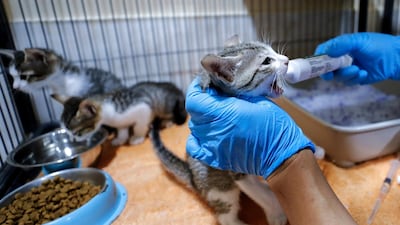
Abu Dhabi, United Arab Emirates, June 22, 2020. Veterinarian Ronalee Toribio, a gently orally injects deworming solution to kittens at the Abu Dhabi Falcon Hospital. Victor Besa / The National Section: NA Reporter: Haneen Dajani -
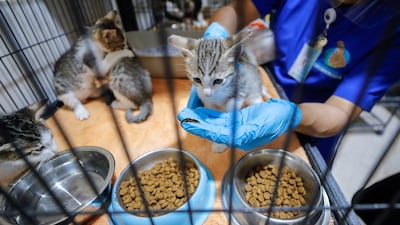
Staff have seen a rise in adoption interest due the virus outbreak, as more residents spend time at home -
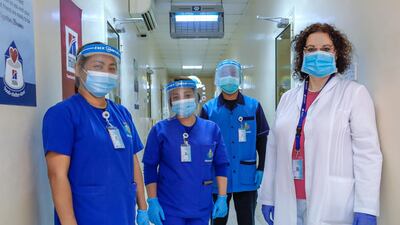
Dr Muller and her team said they love the work they do with animals -
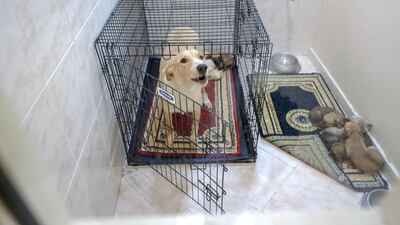
The Dog Maternity unit at the Abu Dhabi Falcon Hospital -

Head veterinarian and supervisor of the Pet Care Centre, Gelah Magtuba (left) with co-veterinarian, Ronalee Toribio -
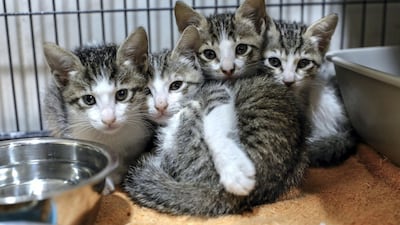
Kittens ready for adoption -

A cat with her week old kittens -
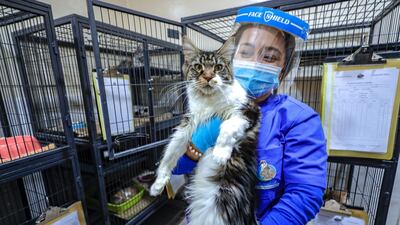
Head vet Gelah Magtuba with her favourite cat, Connie



