



As the mercury rises each summer, the obvious response is to turn the air conditioning to full blast to ensure that, indoors at least, things remain comfortable.
But, as has long been known in the UAE and the wider region, there are ways other than air con, such as employing wind towers and shading, to maintain a pleasant environment during the hottest parts of the year.
Research has shown that some older-style neighbourhoods, such as Al Fahidi in Dubai, which has a higher density of buildings, tend to keep peak temperatures down better than more modern low-rise neighbourhoods, such as Jumeirah in Dubai.
Air temperatures in the country’s more traditional residential neighbourhoods can be 1°C to 2°C lower than those in more modern areas, researchers from Ajman University found.
“The results reveal that the highest density traditional urban form achieved the best thermal comfort values due to the street geometries and less exposure to solar radiation compared with the other configurations,” the researchers wrote.
There is recognition among some architects and others in the building sector that it is important to find ways to keep buildings cool without using energy, not least because air conditioners are consuming increasing amounts of energy.
Between 1990 and 2016, the quantity of energy used to cool internal spaces in the Middle East increased five-fold, from 25 to 125 terawatt hours of electricity, World Bank figures indicate.
As climate change causes temperatures to rise, and as countries become more affluent, the number of air conditioners globally is forecast to triple to five billion by the middle of this century.
The study looked at six neighbourhoods in the UAE, three of which were described as being of more traditional design.
These were Al Marija in Sharjah, a low-density neighbourhood, Sidroh in Ras Al Khaimah, a low-medium density area, and Dubai’s Al Fahidi.
For comparison, three more modern areas in Dubai were assessed, namely Al Mamzar, a low-density neighbourhood, Jumeirah, a low-medium density neighbourhood, and Al Safa I, which has a high density of buildings.

Complex computer simulations found that two metrics were particularly important in determining how much an area was affected by the urban heat island (UHI) effect, which is the way that urban areas tend to have elevated temperatures.
One is the sky view factor (SVF), the amount of sky visible from the ground, while the other is the development’s height-to-width (H/W) ratio.
Every year in August, the more old-fashioned or traditional urban developments with high H/W ratios and low SVFs had the coolest average daily and peak hours temperatures.
“The traditional urban forms recorded 1°C to 2°C less than the modern forms in the daytime peak hours,” the researchers wrote.
Conversely, the highest daily air temperatures were recorded in modern urban configurations with low H/W ratios and high SVFs.
Al Fahidi had the lowest air temperature of all during the day, achieving what was described as “the optimum human thermal comfort”.
“Compact urban morphologies cut down on both the amount of solar radiation that reaches the ground surface as well as the duration that people are exposed to the sun,” the researchers said.
Higher buildings can, the research indicated, help to keep external pathways shaded and so more comfortable. In what are described as “deep canyons”, as little as 8 per cent of the street width may be exposed to solar radiation, while in “shallow canyons” the figure is can be 85 per cent.
Although cooler during the peak hours, traditional neighbourhoods tended to be slightly warmer during the early morning and the late evening.
The Jumeirah neighbourhood in Dubai, a modern area of detached villas of “low-medium density” with low H/W and high SVF, had the highest peak daytime temperatures.
A version of this story was first published in August, 2022
Middle East temperatures set to keep rising: in pictures
-

Temperatures in the Middle East are set to keep rising by almost 0.5°C per decade, with extreme weather events, such as droughts, becoming more common. AFP -
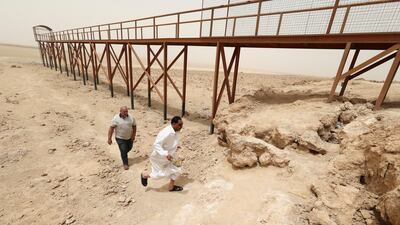
Iraqis visit an area near what used to be Lake Sawa, which has all but dried up due to climate change-induced drought, in Samawa city. Reuters -
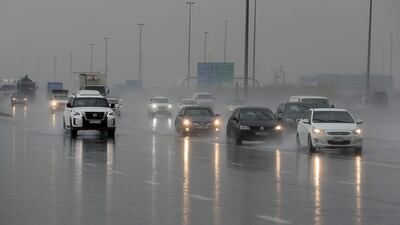
Extreme weather events – including torrential rain – will become more common. Pawan Singh / The National -
Researchers predict an increase in severity and duration of extreme weather, such as dust storms. More torrential rain and subsequent flash floods are also expected. EPA -
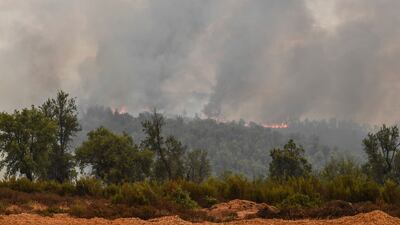
Trees burn during a forest blaze caused by extreme temperatures in Larache, northern Morocco. AP -
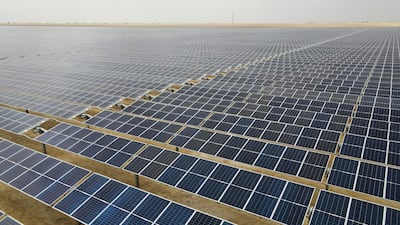
Climate-change experts say countries need to reduce carbon emissions by deploying more solar power, a sector in which the UAE has invested heavily. Pawan Singh / The National -
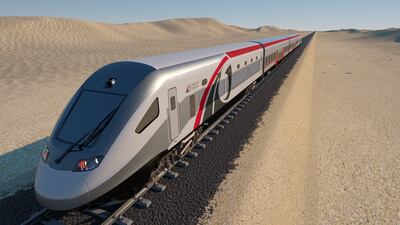
Developing public transport via trains across the Middle East should also be a high priority, researchers said. Photo: Etihad Rail



