• The Red Sea Project will span mountains, islands, wadis and desert.
    The Red Sea Project will span mountains, islands, wadis and desert.
  • The first hotel to be announced for the Red Sea Project in western Saudi Arabia is an eco-friendly mountain retreat. Guests can choose a room at the bottom of the mountain, mid-way up or carved into the massif. All photos: RSDC
    The first hotel to be announced for the Red Sea Project in western Saudi Arabia is an eco-friendly mountain retreat. Guests can choose a room at the bottom of the mountain, mid-way up or carved into the massif. All photos: RSDC
  • Guests at Desert Rock will look out over an uninterrupted wadi-strewn landscape.
    Guests at Desert Rock will look out over an uninterrupted wadi-strewn landscape.
  • The resort has sustainability as its ethos, with stone from the mountain being used to construct interior and exterior walls.
    The resort has sustainability as its ethos, with stone from the mountain being used to construct interior and exterior walls.
  • Access roads are carefully planned to ensure they do not disrupt the landscape. Light pollution will be minimised.
    Access roads are carefully planned to ensure they do not disrupt the landscape. Light pollution will be minimised.
  • All rooms at Desert Rock offers endless wadi views of Saudi Arabia's Red Sea Project landscape.
    All rooms at Desert Rock offers endless wadi views of Saudi Arabia's Red Sea Project landscape.
  • Desert Rock will be home to 48 villas and 12 hotel rooms in western Saudi Arabia.
    Desert Rock will be home to 48 villas and 12 hotel rooms in western Saudi Arabia.
  • Desert Rock is being designed by Oppenheim Architecture. It will reuse excavated stone to create the resort.
    Desert Rock is being designed by Oppenheim Architecture. It will reuse excavated stone to create the resort.
  • Desert Rock is a unique inland experience set to open at the Red Sea Project.
    Desert Rock is a unique inland experience set to open at the Red Sea Project.
  • The first hotel to be announced at Saudi Arabia's Red Sea Project is an eco-friendly mountain resort built into the mountains.
    The first hotel to be announced at Saudi Arabia's Red Sea Project is an eco-friendly mountain resort built into the mountains.
  • The Red Sea Development Project will have its own international airport.
    The Red Sea Development Project will have its own international airport.
  • Overwater villas will be another accommodation option at the project on the west coast of Saudi Arabia.
    Overwater villas will be another accommodation option at the project on the west coast of Saudi Arabia.
  • Mountain canyons at the Red Sea Project.
    Mountain canyons at the Red Sea Project.
  • The Red Sea Project will turn untouched coastlines, mountains and deserts into one of Saudi Arabia's biggest tourism projects.
    The Red Sea Project will turn untouched coastlines, mountains and deserts into one of Saudi Arabia's biggest tourism projects.

Saudi Arabia's Red Sea Project is a blueprint for going beyond sustainability


Kelly Clarke
  • English
  • Arabic

From an isolated coastal expanse to a global tourism centre, Saudi Arabia’s Red Sea Project is paving the way as the blueprint for regenerative urbanism, which is more than just being sustainable.

The multibillion-dollar project, currently under construction on more than 90 islands off the kingdom’s west coast, has already created 2,000 jobs and has an end goal to employ 30,000 people when fully operational.

Dr Maryam Ficociello, chief governance officer for the Red Sea Development Company, said with three resorts scheduled to open to the public by the end of next year, that "depleting the natural environment" should never be an option when building future mega destinations.

We found that during that lengthy exercise there were lots of islands that were natural homes for turtles, so we had to build away from those identified areas
Dr Maryam Ficociello,
Red Sea Development Company

“Regenerative urbanism is about creating a balance where buildings, their occupants and the surrounding systems, whether natural or man-made, work together,” she said during a panel discussion on urbanisation at the Saudi Pavilion at Expo 2020 Dubai.

“Our project spans an area of 32,000 square kilometres, it’s not small, but we have made the decision to only develop 1 per cent of that land and leave the majority of it untouched.

“We’ve been working on ensuring that we develop a tourism destination that is not just sustainable, but even more than that, [it's] regenerative.”

Replanting coral reefs

As early as 2016, Ms Ficociello said the team carried out social and environmental impact assessments to ensure that construction and development did not hurt the natural environment.

The core of the project was to build around nature and with nature, she said.

“We found that during that lengthy exercise there were lots of islands that were natural homes for turtles.”

Desert Rock is being designed by Oppenheim Architecture who will reuse excavated stone to create the resort. Photo: RSDC

“Turtles do not change their homes. They continue to come back to where they were born for years and years, so we had to build away from those identified areas.

“We also found there were lots of islands that were home to migratory birds, so we made sure we master planned in areas that did not hurt the environment.”

With a vision to reach 30 per cent net positive conservation by 2040, Ms Ficociello said they have had to move and replant coral as part of the project.

To make way for a small amount of infrastructure, the developer had to uproot small areas of live coral reef and move it to an area where there would be less disruption.

“We have been moving it in a way that it doesn’t die, but we’re rebuilding and planting more as a result,” she said.

“That’s what we mean by regenerative tourism. We’re essentially regenerating the environment.”

Local workforce with hospitality skills

Giga Projects: Amaala is a planned tourist destination on Saudi Arabia's north-west Red Sea coast.

Citing the goals of Vision 2030, Ms Ficociello said efforts to achieve social sustainability were heavily imbedded in the project.

So far, as part of the Red Sea Project, 2,000 jobs have been created, including employees from villages and towns near to the development site.

The team has also worked with local farmers to provide fresh produce for the resorts such as figs, cucumbers and tomatoes.

“We need 30,000 employees to staff all the resorts so we are also working with universities to create technical and vocational programmes and courses in hospitality and management,” she said.

“We have had some students graduate already, but we want to add two, even three zeros to that number.

“In terms of employment statistics, we have so far reached 50 per cent Saudisation and 22 per cent of the total workforce at present is female. We want to work on that number to increase it.”

Saudisation, officially known as the Saudi nationalisation scheme, is a policy implemented by the kingdom’s government whereby Saudi companies and enterprises are required to fill their workforce with Saudi citizens to certain levels.

The Red Sea Project is part of a huge undertaking to build Saudi Arabia’s tourism industry and reduce its reliance on oil and diversify the economy.

It plans to attract tourists to kilometres of pristine beaches, heritage sites and luxury resorts.

The destination will offer a range of experiences, from island getaways to resort holidays, mountain retreats and desert adventures.

Once fully operational, the site aims to run on 100 per cent renewable energy and, being at the crossroads of Europe, Asia and Africa, can be reached within just four hours flying time by 250 million people.

In pictures - Saudi Arabia Pavilion at Expo 2020 Dubai

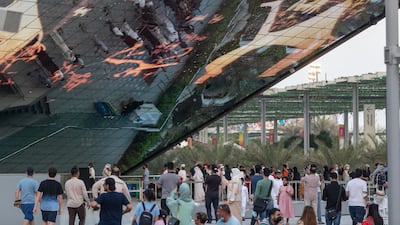
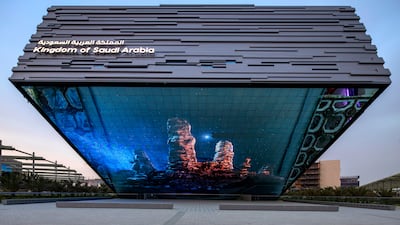
  • Saudi Arabia's pavilion at Expo 2020 Dubai. Photo: Saudi Arabia Expo 2020 Dubai
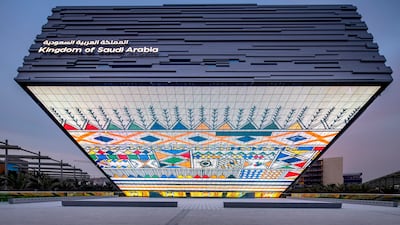
    Saudi Arabia's pavilion at Expo 2020 Dubai. Photo: Saudi Arabia Expo 2020 Dubai
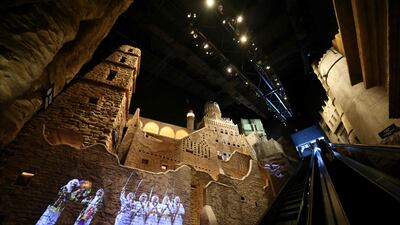
  • Saudi Arabia pavilion at Expo 2020 Dubai. Photo: Saudi Arabia Expo 2020 Dubai
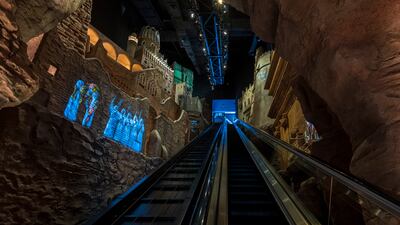
    Saudi Arabia pavilion at Expo 2020 Dubai. Photo: Saudi Arabia Expo 2020 Dubai
  • Saudi Arabia pavilion at Expo 2020 Dubai. Photo: Saudi Arabia Expo 2020 Dubai
    Saudi Arabia pavilion at Expo 2020 Dubai. Photo: Saudi Arabia Expo 2020 Dubai
  • A Guinness World Record was awarded for the longest interactive water feature at the Saudi Arabia Expo pavilion. Khushnum Bhandari / The National
    A Guinness World Record was awarded for the longest interactive water feature at the Saudi Arabia Expo pavilion. Khushnum Bhandari / The National
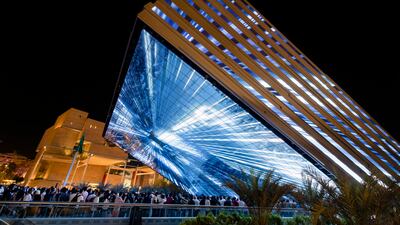
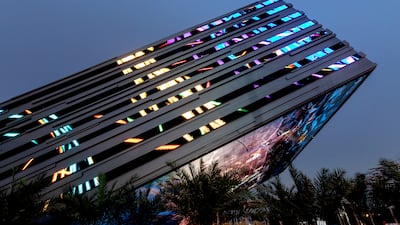
  • The Saudi pavilion lit up at night. Dubai. Chris Whiteoak / The National
    The Saudi pavilion lit up at night. Dubai. Chris Whiteoak / The National
  • Saudi performers in front of country's pavilion. Photo: Expo 2020 Dubai
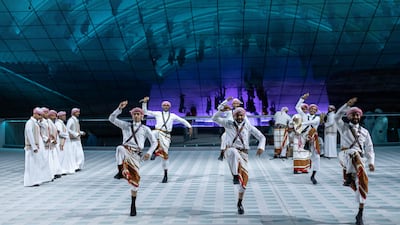
    Saudi performers in front of country's pavilion. Photo: Expo 2020 Dubai
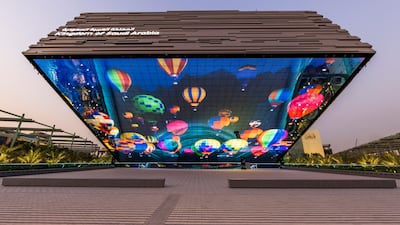
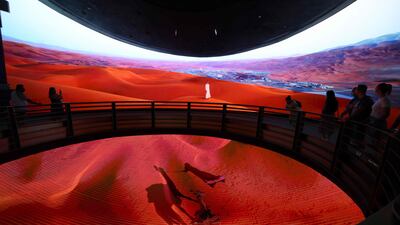
  • An LED mirror screen display at the Saudi Arabia pavilion. Khushnum Bhandari / The National
    An LED mirror screen display at the Saudi Arabia pavilion. Khushnum Bhandari / The National
  • Crowds visit the Saudi Arabia pavilion as the sun sets. Antonie Robertson / The National
    Crowds visit the Saudi Arabia pavilion as the sun sets. Antonie Robertson / The National
  • Visitors at the Saudi pavilion. Photo: Expo 2020 Dubai
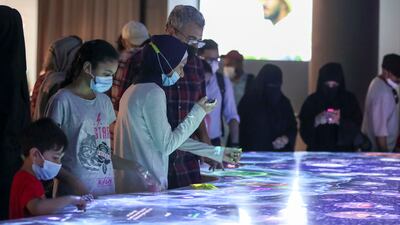
    Visitors at the Saudi pavilion. Photo: Expo 2020 Dubai
  • Visitors tour the Saudi pavilion. AFP
    Visitors tour the Saudi pavilion. AFP
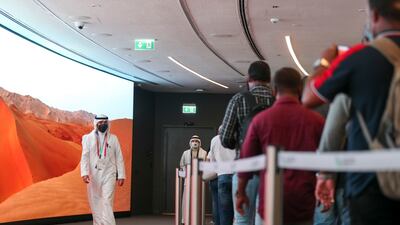
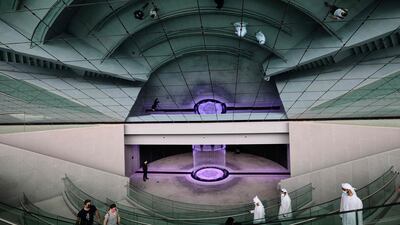
  • Visitors line up inside the Saudi Arabia pavilion at Expo 2020 Dubai. Khushnum Bhandari / The National
    Visitors line up inside the Saudi Arabia pavilion at Expo 2020 Dubai. Khushnum Bhandari / The National
  • Saudi Arabia pavilion at Expo 2020 Dubai. Photo: Saudi Arabia Expo 2020 Dubai
    Saudi Arabia pavilion at Expo 2020 Dubai. Photo: Saudi Arabia Expo 2020 Dubai
  • Saudi Arabia pavilion at Expo 2020 Dubai. Photo: Saudi Arabia Expo 2020 Dubai
    Saudi Arabia pavilion at Expo 2020 Dubai. Photo: Saudi Arabia Expo 2020 Dubai
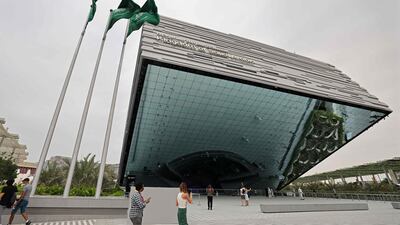
  • Exterior of the Saudi Arabia pavilion. Photo: Expo 2020 Dubai
    Exterior of the Saudi Arabia pavilion. Photo: Expo 2020 Dubai
  • Visitors tour the Saudi Arabia pavilion. AFP
    Visitors tour the Saudi Arabia pavilion. AFP
  • Visitors tour the Saudi Arabia pavilion. AFP
    Visitors tour the Saudi Arabia pavilion. AFP
  • Visitors tour the Saudi Arabia pavilion. AFP
    Visitors tour the Saudi Arabia pavilion. AFP
  • Visitors look at the Saudi Arabia pavilion. AFP
    Visitors look at the Saudi Arabia pavilion. AFP
Ten tax points to be aware of in 2026

1. Domestic VAT refund amendments: request your refund within five years

If a business does not apply for the refund on time, they lose their credit.

2. E-invoicing in the UAE

Businesses should continue preparing for the implementation of e-invoicing in the UAE, with 2026 a preparation and transition period ahead of phased mandatory adoption. 

3. More tax audits

Tax authorities are increasingly using data already available across multiple filings to identify audit risks. 

4. More beneficial VAT and excise tax penalty regime

Tax disputes are expected to become more frequent and more structured, with clearer administrative objection and appeal processes. The UAE has adopted a new penalty regime for VAT and excise disputes, which now mirrors the penalty regime for corporate tax.

5. Greater emphasis on statutory audit

There is a greater need for the accuracy of financial statements. The International Financial Reporting Standards standards need to be strictly adhered to and, as a result, the quality of the audits will need to increase.

6. Further transfer pricing enforcement

Transfer pricing enforcement, which refers to the practice of establishing prices for internal transactions between related entities, is expected to broaden in scope. The UAE will shortly open the possibility to negotiate advance pricing agreements, or essentially rulings for transfer pricing purposes. 

7. Limited time periods for audits

Recent amendments also introduce a default five-year limitation period for tax audits and assessments, subject to specific statutory exceptions. While the standard audit and assessment period is five years, this may be extended to up to 15 years in cases involving fraud or tax evasion. 

8. Pillar 2 implementation 

Many multinational groups will begin to feel the practical effect of the Domestic Minimum Top-Up Tax (DMTT), the UAE's implementation of the OECD’s global minimum tax under Pillar 2. While the rules apply for financial years starting on or after January 1, 2025, it is 2026 that marks the transition to an operational phase.

9. Reduced compliance obligations for imported goods and services

Businesses that apply the reverse-charge mechanism for VAT purposes in the UAE may benefit from reduced compliance obligations. 

10. Substance and CbC reporting focus

Tax authorities are expected to continue strengthening the enforcement of economic substance and Country-by-Country (CbC) reporting frameworks. In the UAE, these regimes are increasingly being used as risk-assessment tools, providing tax authorities with a comprehensive view of multinational groups’ global footprints and enabling them to assess whether profits are aligned with real economic activity. 

Contributed by Thomas Vanhee and Hend Rashwan, Aurifer

Name: Peter Dicce

Title: Assistant dean of students and director of athletics

Favourite sport: soccer

Favourite team: Bayern Munich

Favourite player: Franz Beckenbauer

Favourite activity in Abu Dhabi: scuba diving in the Northern Emirates 


Updated: November 03, 2021, 7:15 PM