



Read also: Climate change: ‘Code red for humanity’ as UN report warns of disaster
Earth’s average temperature will reach 1.5ºC above preindustrial levels at about 2030, a UN assessment has found.
The Intergovernmental Panel on Climate Change was published on Monday and said the tipping point would arrive a decade earlier than projected only three years ago.
Furthermore, the threshold will be breached by about 2050, no matter how aggressively humanity draws down carbon pollution.
Global warming is caused by gases such as carbon dioxide trapping solar radiation in the Earth’s atmosphere, making the climate warmer. This is commonly known as the greenhouse effect.
The IPCC report said the levels of carbon dioxide in the atmosphere are higher than they have been in two million years, and methane and nitrous oxide concentration is higher than any point in at least 800,000 years.
The National found out the five main culprits for this increase in greenhouse gases.
1. Fossil fuels
-

Around $3.5 trillion is required between now and 2050 to meet targets for a 'sustainable path', according to the International Energy Agency. AP Photo -
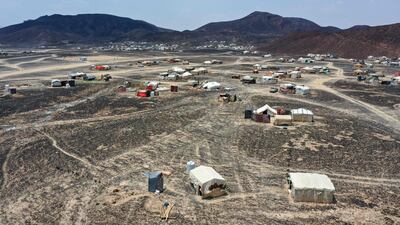
The makeshift Suweida camp for internally displaced people in Yemen’s Marib province. The effects of climate change have exacerbated the displacement of local populations during the country’s war. AFP -
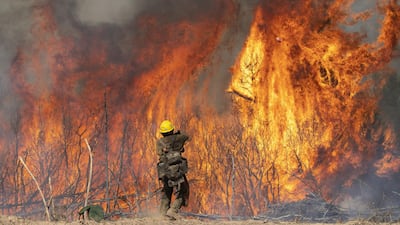
A firefighter monitors a controlled burn, near Jolon, California.Frequent wildfires are an indication of climate change further getting out of control, say environmentalists. Bloomberg -
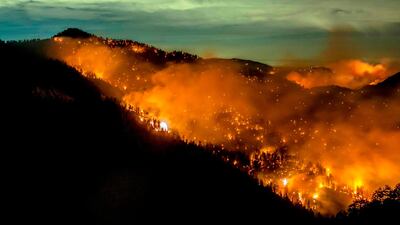
Wildfire burns through the Angeles National Forest in Los Angeles County, north of Azusa, California. AFP -
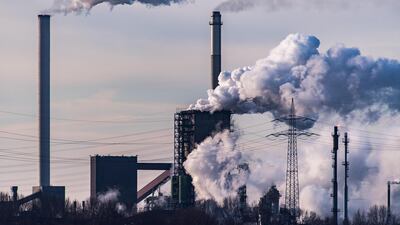
Steam rises from a steel mill in Duisburg, Germany. Some countries are using the coronavirus pandemic to wind back climate change commitments, say environmentalists. Getty Images -
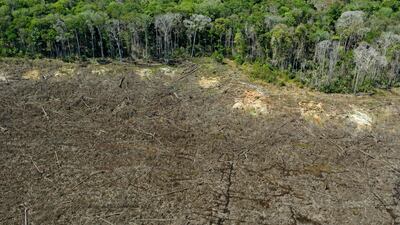
A deforested area close to Sinop, Mato Grosso State, Brazil. Deforestation in Brazil's Amazon rainforest rose by almost 22 percent from August 2020 to July 2021, compared with the same period the year before, reaching a 15-year high. AFP


Gases such as carbon dioxide and methane trap heat in the Earth’s atmosphere. They are mostly created by humans burning fossil fuels – coal, oil, wood and natural gas.
Climate change activists say humans must stop burning these energy sources, and countries and companies need to pledge zero-emission targets.
2. Deforestation
Since about 1960, forests, soil and oceans have steadily absorbed 56 per cent of all the carbon dioxide humanity has put into the atmosphere, despite the 50 per cent rise in emissions.
But trees are being cut down at an alarming rate, in particular in the Amazon rainforest.
It was traditionally viewed as the lungs of the planet, absorbing carbon dioxide and releasing oxygen. But figures released in June showed deforestation approached record levels last year.
A total of 8,712 square kilometres of forest cover – almost the size of Puerto Rico – was destroyed from August 2020 to July 2021, according to satellite data from Brazil’s space agency INPE.
The consequence is that not enough carbon dioxide is being soaked up from the Earth’s atmosphere.
3. Increasing livestock farming

A growing demand for meat has led to intensive agriculture of animals.
Cows and sheep produce large amounts of methane when they digest their food, and this gas adds to the greenhouse effect on the Earth.
Furthermore, animals need fields to graze on, and this leads to deforestation.
Climate change activists suggest humans should choose to eat less meat.
4. Fertilisers containing nitrogen
Intensive farming quickly exhausts the naturally occurring nutrients in the soil, farmers therefore use fertilisers to boost their agricultural output.
But fertilisers containing nitrogen produce nitrous oxide emissions, which increases the warming effect on the Earth’s atmosphere.
Other fertilisers, such as green manure and compost, blood meal, bone meal and seaweed extracts are available. Crop rotation can increase the nutrients in the soil naturally.
5. Fluorinated gases
These particularly damaging gases are emitted from equipment and products such as commercial and industrial refrigerators, air-conditioning systems and heat pumps.
They are also used as blowing agents for foams, fire extinguishers, solvents and aerosol propellants.
Such emissions have a very strong warming effect, up to 23,000 times greater than that of carbon dioxide.
There are options other than fluorinated gases. For instance, hydrocarbons and ammonia, used in refrigeration, are considered safe and energy-efficient.

