

In the hot and unforgiving desert climate of the UAE, a shrimp farm is thriving.
It is the country’s first and only commercial shrimp farm.
Launched in 2004, Al Jaraf Fisheries takes pride in harvesting millions of shrimp and contributing 20 to 30 per cent of the UAE’s shrimp requirement. The rest of the demand is met through imports.
“The reason for the farm’s success is its effective breeding programme,” said general manager Dr SD Gopakumar, as he gave The National a tour of the 100-hectare facility.
Al Jaraf Fisheries
Nestled in Bal Rumaid Island in Abu Dhabi, the farm is a five-minute boat ride from Reem Island. It has 58 ponds of different sizes including 36 one-hectare ponds and 17 half-hectare ponds. Each half-hectare pond has up to 300,000 shrimp and one-hectare pond has more than half a million shrimp.
While the ponds are out in the open, the hatchery section is indoors in a light and temperature-controlled environment.
“When we started the farm, we really struggled because of the harsh climate. But over the years, we have developed a system with different kinds of water quality management and feeding systems. Now we have a very good broodstock.
The mother shrimp can survive in these extreme climatic conditions,” said Dr Gopakumar, who masterminded the project.
-
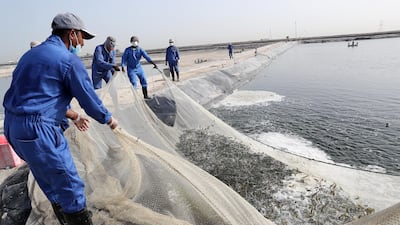
Spreading the net: staff catching the shrimps from the pond. Pawan Singh / The National -

View of the shrimp and fish farm behind Al Reem Island in Abu Dhabi. Pawan Singh / The National -

Staff showing shrimps caught from the pond at the fish farm. Pawan Singh / The National -

Dr Gopakumar, general manager of Al Jaraf Fisheries, UAE, checks shrimp eggs in the hatchery complex. Pawan Singh / The National -
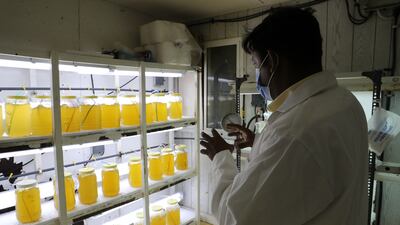
Dr Gopakumar examines algae stock. Pawan Singh / The National -

Five-day-old larvae will be transferred in the shrimp pond. Pawan Singh / The National -

Staff holding shrimps caught from the pond at the fish farm. Pawan Singh / The National -

The hatchery complex. Pawan Singh / The National -

View of the shrimp and fish farm. Pawan Singh / The National -
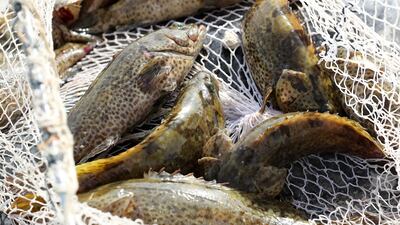
Hamoor fish. Pawan Singh / The National -
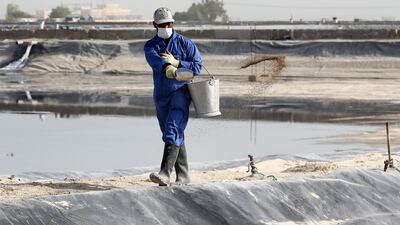
Feeding at the shrimp pond. Pawan Singh / The National -
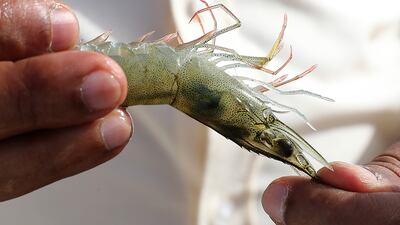
Dr Gopakumar examines one of the finer specimens. Pawan Singh / The National -
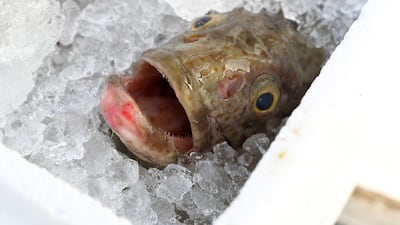
Hamoor fish in the ice box ready to deliver to the market for sale. Pawan Singh / The National -

The early morning journey begins as the shrimp are ferried to the market. Pawan Singh / The National -
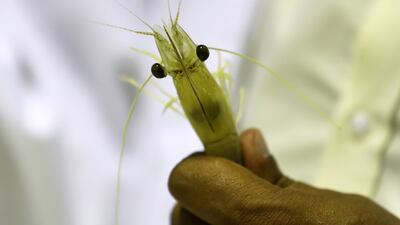
A close-up of a shrimp. Pawan Singh / The National -

An impressive haul of shrimps. Pawan Singh / The National


The farm has a capacity to produce 1.5 to 2 tonnes of shrimp a day. The focus is only on the Penaeus indicus species also called the Indian white shrimp, as they can tolerate the UAE’s hot summers as well as its colder winter temperatures. The farm also grows hammour, sea bream, seabass, barramundi and tilapia.
“We have our own hatchery. We maintain our own mother shrimp and its breeding process, starting from the egg to the post-larvae. Then the post-larvae is brought to the ponds. They shrimp are then reared up to the market size,” Dr Gopakumar said.
The hatchery complex is divided into various sections. The most valued shrimp on the island are the mother shrimp, also called broodstock. They are all grown on the island. This reduces the risk of introducing diseases from seafood brought in from the outside. These mother shrimp produce all other shrimp on the farm.
“The male shrimp has two eyeballs and the female has only one,” Dr Gopakumar explained as he held the mother shrimp in his hands.
“We ablate one of the eyes for induced maturation and spawning. The eye stalk of the shimp has some hormones which inhibit the breeding process. When we remove an eye, the breeding process is faster.”
The facility maintains specific pathogen-free (SPF) mother shrimp in the broodstock section which means they are free of disease-bearing microorganisms. “That is the key to our success. The company has been around for 17 years, and we haven’t seen any viral and bacterial diseases in our shrimp,” he added.
The farm uses state-of-the-art technology to boost its productivity, such as a recirculating aquaculture system (RAS). The benefit of the system is that only 5% of the water is drained away and the remainder is recirculated. Currently, the system is used to rear only fish, however it plans to open an RAS facility for shrimp as well. The fish survival rate in RAS is about 90%.
In the evening, mature female shrimp are collected from the broodstock section and kept in tanks so they can release eggs.
“This is yesterday night’s eggs and they will be hatching in an hour,” said Dr Gopakumar, holding up a jar. “We will then have the first stage of the larvae called the nauplii.”
The farm also maintains its own algae stock, which is used to feed the shrimp larvae. The larvae are reared in tanks for about 20 days, after which they are released in the ponds outside. The ponds have floating aerators to ensure sufficient oxygen supply in the water.
The shrimp are usually harvested in the early morning. Boats take live as well as packed shrimp to delivery vans. They are then supplied to all seven emirates, as well as supermarkets such as Lulu and Carrefour. One kilogram of the shrimp is priced at Dh22.
“The wild shrimp that are caught from the sea are not as fresh as the UAE’s homegrown ones,” said Dr Gopakumar as he boarded one of the boats back to Reem Island.
“They trawl for a week or two, then the shrimps are processed, and so the customer receives shrimp that are a few weeks old. But here at Al Jaraf Fisheries, when we get an order, we harvest and deliver within an hour or two. That is our speciality and the quality is excellent.”

