


Schools across the UAE are preparing to welcome back pupils to classrooms in the next academic year.
Government-run schools will open for face-to-face lessons on August 29, officials announced on Monday.
Public schools had operated remotely throughout the 2020-2021 academic year, including sitting June exams online, as part of Covid-19 health measures.
School leaders believe the success of the inoculation drives will reassure parents that children can go back to school safely – allowing them to benefit from important interactions with teachers and fellow learners.
Here, The National takes a look at what plans are in place for the new school year across the Emirates.
Abu Dhabi
Abu Dhabi authorities approved the return of pupils to in-person classes at schools after the summer.
More than 80 per cent of private school teachers and other staff – including maintenance and security teams – have been vaccinated.
Full-time remote learning will be an option to parents who request it, if offered by their child’s school.
Schools in Abu Dhabi were open for in-person learning in the final weeks of the most recent academic year, though institutions had to close in the event of Covid-19 cases.
-
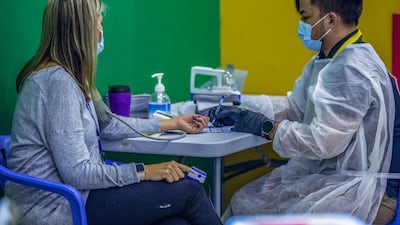
Teachers and school workers in Abu Dhabi are checked over before they receive the Covid-19 vaccine. Courtesy: Adek -
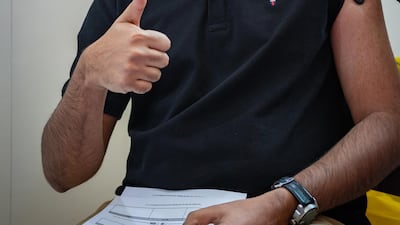
A teacher gives a thumbs up as he receives the Sinopharm shot in Abu Dhabi. Courtesy: Adek -
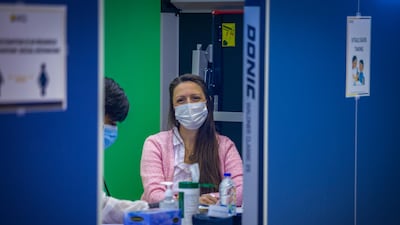
About 60 per cent of the emirate's school staff have been vaccinated to date, including many during this week-long drive. Courtesy: Adek -
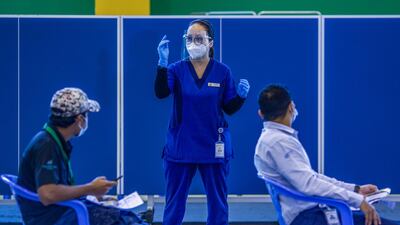
An Abu Dhabi school worker prepares to receive the Covid-19 vaccine. Courtesy: Adek


Most pupils in the capital headed back to classrooms in February after a prolonged period of distance learning.
Dubai
Private schools in Dubai have been open for face-to-face classes since August 2020.
It is widely expected that in-person classes will continue in the next academic year, though education authorities are yet to announce their plans.
More than 286,000 pupils study at Dubai’s private schools.
According to a recent report by the Knowledge and Human Development Authority, which regulates private education in Dubai, 50 per cent of pupils in the emirate were studying online, while the other half chose a combination of distance learning and face-to-face classes.
Authorities have not confirmed if distance learning arrangements will continue next academic year.
Sharjah
Sharjah authorities have not confirmed if private schools will resume in-person education in August.
Private schools were able to provide in-school teaching from April, with an option for distance learning remaining.
Sharjah schools expect to provide in-person classes, together with an option for parents who want online learning.
It is likely more pupils will be able to return to classes with in-person learning expanded.
Some schools may be able to follow Covid-19 prevention protocols and still get all pupils back on campus.
Manju Reji, principal at India International School, said she was awaiting an update from authorities on whether it would have the option to welcome back all of its pupils.
At present, the school follows the emirate's hybrid model.
Of 5,600 pupils enrolled in the school, 1,000 are back for face-to-face classes.
-
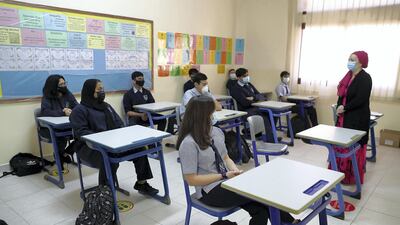
Diana Parva, a French teacher, talks to the class of grade 11 at Victoria English School in Sharjah. Pawan Singh / The National -
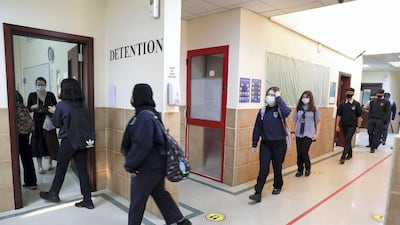
Pupils of grade 11 go to their class on the first day of the school reopening in 2020. Pawan Singh / The National -
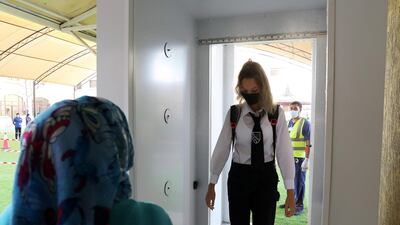
Pupils pass through the disinfection tunnel at the Victoria English School in Sharjah last year. Pawan Singh / The National -
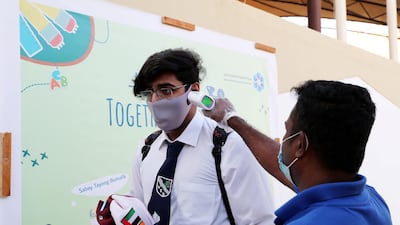
A staff member checks the temperature of a pupil at the entrance gate at the Victoria English School in Sharjah in 2020. Pawan Singh / The National -
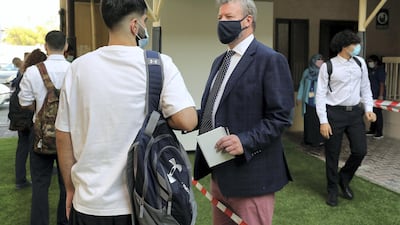
School principal Keith Sykes (R) talks to pupils at Victoria English School in Sharjah on the first day of school in 2020. Pawan Singh / The National -

Pupils stand in a socially distanced queue at the Victoria English School in Sharjah. Pawan Singh / The National


Ms Reji said that if more pupils could be brought back on campus, the school may choose to have two shifts every day or in-person lessons on alternate days to accommodate more children.
Northern Emirates
Schools expect to continue in-person education, although they are awaiting a final directive from the authorities.
Graham Beale, executive principal of RAK Academy in Ras Al Khaimah is looking forward to having pupils back in school.
"RAK Academy plans to provide full-time, in-person learning from the start of next academic year," said Mr Beale.
"Our model will focus on maximising in-class learning opportunities for our students across all of our five schools, through both our IB and British curriculum offerings and for all age groups from Pre-K to Grade 12.
"We are currently waiting on final directives from the authorities on this matter."
Mr Beale said the school had worked to maximise in-school learning for pupils, while offering a full-time distance learning option for pupils whose families may be at high risk.

"The current information we have from the authorities is that it is highly likely that we will be able to offer full-time in-class learning from the start of the academic year," he said.
Suzanne Watson, principal at Ajman Modern School, which has 400 pupils, also said that she waiting for an update from authorities, but hoped to continue in-person classes in the next academic year.
"I am working on the assumption that we will go back to a face-to face model or a blended model," said Ms Watson.
Parents would still be given the option of online learning.
The school is open for in-person classes now, but only 50 per cent of pupils and staff have been allowed back on campus.
Pupils in kindergarten to grade four are on campus, while middle and high school teachers and pupils have virtual learning.
Schools across most of the Northern Emirates switched to online lessons in mid-February, after an increase in Covid-19 cases in the UAE.

