

A family in Dubai desperately trying to return to Australia are in limbo after their fourth flight in as many months was cancelled.
Brian and Martha Fisher have waited more than four months to fly home after Mr Fisher was made redundant from his job in June as a result of the coronavirus pandemic.
The couple and their four-year-old twins were booked on to an Emirates flight to Sydney on September 28 but it was cancelled weeks before because Australia capped the number of international passenger arrivals to combat the virus.
They have had three further flights cancelled, on November 2, December 23 and January 27.
"We're frustrated, heartbroken and feel completely stuck in limbo," Ms Fisher told The National.
“In March, at the start of the pandemic, the Australian government told its citizens who were travelling abroad on holiday to return home.
“If you were working overseas and secure, you were advised to shelter in place, which is what we did.
“Not long after, my husband was made redundant and we had no choice but to make the decision to go back to Australia.”
Australia's caps quota was introduced last year to ease pressure on state and territory quarantine facilities. Everyone entering the country is required to quarantine on arrival for 14 days in approved locations.
Under recent changes to the rules, the number of flights returning to Australia was reduced.
Until February 15, New South Wales will be allowed to take a maximum of 1,505 people a week into hotel quarantine.
Queensland will be allowed a maximum of 500 people a week, while Western Australia will cap numbers at 512.
-

A civic authority worker fumigates a Covid-19 vaccination centre in the Rajawadi Hospital as a preventive measure against disease-carrying mosquitoes in Mumbai. AFP -
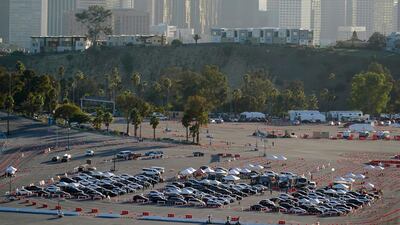
Motorists line up at a Covid-19 vaccination site at Dodger Stadium, in Los Angeles. AP Photo -

Donald Caster, 88, receives a dose of the coronavirus vaccine at Mission Commons assisted-living community in Redlands, California, US. Reuters -
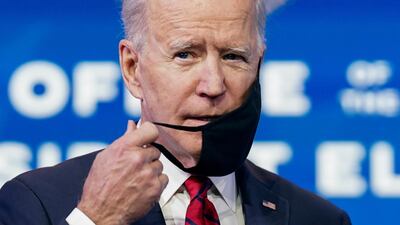
U.S. President-elect Joe Biden adjusts his face mask as he speaks about his plan to administer coronavirus vaccines to the US population during a news conference at Biden's transition headquarters in Wilmington, Delaware, US. Reuters -

Hamilton at Richard Rodgers Theatre near Times Square remains closed following restrictions imposed to slow the spread of coronavirus in New York City. The pandemic has caused long-term repercussions throughout the tourism and entertainment industries, costing the city and businesses billions in revenue. AFP -
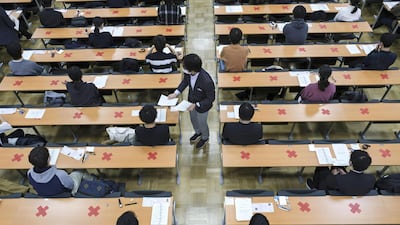
Candidates practice social distancing as they attend the annual unified college entrance examinations at the University of Tokyo, during the second state of emergency for the capital and some prefectures. Reuters -

An image of Brazil's President Jair Bolsonaro with the phrase "How many deaths until impeachment" is projected on a building during a protest against his policies for the coronavirus outbreak and Manaus' health crisis at Santa Cecilia neighbourhood in Sao Paulo, Brazil. Reuters -
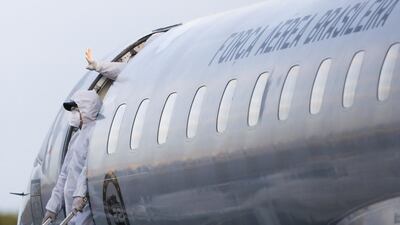
Health workers are seen in Manaus while transporting patients to a Brazilian Air Force airplane before being moved to Maranhao state. Reuters -
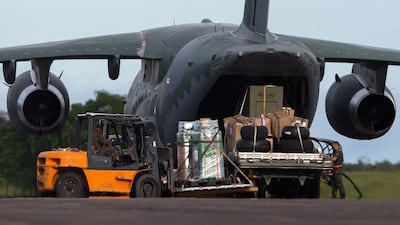
A military airplane arrives with medical supplies, including oxygen tanks, at the Ponta Pelada airport in Manaus, Brazil. The health system in Manaus, in the Brazilian northern state of Amazonas, is at breaking point with the city's hospital intensive care units at 100 per cent capacity for the past two weeks. AFP -

A paramedic has foggy goggles after transferring a Covid-19 patient, in Zapopan, Jalisco State, Mexico. AFP -

Los Angeles Mayor Eric Garcetti, not pictured, is joined by Governor Gavin Newsom, second left, Los Angeles City Council President Nury Martinez, left, Los Angeles City Council member Gil Cedillo, right, Congressman Jimmy Gomez, third left, Sen. Steven Bradford, D-Gardena, second right, and Dodgers President and CEO Stan Kasten, foreground, to launch the mass Covid-19 vaccination site at Dodger Stadium, in Los Angeles. AP Photo -

UK Prime Minister Boris Johnson smiles as he speaks during a Covid-19 media briefing at Downing Street in London, England. Getty Images


As a result, airlines around the world have cancelled flights because of low passenger demand, leaving citizens like the Fishers stranded overseas.
Staying in a small hotel apartment in Deira, the family said they were at their wits end.
"We shipped all our belongings back to Australia in September when our first flight home was booked," Mr Fisher said.
“We understand the government needs to protect Australians but there needs to be a balance.
“The human cost of this caps system is becoming even bigger than Covid-19 itself, for us at least.
“Thankfully, we haven’t contracted the virus but we have been dramatically affected by it."
The Australian government recently announced it would operate 20 repatriation flights from around the world and the family are trying to register for the service.
Although Mr Fisher was made redundant from his construction consultancy company in June, his last working day was September 21.

Since then, the family have not had an income and have been living off their savings.
Mr Fisher's former employer has been supporting the family with their accommodation costs.
“Our kids are struggling to sleep at night and adjust to this new norm,” Mr Fisher said.
“We had to take them out of school because we thought we were going home in September.
“We can’t enrol them again as we are worried they might get sick, plus we are now on tourist visas.”
Mr Fisher’s residence visa expired on January 8, as did those of his wife and children, who were sponsored under his name.
On January 15, Emirates airline said it was suspending flights to Australia's three largest cities. It last flew to Brisbane on January 16, to Sydney on January 18 and to Melbourne on January 20.
“We had a flight scheduled for January 27. It was the closest we have ever been to getting home and we really thought it was going to work but we found out just a few days ago that it was cancelled,” Mr Fisher said.
"We have been trying to get on standby flights but failed.
“People have said why don’t we fly to another city or country like Bangkok or Singapore and connect on a flight there, but if we do that we run the risk of the connecting flight to Australia being cancelled again.
“We have lived in the UAE for 13 years so at least if we stay here and keep trying to fly out, we have a small support system in place.”
Although the couple has been in contact with the Australian consulate in the UAE, they said everyone's hands were tied.
“We are at the mercy of this caps system and we just desperately hope things change soon,” Ms Fisher said.
“Australia is my home and I always had this vision that I could go home and be safe whenever I wanted.
“Right now I feel lost and the thought of not knowing when I will see my mum again is heartbreaking.”

