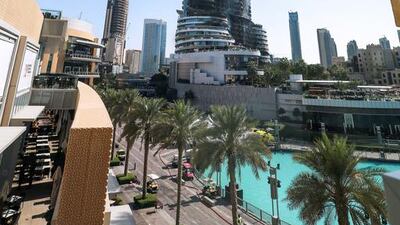
• Some restaurants were open near The Address Downtown Dubai hotel on New Year’s Day. Satish Kumar / The National
    Some restaurants were open near The Address Downtown Dubai hotel on New Year’s Day. Satish Kumar / The National
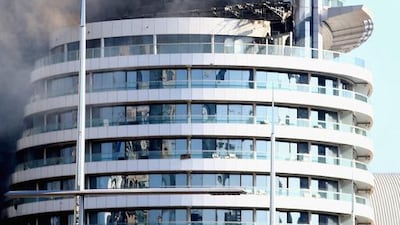
  • Fresh flames coursed through the glass facade and large chunks of debris fell as the fire spread along the building’s rim, near sections that were charred in the blaze that began around 9.30pm on Thursday. Satish Kumar / The National
    Fresh flames coursed through the glass facade and large chunks of debris fell as the fire spread along the building’s rim, near sections that were charred in the blaze that began around 9.30pm on Thursday. Satish Kumar / The National
  • “It is under control, we had four units working,” said a Civil Defence official, adding the fire was put out at 1.45pm. Satish Kumar / The National
    “It is under control, we had four units working,” said a Civil Defence official, adding the fire was put out at 1.45pm. Satish Kumar / The National
  • “We thought there would be a lot of fire inside but most of the fire was outside on the cladding.” Satish Kumar / The National
    “We thought there would be a lot of fire inside but most of the fire was outside on the cladding.” Satish Kumar / The National
  • At least 16 people sustained minor injuries in the blaze that broke out hours before the city’s New Year’s Eve fireworks started at the nearby Burj Khalifa. Francois Nel / Getty Images
    At least 16 people sustained minor injuries in the blaze that broke out hours before the city’s New Year’s Eve fireworks started at the nearby Burj Khalifa. Francois Nel / Getty Images
  • Those injured were treated for smoke inhalation. Francois Nel / Getty Images
    Those injured were treated for smoke inhalation. Francois Nel / Getty Images
  • Gas lines have been turned off in restaurants and hotel apartments near the hotel. Satish Kumar / The National
    Gas lines have been turned off in restaurants and hotel apartments near the hotel. Satish Kumar / The National
  • Civil Defence at The Address. Satish Kumar / The National
    Civil Defence at The Address. Satish Kumar / The National
  • Smoke billows from The Address Downtown Dubai. Jon Gambrell / AP Photo
    Smoke billows from The Address Downtown Dubai. Jon Gambrell / AP Photo
  • Firefighters spray water on the fire. Sunday Alamba / AP Photo
    Firefighters spray water on the fire. Sunday Alamba / AP Photo
  • The blaze continues to burn. Sunday Alamba / AP Photo
    The blaze continues to burn. Sunday Alamba / AP Photo
  • The Address Downtown Dubai after the fire from Dubai Mall Level 1-Aigner shop. Victor Besa for The National
    The Address Downtown Dubai after the fire from Dubai Mall Level 1-Aigner shop. Victor Besa for The National
  • The Address Downtown Dubai from Trade Center Road. Victor Besa for The National
    The Address Downtown Dubai from Trade Center Road. Victor Besa for The National
  • Firemen rest after the fire was declared under control. Victor Besa for The National.
    Firemen rest after the fire was declared under control. Victor Besa for The National.
  • Abdulla Hassan, Sultan Ashor, Waleed Issa and Ashraf Khan from the Dubai Fire Station were amongst the first batch of firefighters to arrive on the scene last night. Here they rest after the fire was declared under controlon Friday afternoon. Victor Besa for The National.
    Abdulla Hassan, Sultan Ashor, Waleed Issa and Ashraf Khan from the Dubai Fire Station were amongst the first batch of firefighters to arrive on the scene last night. Here they rest after the fire was declared under controlon Friday afternoon. Victor Besa for The National.

Dubai Civil Defence put out The Address Downtown blaze — in pictures


  • English
  • Arabic

Civil Defence workers put out the New Year’s Eve blaze at The Address Downtown Dubai hotel at about 1.45pm on Friday.

What is blockchain?

Blockchain is a form of distributed ledger technology, a digital system in which data is recorded across multiple places at the same time. Unlike traditional databases, DLTs have no central administrator or centralised data storage. They are transparent because the data is visible and, because they are automatically replicated and impossible to be tampered with, they are secure.

The main difference between blockchain and other forms of DLT is the way data is stored as ‘blocks’ – new transactions are added to the existing ‘chain’ of past transactions, hence the name ‘blockchain’. It is impossible to delete or modify information on the chain due to the replication of blocks across various locations.

Blockchain is mostly associated with cryptocurrency Bitcoin. Due to the inability to tamper with transactions, advocates say this makes the currency more secure and safer than traditional systems. It is maintained by a network of people referred to as ‘miners’, who receive rewards for solving complex mathematical equations that enable transactions to go through.

However, one of the major problems that has come to light has been the presence of illicit material buried in the Bitcoin blockchain, linking it to the dark web.

Other blockchain platforms can offer things like smart contracts, which are automatically implemented when specific conditions from all interested parties are reached, cutting the time involved and the risk of mistakes. Another use could be storing medical records, as patients can be confident their information cannot be changed. The technology can also be used in supply chains, voting and has the potential to used for storing property records.

Mercer, the investment consulting arm of US services company Marsh & McLennan, expects its wealth division to at least double its assets under management (AUM) in the Middle East as wealth in the region continues to grow despite economic headwinds, a company official said.

Mercer Wealth, which globally has $160 billion in AUM, plans to boost its AUM in the region to $2-$3bn in the next 2-3 years from the present $1bn, said Yasir AbuShaban, a Dubai-based principal with Mercer Wealth.

Within the next two to three years, we are looking at reaching $2 to $3 billion as a conservative estimate and we do see an opportunity to do so,” said Mr AbuShaban.

Mercer does not directly make investments, but allocates clients’ money they have discretion to, to professional asset managers. They also provide advice to clients.

“We have buying power. We can negotiate on their (client’s) behalf with asset managers to provide them lower fees than they otherwise would have to get on their own,” he added.

Mercer Wealth’s clients include sovereign wealth funds, family offices, and insurance companies among others.

From its office in Dubai, Mercer also looks after Africa, India and Turkey, where they also see opportunity for growth.

Wealth creation in Middle East and Africa (MEA) grew 8.5 per cent to $8.1 trillion last year from $7.5tn in 2015, higher than last year’s global average of 6 per cent and the second-highest growth in a region after Asia-Pacific which grew 9.9 per cent, according to consultancy Boston Consulting Group (BCG). In the region, where wealth grew just 1.9 per cent in 2015 compared with 2014, a pickup in oil prices has helped in wealth generation.

BCG is forecasting MEA wealth will rise to $12tn by 2021, growing at an annual average of 8 per cent.

Drivers of wealth generation in the region will be split evenly between new wealth creation and growth of performance of existing assets, according to BCG.

Another general trend in the region is clients’ looking for a comprehensive approach to investing, according to Mr AbuShaban.

“Institutional investors or some of the families are seeing a slowdown in the available capital they have to invest and in that sense they are looking at optimizing the way they manage their portfolios and making sure they are not investing haphazardly and different parts of their investment are working together,” said Mr AbuShaban.

Some clients also have a higher appetite for risk, given the low interest-rate environment that does not provide enough yield for some institutional investors. These clients are keen to invest in illiquid assets, such as private equity and infrastructure.

“What we have seen is a desire for higher returns in what has been a low-return environment specifically in various fixed income or bonds,” he said.

“In this environment, we have seen a de facto increase in the risk that clients are taking in things like illiquid investments, private equity investments, infrastructure and private debt, those kind of investments were higher illiquidity results in incrementally higher returns.”

The Abu Dhabi Investment Authority, one of the largest sovereign wealth funds, said in its 2016 report that has gradually increased its exposure in direct private equity and private credit transactions, mainly in Asian markets and especially in China and India. The authority’s private equity department focused on structured equities owing to “their defensive characteristics.”

Fast%20X
%3Cp%3E%3Cstrong%3EDirector%3A%3C%2Fstrong%3E%20Louis%20Leterrier%3C%2Fp%3E%0A%3Cp%3E%3Cstrong%3EStars%3A%3C%2Fstrong%3E%20Vin%20Diesel%2C%20Michelle%20Rodriguez%2C%20Jason%20Statham%2C%20Tyrese%20Gibson%2C%20Ludacris%2C%20Jason%20Momoa%2C%20John%20Cena%2C%20Jordana%20Brewster%2C%20Nathalie%20Emmanuel%2C%20Sung%20Kang%2C%20Brie%20Larson%2C%20Helen%20Mirren%20and%20Charlize%20Theron%3C%2Fp%3E%0A%3Cp%3E%3Cstrong%3ERating%3A%3C%2Fstrong%3E%203%2F5%3C%2Fp%3E%0A
Most%20polluted%20cities%20in%20the%20Middle%20East
%3Cp%3E1.%20Baghdad%2C%20Iraq%3Cbr%3E2.%20Manama%2C%20Bahrain%3Cbr%3E3.%20Dhahran%2C%20Saudi%20Arabia%3Cbr%3E4.%20Kuwait%20City%2C%20Kuwait%3Cbr%3E5.%20Ras%20Al%20Khaimah%2C%20UAE%3Cbr%3E6.%20Ash%20Shihaniyah%2C%20Qatar%3Cbr%3E7.%20Abu%20Dhabi%2C%20UAE%3Cbr%3E8.%20Cairo%2C%20Egypt%3Cbr%3E9.%20Riyadh%2C%20Saudi%20Arabia%3Cbr%3E10.%20Dubai%2C%20UAE%3C%2Fp%3E%0A%3Cp%3E%3Cem%3ESource%3A%202022%20World%20Air%20Quality%20Report%3C%2Fem%3E%3C%2Fp%3E%0A
MOST%20POLLUTED%20COUNTRIES%20IN%20THE%20WORLD
%3Cp%3E1.%20Chad%3Cbr%3E2.%20Iraq%3Cbr%3E3.%20Pakistan%3Cbr%3E4.%20Bahrain%3Cbr%3E5.%20Bangladesh%3Cbr%3E6.%20Burkina%20Faso%3Cbr%3E7.%20Kuwait%3Cbr%3E8.%20India%3Cbr%3E9.%20Egypt%3Cbr%3E10.%20Tajikistan%3Cbr%3E%3Cbr%3E%3Cem%3ESource%3A%202022%20World%20Air%20Quality%20Report%3C%2Fem%3E%3C%2Fp%3E%0A
Defence review at a glance

• Increase defence spending to 2.5% of GDP by 2027 but given “turbulent times it may be necessary to go faster”

• Prioritise a shift towards working with AI and autonomous systems

• Invest in the resilience of military space systems.

• Number of active reserves should be increased by 20%

• More F-35 fighter jets required in the next decade

• New “hybrid Navy” with AUKUS submarines and autonomous vessels

The five pillars of Islam

1. Fasting 

2. Prayer 

3. Hajj 

4. Shahada 

5. Zakat