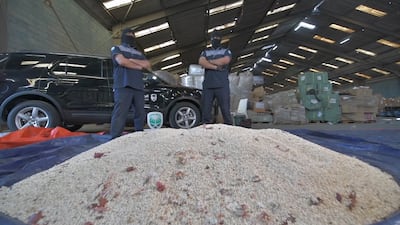
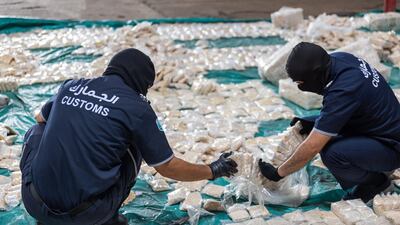
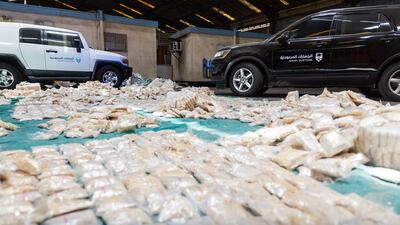
Authorities at Dubai Customs’ Jebel Ali and Tecom Center seized 1.5 tonnes of crushed Captagon pills. Photo: Dubai Customs

Dubai Customs foil attempt to smuggle Dh1.4bn worth of Captagon pills


Sarah Forster
  • English
  • Arabic

In the biggest haul of its kind in the country, Dubai Customs officers managed to foil an attempt to smuggle crushed Captagon pills worth Dh1.4 billion into the emirate.

Authorities at Dubai Customs’ Jebel Ali and Telecom Centre analysed data regarding a shipment coming into Jebel Ali Port and inspected the container on arrival. It was then that they discovered 1.5 tonnes of the illegal stimulant.

Officials shared a video of the operation online.

“Dubai Customs’ people are very professional and always on the lookout for any illegitimate and suspicious activity without disrupting shipment clearance operations,” said Sultan bin Sulayem, DP World group chairman & chief executive and chairman of Ports, Customs and Free Zone Corporation.

“This operation is an example of what we do to secure our borders.”

Jebel Ali Port, the busiest port in the Middle East and one of the biggest in the world, has the capacity to handle more than 22 million containers every year.

All the containers arriving at the port are scanned for narcotics, explosives and other illegal and counterfeit items.

“Dubai Customs never ceases to develop and improve their inspection systems,” said Abdullah Busnad, executive director of the Customs Inspection Division.

“We have plans set to monitor, follow and intercept high-risk shipments, supported by our highly trained inspectors and sophisticated systems and devices.”

Dubai Customs thwarted 398 attempts to smuggle drugs into the city in the first three months of this year. The largest drug bust among them was a shipment of nearly three million Captagon pills concealed in a container of spare vehicle parts at Jebel Ali Port.

Drugs intercepted at Saudi Arabian port: in pictures

  • Saudi customs officials stand in front of a mound of seized Captagon pills
    Saudi customs officials stand in front of a mound of seized Captagon pills
  • A customs officer opens pomegranates in search of drugs after an attempt was made to smuggle millions of Captagon pills from Lebanon through Jeddah Islamic Port inside a shipment of the fruit.
    A customs officer opens pomegranates in search of drugs after an attempt was made to smuggle millions of Captagon pills from Lebanon through Jeddah Islamic Port inside a shipment of the fruit.
  • Customs officials unpack the bags of tablets seized.
    Customs officials unpack the bags of tablets seized.
  • Saudi port authorities said about nine million Captagon pills were intercepted.
    Saudi port authorities said about nine million Captagon pills were intercepted.
England v West Indies

England squad for the first Test Cook, Stoneman, Westley, Root (captain), Malan, Stokes, Bairstow, Moeen, Roland-Jones, Broad, Anderson, Woakes, Crane

Fixtures

1st Test Aug 17-21, Edgbaston

2nd Test Aug 25-29, Headingley

3rd Test Sep 7-11, Lord's

Jetour T1 specs

Engine: 2-litre turbocharged

Power: 254hp

Torque: 390Nm

Price: From Dh126,000

Available: Now

Ways to control drones

Countries have been coming up with ways to restrict and monitor the use of non-commercial drones to keep them from trespassing on controlled areas such as airports.

"Drones vary in size and some can be as big as a small city car - so imagine the impact of one hitting an airplane. It's a huge risk, especially when commercial airliners are not designed to make or take sudden evasive manoeuvres like drones can" says Saj Ahmed, chief analyst at London-based StrategicAero Research.

New measures have now been taken to monitor drone activity, Geo-fencing technology is one.

It's a method designed to prevent drones from drifting into banned areas. The technology uses GPS location signals to stop its machines flying close to airports and other restricted zones.

The European commission has recently announced a blueprint to make drone use in low-level airspace safe, secure and environmentally friendly. This process is called “U-Space” – it covers altitudes of up to 150 metres. It is also noteworthy that that UK Civil Aviation Authority recommends drones to be flown at no higher than 400ft. “U-Space” technology will be governed by a system similar to air traffic control management, which will be automated using tools like geo-fencing.

The UAE has drawn serious measures to ensure users register their devices under strict new laws. Authorities have urged that users must obtain approval in advance before flying the drones, non registered drone use in Dubai will result in a fine of up to twenty thousand dirhams under a new resolution approved by Sheikh Hamdan bin Mohammed, Crown Prince of Dubai.

Mr Ahmad suggest that "Hefty fines running into hundreds of thousands of dollars need to compensate for the cost of airport disruption and flight diversions to lengthy jail spells, confiscation of travel rights and use of drones for a lengthy period" must be enforced in order to reduce airport intrusion.

Updated: December 29, 2021, 5:16 PM