
Pope Francis has made building a good relationship between Christianity and Islam one of the priorities of his papacy.
More than that, he has demonstrated a clear sympathy for oppressed minorities in the Arab world.
This is in stark contrast to the approach of his predecessor, Pope Benedict XVI, who set back relations between the faiths with an approach characterised by theological challenge – accusing “radical Islam” of creating an “explosive situation in Europe”.
Pope Benedict’s speech, at Regensburg in Germany in 2006, angered the Muslim world and sparked deadly protests in several countries.
Pope Francis, since his election as Supreme Pontiff of the Roman Catholic Church in 2013, has made efforts to build the bridges that Pope Benedict burnt.
Only this week, the Pope received Palestinian President Mahmoud Abbas in the Vatican and gave his backing to plans to reactivate the peace process between Israelis and Palestinians, and to work for the two-state solution that US President Donald Trump has been downgrading. It was under Pope Francis that the Vatican first recognised the state of Palestine in 2016.
He has visited no fewer than eight Muslim-majority countries in his five years as Pope. They include Turkey in 2014, Bosnia in 2015, Azerbaijan in 2016 and Egypt and Bangladesh in 2017.
His commitment to this is significant. He visited Cairo only three weeks after 45 Christian worshippers were killed in bomb attacks on Egyptian churches.
Yet despite that, the Pope refused a bulletproof vehicle and travelled through the crowds in an open-topped golf buggy. The personal warmth of his intentions was symbolised in the Al Azhar Mosque by his embrace of the Grand Imam, Dr Ahmed Al Tayeb.
The very name that Francis chose as pope was revealing.
His namesake, Francis of Assisi, was not only a great advocate of the poor and champion of the environment – two of the Pope's cornerstone causes – he was also one of the first Christians to conduct a dialogue with Muslims. In the year 1219, when Europeans were embarking on military crusades in the Middle East, the original Francis travelled to Egypt to meet the great Muslim leader Sultan Al Kamil. After three weeks of dialogue, St Francis returned to Italy to promote respect for Muslims and encourage Christians to emulate their zeal for prayer.
The current pope’s embrace of Islam is part of his wider approach to inclusivity.
He puts people before doctrine. One of his favourite sayings is "realities are greater than ideas" – not something you can imagine the theologian Pope Benedict XVI, or the philosopher Pope John Paul II, saying.
This pope is a religious leader who does not have his finger out to wag but his arms open to embrace.
Francis is a reforming pope. He has revolutionised the Vatican’s corrupt finances. He has changed the way the Church makes decisions – re-empowering synods of bishops, which were merely rubber-stamping bodies under previous popes.
He has opened the way for free discussion, once suppressed as dissent, within the Catholic Church.
Conservative clerics who have stood in the way of all this have been removed from key posts. His new clerical appointments have embodied a pastoral rather than an ideological approach.

They are, to use the Pope's words, shepherds who "smell of their sheep" and are willing to accompany the ordinary people through the difficulties of their daily lives.
Rebuilding relationships with Islam was an early priority. Francis, who will be 82 this month, moved quickly to make interfaith overtures as soon he was elected. One of his first symbolic moves was to invite two old friends from his time as archbishop of Buenos Aires to join him in his visit to the Holy Land.
In Jerusalem, sacred to the three Abrahamic faiths, the three men embraced – the Pope; a Jewish rabbi, Abraham Skorka; and a Muslim professor, Omar Abboud, president of the Institute for Inter-Religious Dialogue in Argentina.
_______________
Read more:
Pope Francis to make landmark visit to the UAE
The Pope's visit: The story of the Roman Catholic Church in the UAE
Sheikh Mohamed bin Zayed meets Pope Francis at the Vatican - in pictures
Pope Francis invited to visit the UAE
_______________
Afterwards, he invited the presidents of Israel and Palestine to the Vatican for a prayer summit. They went, and prayed alongside each other.
Pope Francis’s friendship with Mr Abboud and Mr Skorka was more than nominal.
In his ill-judged Regensburg lecture in 2006, Pope Benedict quoted a highly inflammatory remark by a 14th-century Christian emperor.
Immediately, the man who later became Pope Francis stepped out of line. Cardinal Jorge Mario Bergoglio, as he was then, told the Argentine media: “Pope Benedict’s statement ... will serve to destroy in 20 seconds the careful construction of a relationship with Islam that Pope John Paul II built over the past 20 years.”
The Vatican rapped his knuckles, but Bergoglio merely responded by calling an interfaith meeting in his homeland, inviting, among others, Mr Abboud and Mr Skorka.
In 2013's Evangelii Gaudium, the first major document he produced as pope – which set out his personal manifesto – Pope Francis pointedly wrote: "Authentic Islam and the proper reading of the Quran are opposed to every form of violence."
He echoed the sentiment a year later in his Letter to the Christians in the Middle East, declaring: "Islam is a religion of peace, one which is compatible with respect for human rights and favours peaceful coexistence."
Last year, he went further while on the plane back from Egypt, saying: "It is not right to identity Islam with violence".
Terrorism was, rather, caused by social injustice and societies where “money is made a god”. Francis has condemned those in western nations who support anti-immigration policies.
_____________
When Mohamed met Pope Francis in 2016
-
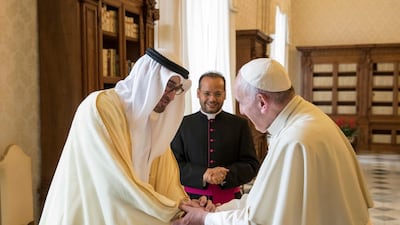
Sheikh Mohamed bin Zayed, Crown Prince of Abu Dhabi and Deputy Supreme Commander of the Armed Forces, met Pope Francis during a visit to the Vatican in 2016. Mohamed Al Hammadi / Crown Prince Court - Abu Dhabi -
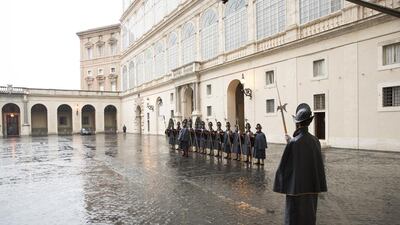
The Swiss Honour Guard await the arrival of Sheikh Mohamed bin Zayed at the Apostolic Palace. Ryan Carter / Crown Prince Court - Abu Dhabi -
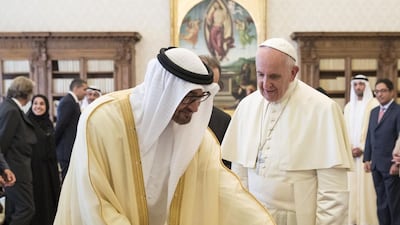
Sheikh Mohamed bin Zayed with Pope Francis. Ryan Carter / Crown Prince Court - Abu Dhabi -
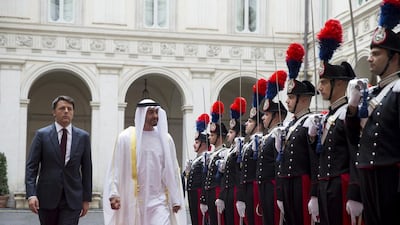
Sheikh Mohamed bin Zayed is received by Matteo Renzi, Prime Minister of Italy, at Palazzo Chigi on Thursday. Mohamed Al Hammadi / Crown Prince Court - Abu Dhabi -
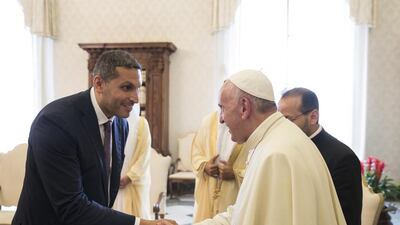
Pope Francis greets Khaldoon Khalifa Al Mubarak, CEO and managing director, Mubadala, and Chairman of the Abu Dhabi Executive Affairs Authority. Ryan Carter / Crown Prince Court - Abu Dhabi -
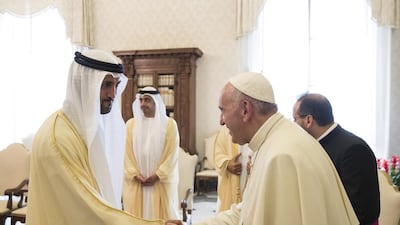
Pope Francis with Mohammed Mubarak Al Mazrouei, Undersecretary of the Crown Prince Court of Abu Dhabi. Ryan Carter / Crown Prince Court - Abu Dhabi -
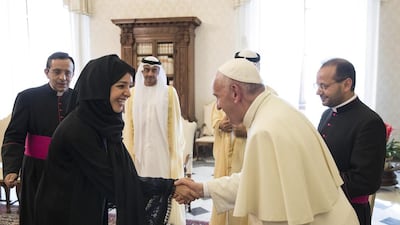
Reem Ibrahim Al Hashimi, Minister of State for International Cooperation, with the Pope. Ryan Carter / Crown Prince Court - Abu Dhabi -
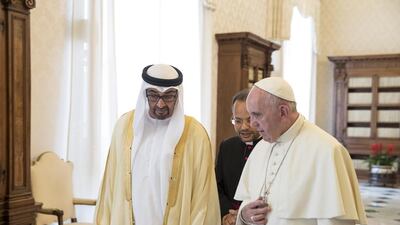
Sheikh Mohamed bin Zayed, Crown Prince of Abu Dhabi and Deputy Supreme Commander of the Armed Forces, with Pope Francis in the Papal Library at the Apostolic Palace. Ryan Carter / Crown Prince Court – Abu Dhabi -
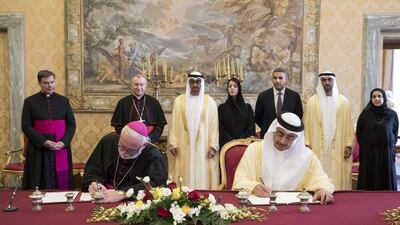
Sheikh Mohamed bin Zayed, back third left, watches as Sheikh Abdullah bin Zayed, Minister of Foreign Affairs and International Cooperation, signs a memorandum of understanding with Archbishop Paul Gallagher, Vatican Secretary for Relations with States. Watching them are Cardinal Pietro Parolin, Vatican Secretary of State, back second left, Reem Ibrahim Al Hashimi, Minister of State for International Cooperation, back fourth left, Khaldoon Khalifa Al Mubarak, CEO and Managing Director, Mubadala, and Chairman of the Abu Dhabi Executive Affairs Authority, back fifth left, Mohammed Mubarak Al Mazrouei, Undersecretary of the Crown Prince Court of Abu Dhabi, back sixth left, and Dr Hessa Al Otaiba, UAE Ambassador to Spain and Non-Resident Ambassador to the Vatican, back right. Ryan Carter / Crown Prince Court - Abu Dhabi -
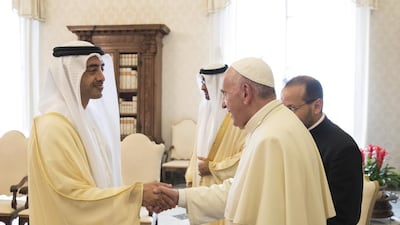
Pope Francis meets Sheikh Abdullah bin Zayed. Ryan Carter / Crown Prince Court - Abu Dhabi -
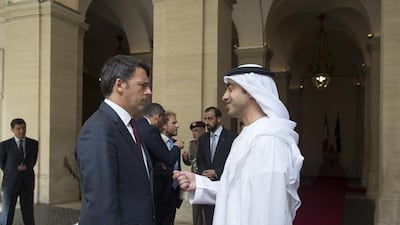
Italian Prime Minister Matteo Renzi with Sheikh Abdullah bin Zayed after a lunch reception at Palazzo Chigi. Mohamed Al Hammadi / Crown Prince Court - Abu Dhabi -
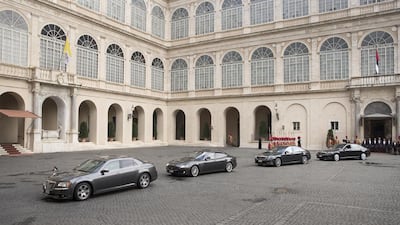
A motorcade carrying the UAE delegation led by Sheikh Mohamed bin Zayed leaves the Apostolic Palace. Ryan Carter / Crown Prince Court - Abu Dhabi -
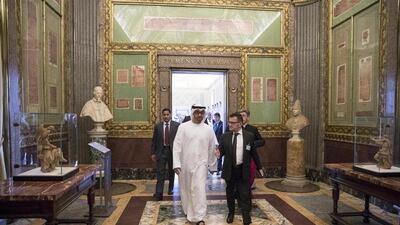
Sheikh Mohamed bin Zayed visits the Vatican museums in the Apostolic Palace. Ryan Carter / Crown Prince Court - Abu Dhabi -
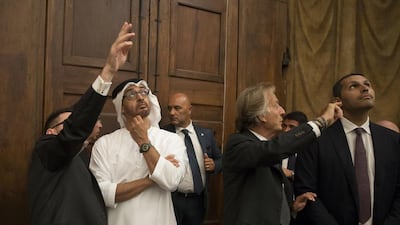
Sheikh Mohamed bin Zayed at the Sistine Chapel. With him is Khaldoon Khalifa Al Mubarak, CEO and Managing Director, Mubadala, and Chairman of the Abu Dhabi Executive Affairs Authority. Mohamed Al Hammadi / Crown Prince Court - Abu Dhabi -
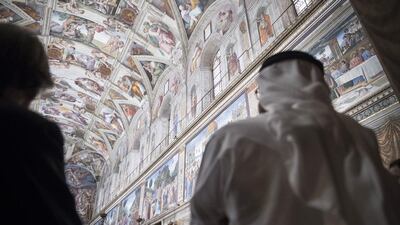
Sheikh Mohamed bin Zayed admires the frescos in the Sistine Chapel at the Apostolic Palace. Ryan Carter / Crown Prince Court - Abu Dhabi -
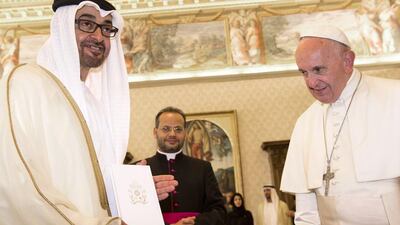
Crown Prince of Abu Dhabi and Deputy Supreme Commander of the UAE Armed Forces, Sheikh Mohamed bin Zayed, and Pope Francis exchange gifts at the Vatican. Claudio Peri / Pool Photo via AP -

Sheikh Mohamed bin Zayed with Pope Francis. Mohamed Al Hammadi / Crown Prince Court - Abu Dhabi


Instead, he has urged Christians to take in Muslim refugees, and himself housed Muslim refugees in the Vatican to send a message of inclusiveness. He has paid a price for living up to his name – the word pontiff means bridge builder.
His dialogue with Islam has brought criticism from theological conservatives as well as Christians living in beleaguered places like Iraq, where one Christian minority leader described Pope Francis’s approach as “naive and short-sighted”.
But he has persevered. He is not afraid to speak out in defence of Islam. But nor is he afraid to defend the increasingly minority status of Christians in the Middle East.
By the time of his visit to the birthplace of Christ, Bethlehem, in 2013, the little town, which had been 60 per cent Christian in 1990, had a Christian population of only 15 per cent. This prompted the pope to authorise the Vatican website to condemn the persecution of Palestinian Christians.
Paul Vallely is the author of Pope Francis: the Struggle for the Soul of Catholicism, published by Bloomsbury

