
Live updates: Follow the latest on Israel-Gaza
Palestinians evacuated from Gaza and given a safe haven in the UAE have delivered impassioned prayers for peace in their besieged homeland as they reflected on a Ramadan marred by conflict.
More than 1,200 Gazans being housed at Abu Dhabi's Emirates Humanitarian City sat side by side for a poignant iftar on Tuesday evening as thoughts turned to loved ones in the Gaza Strip.
The traditional breaking of the fast, usually shared with friends and family, resonates deeply with a proud community left yearning for a return to better times after months of violence.
More than 31,900 Palestinians have been killed since the Israeli offensive began, Gaza's Health Ministry says, with women and children making up two thirds of the dead.
The majority of the territory's 2.3 million people remain displaced, as a humanitarian crisis worsens and the threat of famine looms.
A sombre holy month
Riyad Alderbi, 65, is receiving medical treatment in the UAE for osteoporosis and an enlarged prostate.
He is joined at the vast Emirates Humanitarian City (EHC) compound by his wife, who is being treated for cancer.
The couple are parents to four boys and two girls who live across the world, including a 17-year-old son with autism who remains in Gaza.
“Last year around this time, I was in Gaza and it was Ramadan," Mr Alderbi said.
"You could feel the poverty but we were all together.”
-

Palestinians share iftar during Ramadan at Emirates Humanitarian City in Abu Dhabi. Wajod Alkhamis / The National -
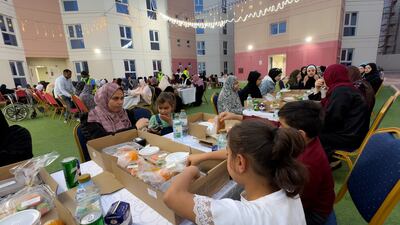
The Palestinians were evacuated from Gaza under the directive of President Sheikh Mohamed, amid the war with Israel. Wajod Alkhamis / The National -
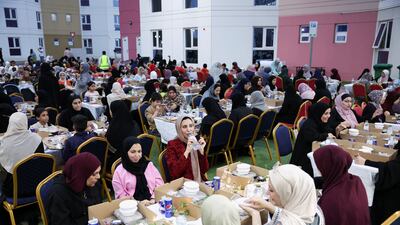
Almost half of them are critically ill. Reuters -

The group iftar was hosted by Emirates Humanitarian City where the evacuees are staying. Reuters -
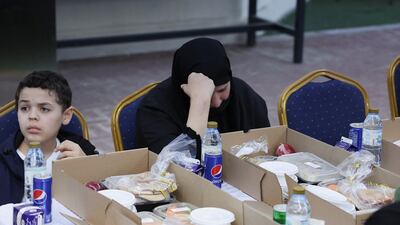
A woman and child wait for the group iftar to start. Reuters -
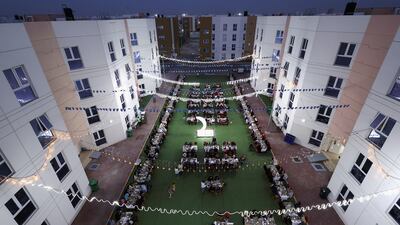
Palestinian evacuees share iftar at Emirates Humanitarian City. Reuters -
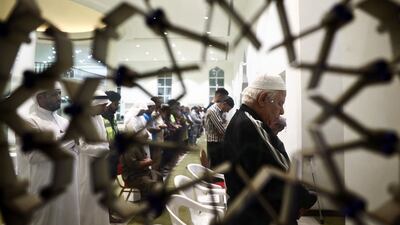
Muslims, including Palestinians from Gaza, perform taraweeh prayers at Emirates Humanitarian City. Reuters -

A Palestinian evacuee reads the Quran at a mosque before taraweeh prayers in Emirates Humanitarian City. Reuters -
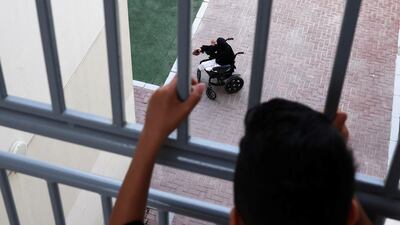
A Palestinian child watches his friend Tuqa Ibrahim, 12, before iftar in Emirates Humanitarian City. Tuqa lost her legs during an Israeli air strike in Gaza. Reuters -
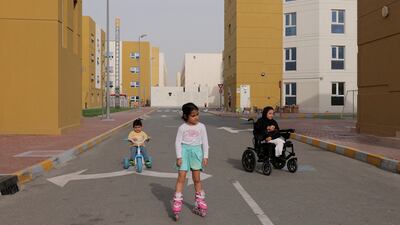
Tuqa sits in her wheelchair as she watches other Palestinian children play at Emirates Humanitarian City. Reuters -
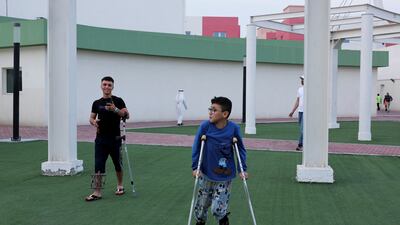
Palestinian evacuees walk ahead of iftar at Emirates Humanitarian City. Reuters -
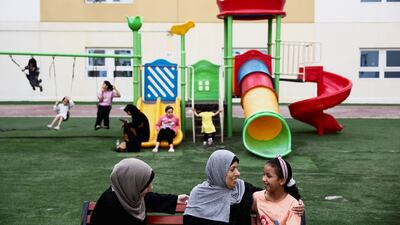
Palestinian evacuee and cancer patient Hanaa Saeed Selim, from Gaza, sits in a playground with her her daughter, who was brought from the U. S. to accompany her, during the Muslim holy month of Ramadan at Emirates Humanitarian City, in Abu Dhabi, United Arab Emirates, March 19, 2024. REUTERS / Amr Alfiky -
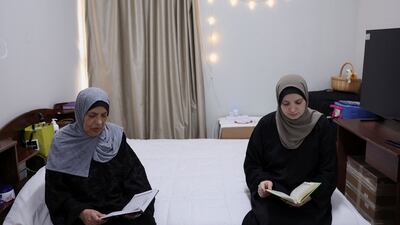
Ms Selim with her daughter, who came from the US. Reuters -
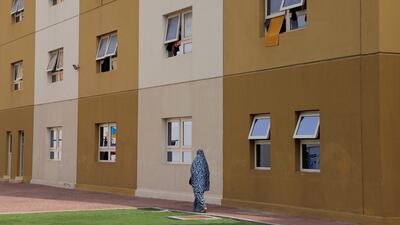
A Palestinian evacuee walks during Ramadan at Emirates Humanitarian City. Reuters -
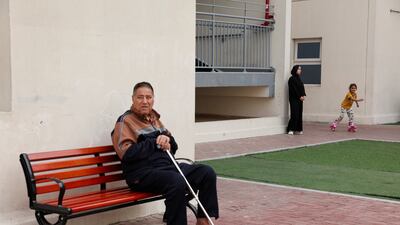
Cancer patient Ahmed Shamiyeh, from Gaza, sits on a bench while Palesintian children play ahead of iftar. Reuters


Their lives were changed forever when war broke out on October 7.
He is grateful for the crucial support offered by the UAE but is desperate to be reunited once more with his entire family.
“In the UAE and the EHC, we have not been left wanting for anything. We are getting our treatment and everything we need but everybody wants all their family."
'No Ramadan in Gaza'
Hanadi Abed, 37, is a mother of seven, aged four to 14.
She was flown to Abu Dhabi with her 12-year-old son Mahmoud, who suffered two fractures in his left leg after the building they lived in was bombed.
Mahmoud was pulled out from under the rubble eight hours later and was initially presumed dead.
“This isn't the Ramadan that we know. It used to be beautiful," said Ms Abed.
"This time we would be preparing food to eat together as a family. Today, I’m away from my children, my husband and my homeland.
“My children can’t find food to eat.”
Her other children live with friends in the Gazan city of Deir Al Balah after their home was destroyed in the Israeli attack.
Many of the children of evacuated families have been left without homes and are now living in tents in southern Gaza that have been flooded after heavy rain.
“There is no Ramadan for us in Gaza," said Ms Abed. "Many don’t even realise it is Ramadan, we fast because we have to, but nobody sits down to break their fast any more because there is no food.
"In Gaza, my children eat whenever they can and it is all canned food – when available."

She is thankful for the vital lifeline offered by the Emirates as part of its extensive aid programme for Gaza.
“There is nothing better than the UAE and they have given us everything in every sense but I really want my children.
"I want my son to be better and to go back home to a Gaza that is free of war,” she said, with tears in her eyes.
“I can’t sleep at night, most of us can't. We think of our kids and pray for their safety. We can't call them or check on them because the internet and communications are down.”
Her son Mahmoud likes the UAE but dearly wishes all of his family could be with them.
“We are grateful to the UAE, and this is really the best place to be, but Ramadan without family is hard, even though it is beautiful here," he said.
"Look at the set-up they made for us. But I want my father and siblings to be with me.
“You know in Gaza before the war, it was beautiful. We would play with firecrackers and sparklers, and the sambousa and kibbeh are the best,” he said.
Reliving 'nightmare' of war
Khaled Abu Zayed, 30, cannot imagine returning to his home in Gaza, which once brought him such joy.
“There is nothing in the world like Ramadan in Gaza,” he said.
The father of four daughters aged three to 10 arrived at EHC four months ago to receive cancer treatment.
He felt his illness was proving a burden to his family as they sought to survive each day in a war zone.
His children live in a tent, which was recently flooded. He fears for their lives with a chronic shortage of food.
“They are dying of hunger,” he said. “I miss them terribly but I was a burden on them.
"I was very sick and my eldest daughter, who was only 10, would help me when I was in so much pain. I don’t want to go back to the nightmare that is Gaza now.
"The things that I saw are a nightmare that still keeps me up at night.”
He recalls sheltering 35 orphaned children in a building, which was soon reduced to rubble in a subsequent air raid.
“I screamed to the ambulance to help me pull them out again and they said they had nothing to bring them out with.”
Offering sanctuary and solidarity

About half of the 1,200 Gazans at EHC are patients requiring treatment, with the remainder being relatives accompanying them.
Many of them children, some only a few months old, and have known only the horrors of war.
Mubarak Al Qahtani, a spokesman for EHC, said the UAE has sought to offer solace and some sense of normality in the most trying of times.
The sprawling housing complex is supported by the UAE's Family Development Authority, the Zayed Higher Organisation for People of Determination, the Emirates Red Crescent and a number of other groups.
Those observing Ramadan are given daily iftars and suhoors. After breaking fast, a variety of activities are laid on to offer a much-needed distraction and mental respite.
Trips out to malls and various festivals and events in Abu Dhabi are also organised.
“We are all trying our best," said Mr Al Qahtani. "We understand that it is hard and are trying all avenues to alleviate their suffering.
"Many have lost their families and they are all away from home.
"We have several cancer patients and amputees. Thankfully, many are getting better and others have refused prosthetics.
“The EHC is a collaborative effort and many of us feel privileged to be given this opportunity to support our brothers and sisters in Gaza.”
Mr Al Qahtani and many of the Emirati volunteers will be away from loved ones and are spending Ramadan with their “second family.”
“We do believe that we are lucky and my family understands,” he said.
“They understand that this is a humanitarian cause and a necessity. What the Palestinians have gone through is unimaginable.
"This experience has humbled all of us and has also made us more appreciative of everything I have. What you see on television is nothing like the reality."

