



People bargain for gold at the souq, tourists walk through the historic markets and porters haul goods on handcarts through the labyrinthine alleyways.
It seems like any other day in one of Dubai’s oldest and most densely populated districts.
But once the sun begins to set over Deira during Ramadan, the neighbourhood starts to change.
People purchase freshly cut watermelon and samosas from street stalls and small tandoor bakeries are thronged.
Workers start to unfurl carpets or plastic lining on many shop floors, places are set and food laid out. It is the same in scores of shops across the old town.

“At iftar, all of us are together,” said Adam Abd Al Rahman, an Egyptian, who was preparing to break his fast by sitting on the floor of the shop he works in selling tourist items. “It is extra special.”
Mr Al Rahman and his colleagues, whose shop is close to the gold souq, will have a simple meal together, typically consisting of dates, rice, bread, curried meat or vegetables, a piece of fruit and juice.
“There is not a manager, not a worker, not a salesman or not a cleaner – all of us are the same – the same food, the same chairs, the same everything,” he said.
'Like a family'
Taj Muhammad has worked in Deira for about seven years and also was about to break his fast on the shop floor.
“We will sit together and eat together,” said Mr Muhammad, who was born in Pakistan but grew up in Afghanistan.
“It is not like he is a senior or he is a junior. We are living like brothers, like a family.”
Mr Al Rahman, who has been in Dubai since 2011, said people changed during Ramadan, were more forgiving and there was no shouting like in normal times.
Gaza was also on people’s minds, he said. “People have a bad feeling about the situation in Palestine.”

Deira is a place where it is possible to purchase anything from gold bracelets and mobile phones to ornate Turkish-made lanterns.
But Mr Al Rahman said business takes a back seat during the holy month and work is not a priority.
“People do not care 100 per cent about business at this time,” he said.
“If someone would like to catch a customer, he is welcome. If not, we do not care.
“What is most important is praying, reading the Quran and reading some Hadiths,” he said. “Our mind is clearer. All of us try to do better.”
Curiosity from visitors
Ramadan now takes place during the traditional tourist season.
Guides were leading groups from China to America through the souq as the sun was about to set.
Mr Muhammad said tourists did ask them about Ramadan and why they were eating together in their shops.
“Sometimes they will try some food,” he said. “They haven't tried these kinds of things in their country, like the spices. They see us and we are all sitting together, like friends and family, so that's why they are surprised.”
Sher Khan, an Afghan resident who has been working in Deira about six years in an adjacent shop, agrees.
“Tourists some to the shop and say, 'very nice',” he said. “They take a little taste with us.”
Before sunset, charities distribute boxes of food to those who need it the most. Mosques also organise free iftars on the streets outside. And in the minutes before the maghrib prayer that marks the end of the fast sounds out across the old town, quiet descends.
The bright lights of shops selling everything from spices to carpets then start to dim. Sunset falls, people break their fast and the busy world outside can wait.
After iftar, many people walk to the neighbourhood mosques. The sounds of quiet prayer filter out across the old town, through the small side streets, into the souqs and drift out over Dubai Creek.
And when workers return to their jobs, life goes on, but at a slower pace.
“We will not fight for business,” said Mr Al Rahman.
“We trust that business comes from Allah.”
The first week of Ramadan around the Middle East and North Africa region – in pictures
-
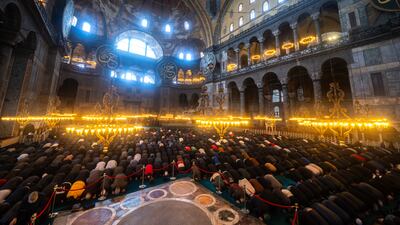
Worshippers at Hagia Sophia Mosque in Istanbul. AP Photo -
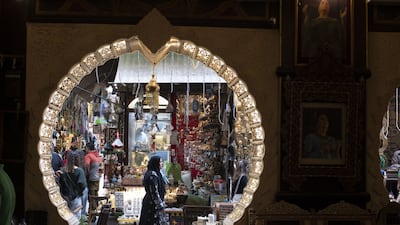
Stores in the Khan Al Khalili bazaar in Cairo, Egypt, during the first week of Ramadan. Bloomberg -
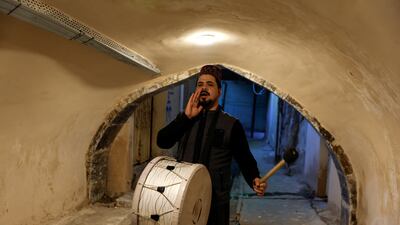
A drummer sounds the wake-up call for residents of the Old City of Mosul, in northern Iraq, before the start of the day's fast. Reuters -

Volunteers prepare food for displaced people to break their fast in Al Qadarif, eastern Sudan. The country is experiencing its second consecutive Ramadan in the grip of conflict. AFP -
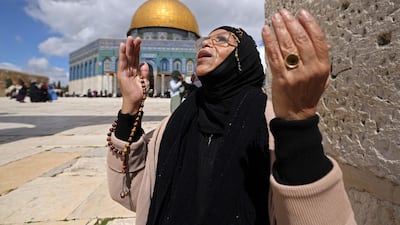
A woman offers first Friday noon prayers of Ramadan near the Dome of the Rock shrine, at the Al Aqsa Mosque compound, in the Old City of occupied East Jerusalem. AFP -
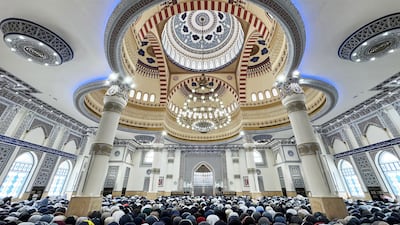
First Friday prayers of Ramadan at Al Farooq Omar bin Al Khattab mosque in Dubai. Pawan Singh / The National -
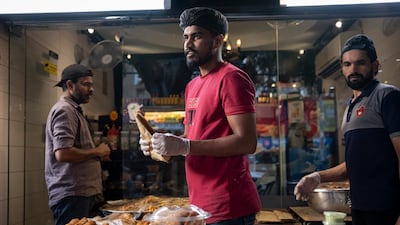
Restaurant staff sell Subcontinent street food to patrons on the streets of Bur Dubai as Iftar approaches. Antonie Robertson/The National -
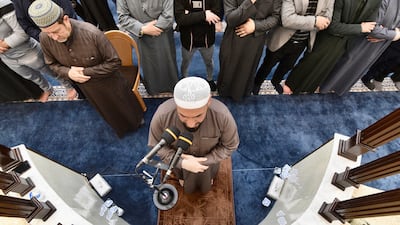
A cleric guides Iraqi devotees as they perform an evening prayer known as 'Tarawih' at the Mohammed Amin mosque near Mosul. AFP -
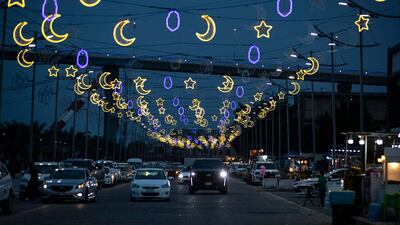
Decorations adorn the streets of the Iraqi southern city of Basra ahead of the Muslim holy fasting month of Ramadan. AFP -
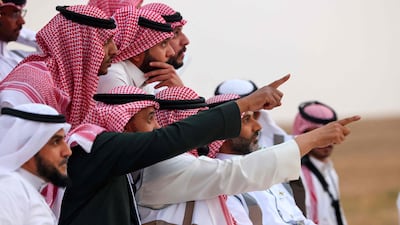
Saudi men look to spot the first crescent of the moon marking the start of the Muslim holy fasting month of Ramadan, in the southern Saudi city of Hautat Sudair. AFP -
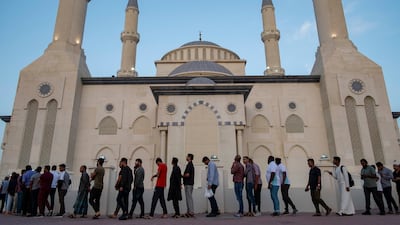
First Ramadan Iftar at the The Al Farooq Omar Bin Al Khattab Mosque located in Dubai, United Arab Emirates. The mosque is named after Umar bin Al Khattab, a companion of The Prophet Muhammad (PBUH) who became the second Caliph after Abu Bakr and was given the title Al Farooq, meaning someone who distinguished truth from falsehood. Antonie Robertson/The National -

Palestinians break their fast amid the rubble of their destroyed home during the Muslim holy fasting month of Ramadan, as the conflict between Israel and Hamas continues, in Rafah, in the southern Gaza Strip. Reuters -
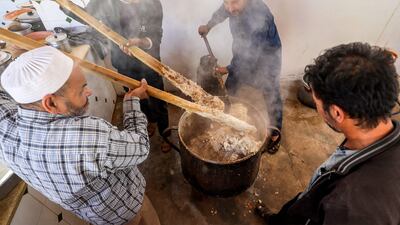
Volunteers cook together portions of the traditional Libyan dish "Bazin", which consists of a dough made with barley, water, and salt in the coastal city of Tajura east of Tripoli, to be distributed to needy families during the Muslim holy fasting month of Ramadan. AFP -
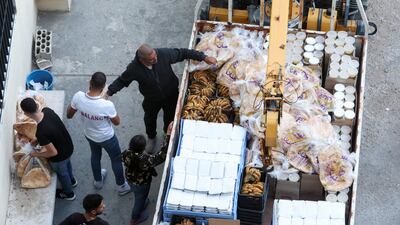
Volunteers prepare to distribute Iftar meals to internally displaced people who fled from their border villages due to ongoing cross-border hostilities between Hezbollah and Israeli forces, at a school turned into shelter, during the holy month of Ramadan, in Tyre, southern Lebanon. Reuters -
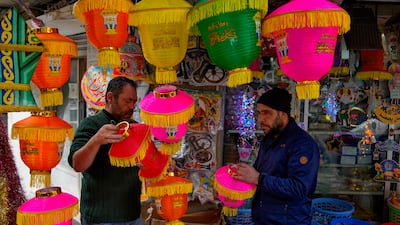
People shop for decorations for the Muslim holy month of Ramadan at a shop in Beirut, Lebanon. AP -
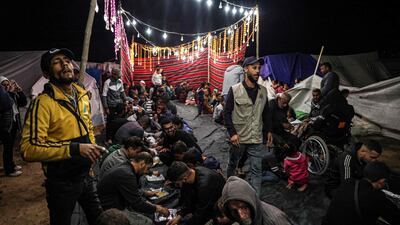
Palestinians share an iftar meal, the breaking of fast, on the first day of the Muslim holy fasting month of Ramadan, at a camp for displaced people in Rafah in the southern Gaza Strip. AFP -
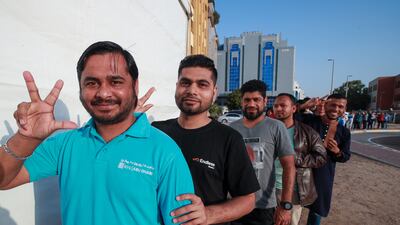
Residents queue outside the iftar tent set up by Emirates Red Crescent and Oxy beside the Abu Dhabi Central Bus Station. Victor Besa / The National -
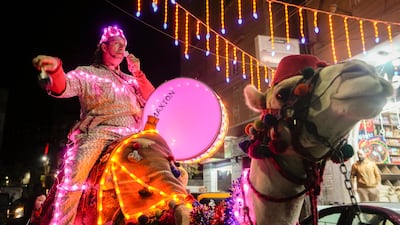
Mohammed El-Dahshan, a 39-year-old "Mesaharati," or dawn caller, rides his camel wrapped with colored led lights to wake Muslims up for a meal before sunrise, during the Islamic holy month of Ramadan, in the Delta city of Dikernis, Egypt, about 93 miles (150 kilometers) north of Cairo. AP -
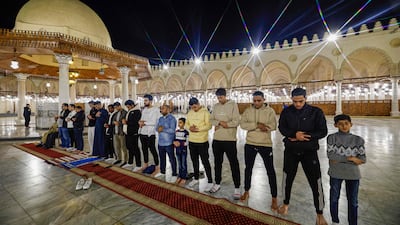
Egyptians perform an evening prayer known as 'Tarawih' on the eve of the Muslim holy fasting month of Ramadan at Cairo's historic mosque of Amr Ibn al-Aas. AFP -
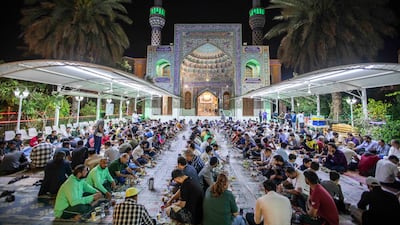
Iftar at Imam Hussein Mosque also known as Iranian Mosque in Al Satwa, Dubai. Leslie Pableo for The National -

First Ramadan Morning Prayer at the The Al Farooq Omar Bin Al Khattab Mosque located in Dubai, United Arab Emirates. The mosque is named after Umar bin Al Khattab, a companion of The Prophet Muhammad (PBUH) who became the second Caliph after Abu Bakr and was given the title Al Farooq, meaning someone who distinguished truth from falsehood. Antonie Robertson/The National -
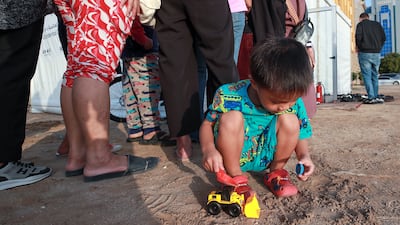
A boy plays with his toys outside the iftar tent set up by Emirates Red Crescent and Oxy beside the Abu Dhabi Central Bus Station. Victor Besa / The National -
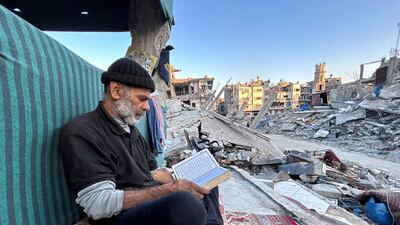
Palestinian man Ismail Al-Khlout reads the Koran as he waits to break his fast while sitting on the rubble of his house, which was destroyed during Israel's military offensive as the conflict between Israel and Hamas continues, during the holy month of Ramadan, in Beit Lahia in the northern Gaza Strip. Reuters -
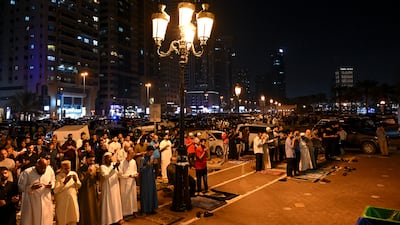
Muslims offering taraweeh prayers at Al Noor mosque in Sharjah. 11th March 2024 Photo Credit:Ahmed Ramzan for The National -

A sells cotton candy for iftar (breaking of the fast) on the first day of the Muslim holy fasting month of Ramadan in the northern Syrian city of Al-Bab. AFP -
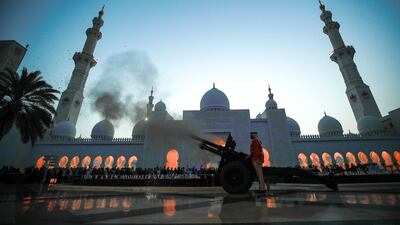
A cannon at Sheikh Zayed Grand Mosque in Abu Dhabi is fired to mark the end of the day's fasting. Victor Besa / The National



