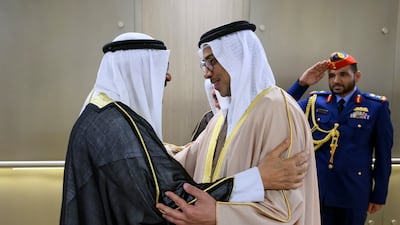
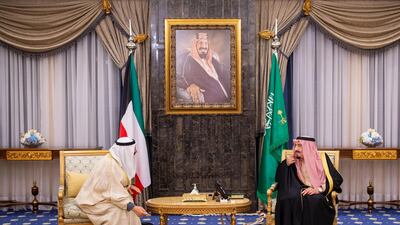
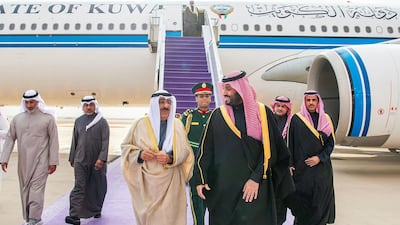
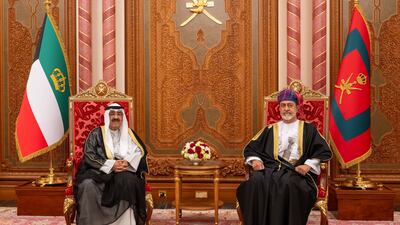
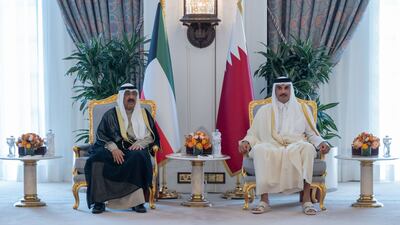
Kuwait’s Emir Sheikh Meshal visited Abu Dhabi on Tuesday on an official state visit.
Sheikh Meshal was received by President Sheikh Mohamed and Sheikh Mansour bin Zayed, Vice President, Deputy Prime Minister and Chairman of the Presidential Court, on his arrival, state news agency Wam reported.
The motorcade at Qasr Al Watan was escorted by horsemen and camel riders, as well as Emirati folk art groups, before Sheikh Mohamed led Sheikh Meshal to the dais of honour.
The ceremony featured the national anthems of the UAE and Kuwait, an honour guard and a 21-gun salute, before Al Fursan aerobatics team depicted the Kuwaiti flag in the sky. Landmarks and streets in Abu Dhabi were also decorated with Kuwaiti flags.
Sheikh Mohamed and Sheikh Meshal discussed relations between their countries, particularly in the economic, trade, investment and developmental sectors.
They also emphasised the need to bolster regional security and stability, while promoting the framework of the Gulf Co-operation Council.
Sheikh Meshal wrote in the Qasr Al Watan VIP guestbook, expressing his appreciation of the UAE’s leadership, government and people.
Sheikh Mohamed awarded the Order of Zayed to Sheikh Meshal, while the President was awarded the Order of Mubarak the Great in return, as a mark of respect between the two nations.
Sheikh Meshal left Abu Dhabi on Tuesday afternoon and was bid farewell by Sheikh Mansour.
“I was pleased to welcome my brother Sheikh Mishal Al Ahmad Al Sabah, Emir of Kuwait, to Abu Dhabi to discuss the strong and deep-rooted bonds that unite our nations in pursuit of a better future for our region,” Sheikh Mohamed wrote on X.
“The UAE and Kuwait are committed to advancing bilateral co-operation as we work to foster progress, prosperity, and stability for all.”
The Emir, who was sworn in as ruler in December following the death of his half-brother Sheikh Nawaf, had already visited the other countries – Saudi Arabia, Bahrain, Qatar and Oman – that make up the GCC over the past couple of months.
Economic and trade agreements and deals between the two countries over the past several decades have contributed to increasing the volume of investments and trade exchanges between Kuwait and the UAE.
In 2014, the UAE and Kuwait established a high-joint committee with an emphasis on intensifying efforts to enhance co-operation between both countries and advance the joint GCC action.
Among the most prominent agreements between the two countries was a three-way deal in the field of securities signed in February 2022 between the Abu Dhabi Securities Exchange, the Kuwait Stock Exchange and the Kuwait Clearing Company.
Statistics from the UAE’s Securities and Commodities Authority indicate that the number of Kuwaiti shareholders in publicly traded companies increased from three individuals in 2000 to 40,979 in 2022, according to the Ministry of Finance.
Trade between the UAE and Kuwait in the first half of 2023 reached Dh22.3 billion ($6.07 billion), while statistics compiled by the Federal Authority for Identity, Citizenship, Customs and Port Security show the total trade exchange between the UAE and Kuwait amounted to Dh44.8 billion during 2023, and Dh44.1 billion during 2022, a growth of 15 per cent compared with 2021.
Kuwaiti Emir Sheikh Meshal on regional tour - in pictures
Recycle Reuse Repurpose
New central waste facility on site at expo Dubai South area to handle estimated 173 tonne of waste generated daily by millions of visitors
Recyclables such as plastic, paper, glass will be collected from bins on the expo site and taken to the new expo Central Waste Facility on site
Organic waste will be processed at the new onsite Central Waste Facility, treated and converted into compost to be re-used to green the expo area
Of 173 tonnes of waste daily, an estimated 39 per cent will be recyclables, 48 per cent organic waste and 13 per cent general waste.
About 147 tonnes will be recycled and converted to new products at another existing facility in Ras Al Khor
Recycling at Ras Al Khor unit:
Plastic items to be converted to plastic bags and recycled
Paper pulp moulded products such as cup carriers, egg trays, seed pots, and food packaging trays
Glass waste into bowls, lights, candle holders, serving trays and coasters
Aim is for 85 per cent of waste from the site to be diverted from landfill
What it means to be a conservationist
Who is Enric Sala?
Enric Sala is an expert on marine conservation and is currently the National Geographic Society's Explorer-in-Residence. His love of the sea started with his childhood in Spain, inspired by the example of the legendary diver Jacques Cousteau. He has been a university professor of Oceanography in the US, as well as working at the Spanish National Council for Scientific Research and is a member of the World Economic Forum’s Global Future Council on Biodiversity and the Bio-Economy. He has dedicated his life to protecting life in the oceans. Enric describes himself as a flexitarian who only eats meat occasionally.
What is biodiversity?
According to the United Nations Environment Programme, all life on earth – including in its forests and oceans – forms a “rich tapestry of interconnecting and interdependent forces”. Biodiversity on earth today is the product of four billion years of evolution and consists of many millions of distinct biological species. The term ‘biodiversity’ is relatively new, popularised since the 1980s and coinciding with an understanding of the growing threats to the natural world including habitat loss, pollution and climate change. The loss of biodiversity itself is dangerous because it contributes to clean, consistent water flows, food security, protection from floods and storms and a stable climate. The natural world can be an ally in combating global climate change but to do so it must be protected. Nations are working to achieve this, including setting targets to be reached by 2020 for the protection of the natural state of 17 per cent of the land and 10 per cent of the oceans. However, these are well short of what is needed, according to experts, with half the land needed to be in a natural state to help avert disaster.
Traces%20of%20Enayat
%3Cp%3E%3Cstrong%3EAuthor%3A%3C%2Fstrong%3E%20Iman%20Mersal%3Cbr%3E%3Cstrong%3EPublisher%3A%3C%2Fstrong%3E%20And%20Other%20Stories%3Cbr%3E%3Cstrong%3EPages%3A%3C%2Fstrong%3E%20240%3C%2Fp%3E%0A
Classification of skills
A worker is categorised as skilled by the MOHRE based on nine levels given in the International Standard Classification of Occupations (ISCO) issued by the International Labour Organisation.
A skilled worker would be someone at a professional level (levels 1 – 5) which includes managers, professionals, technicians and associate professionals, clerical support workers, and service and sales workers.
The worker must also have an attested educational certificate higher than secondary or an equivalent certification, and earn a monthly salary of at least Dh4,000.
How to wear a kandura
Dos
- Wear the right fabric for the right season and occasion
- Always ask for the dress code if you don’t know
- Wear a white kandura, white ghutra / shemagh (headwear) and black shoes for work
- Wear 100 per cent cotton under the kandura as most fabrics are polyester
Don’ts
- Wear hamdania for work, always wear a ghutra and agal
- Buy a kandura only based on how it feels; ask questions about the fabric and understand what you are buying
Ferrari 12Cilindri specs
Engine: naturally aspirated 6.5-liter V12
Power: 819hp
Torque: 678Nm at 7,250rpm
Price: From Dh1,700,000
Available: Now
Ten tax points to be aware of in 2026
1. Domestic VAT refund amendments: request your refund within five years
If a business does not apply for the refund on time, they lose their credit.
2. E-invoicing in the UAE
Businesses should continue preparing for the implementation of e-invoicing in the UAE, with 2026 a preparation and transition period ahead of phased mandatory adoption.
3. More tax audits
Tax authorities are increasingly using data already available across multiple filings to identify audit risks.
4. More beneficial VAT and excise tax penalty regime
Tax disputes are expected to become more frequent and more structured, with clearer administrative objection and appeal processes. The UAE has adopted a new penalty regime for VAT and excise disputes, which now mirrors the penalty regime for corporate tax.
5. Greater emphasis on statutory audit
There is a greater need for the accuracy of financial statements. The International Financial Reporting Standards standards need to be strictly adhered to and, as a result, the quality of the audits will need to increase.
6. Further transfer pricing enforcement
Transfer pricing enforcement, which refers to the practice of establishing prices for internal transactions between related entities, is expected to broaden in scope. The UAE will shortly open the possibility to negotiate advance pricing agreements, or essentially rulings for transfer pricing purposes.
7. Limited time periods for audits
Recent amendments also introduce a default five-year limitation period for tax audits and assessments, subject to specific statutory exceptions. While the standard audit and assessment period is five years, this may be extended to up to 15 years in cases involving fraud or tax evasion.
8. Pillar 2 implementation
Many multinational groups will begin to feel the practical effect of the Domestic Minimum Top-Up Tax (DMTT), the UAE's implementation of the OECD’s global minimum tax under Pillar 2. While the rules apply for financial years starting on or after January 1, 2025, it is 2026 that marks the transition to an operational phase.
9. Reduced compliance obligations for imported goods and services
Businesses that apply the reverse-charge mechanism for VAT purposes in the UAE may benefit from reduced compliance obligations.
10. Substance and CbC reporting focus
Tax authorities are expected to continue strengthening the enforcement of economic substance and Country-by-Country (CbC) reporting frameworks. In the UAE, these regimes are increasingly being used as risk-assessment tools, providing tax authorities with a comprehensive view of multinational groups’ global footprints and enabling them to assess whether profits are aligned with real economic activity.
Contributed by Thomas Vanhee and Hend Rashwan, Aurifer
The biog
Family: Parents and four sisters
Education: Bachelor’s degree in business management and marketing at American University of Sharjah
A self-confessed foodie, she enjoys trying out new cuisines, her current favourite is the poke superfood bowls
Likes reading: autobiographies and fiction
Favourite holiday destination: Italy
Posts information about challenges, events, runs in other emirates on the group's Instagram account @Anagowrunning
Has created a database of Emirati and GCC sportspeople on Instagram @abeermk, highlight: Athletes
Apart from training, also talks to women about nutrition, healthy lifestyle, diabetes, cholesterol, blood pressure
India Test squad
Virat Kohli (c), Mayank Agarwal, Rohit Sharma, Cheteshwar Pujara, Ajinkya Rahane, Hanuma Vihari, Rishabh Pant (wk), Wriddhiman Saha (wk), Ravichandran Ashwin, Ravindra Jadeja, Kuldeep Yadav, Mohammed Shami, Umesh Yadav, Ishant Sharma, Shubman Gill
More on Quran memorisation:
UAE currency: the story behind the money in your pockets
How to apply for a drone permit
- Individuals must register on UAE Drone app or website using their UAE Pass
- Add all their personal details, including name, nationality, passport number, Emiratis ID, email and phone number
- Upload the training certificate from a centre accredited by the GCAA
- Submit their request
What are the regulations?
- Fly it within visual line of sight
- Never over populated areas
- Ensure maximum flying height of 400 feet (122 metres) above ground level is not crossed
- Users must avoid flying over restricted areas listed on the UAE Drone app
- Only fly the drone during the day, and never at night
- Should have a live feed of the drone flight
- Drones must weigh 5 kg or less
Killing of Qassem Suleimani
The specs: 2018 Nissan 370Z Nismo
Price, base / as tested: Dh182,178
Engine: 3.7-litre V6
Power: 350hp @ 7,400rpm
Torque: 374Nm @ 5,200rpm
Transmission: Seven-speed automatic
Fuel consumption, combined: 10.5L / 100km
BMW M5 specs
Engine: 4.4-litre twin-turbo V-8 petrol enging with additional electric motor
Power: 727hp
Torque: 1,000Nm
Transmission: 8-speed auto
Fuel consumption: 10.6L/100km
On sale: Now
Price: From Dh650,000
The%20specs
%3Cp%3E%3Cstrong%3EPowertrain%3A%20%3C%2Fstrong%3ESingle%20electric%20motor%0D%3Cbr%3E%3Cstrong%3EPower%3A%20%3C%2Fstrong%3E201hp%0D%3Cbr%3E%3Cstrong%3ETorque%3A%20%3C%2Fstrong%3E310Nm%0D%3Cbr%3E%3Cstrong%3ETransmission%3A%20%3C%2Fstrong%3ESingle-speed%20auto%0D%3Cbr%3E%3Cstrong%3EBattery%3A%20%3C%2Fstrong%3E53kWh%20lithium-ion%20battery%20pack%20(GS%20base%20model)%3B%2070kWh%20battery%20pack%20(GF)%0D%3Cbr%3E%3Cstrong%3ETouring%20range%3A%20%3C%2Fstrong%3E350km%20(GS)%3B%20480km%20(GF)%0D%3Cbr%3E%3Cstrong%3EPrice%3A%20%3C%2Fstrong%3EFrom%20Dh129%2C900%20(GS)%3B%20Dh149%2C000%20(GF)%0D%3Cbr%3E%3Cstrong%3EOn%20sale%3A%3C%2Fstrong%3E%20Now%3C%2Fp%3E%0A
Mobile phone packages comparison