

Abu Dhabi has launched a new air quality improvement plan to pinpoint pollution hotspots and curb the environmental impact of building development in the emirate.
The cutting-edge air-quality system – developed by the Environment Agency Abu Dhabi – aims to reduce exposure to pollution and provide cleaner air across the capital.
The agency said the system will support environmental regulation policies by assessing the expected impact of urban development projects.
It will include the release of detailed emirate-wide air-quality maps each year and will work to identify areas experiencing higher levels of pollution.
Data gathered under the strategy will be shared with the public through air-quality forecasts.
'Better air quality for all'

"Air pollution represents the biggest environmental threat to human health," said Faisal Al Hammadi, executive director of the agency's Environmental Quality Sector.
"Therefore, robust evidence-based tools and systems are required to enable the effective management of air quality, to support the identification and selection of measures that will reduce air pollution and protect human and environmental health.
“As our mandate is the emirate of Abu Dhabi, we have developed a bespoke Air Quality Modelling System for the emirate that will strengthen our ability to secure better air quality for all.
"The new system will have the immediate capacity to support permitting activities, compliance evaluation and the future development of scenarios. It will also assist with air-quality forecasts, public awareness and, most importantly, climate and odour impacts.
“Similarly, the new air-quality modelling capability will also support the evaluation of human exposure to air pollution, develop robust atmospheric emission inventories, tools and databases – which include air emissions and GHG [greenhouse gas] emissions – and, most importantly, support and expedite decision-making in environmental emergencies.”
Heavy industry, traffic congestion and weather factors, such as sand and dust storms, which are prevalent in the region, all contribute to poor air quality.
In July, air quality in parts of the UAE were rated “hazardous” as a result of increasing wind bringing dusty conditions over the weekend.
IQ Air Index, a global indicator of air quality, issued the alert following the challenging weather conditions.
Doctors in the UAE have previously told The National how air pollution can adversely affect health, particularly for those with underlying respiratory illnesses such as asthma, who can develop a worsening cough and difficulty breathing if exposed to dust and smoke.
A network of 22 air monitors across the emirate, 20 of which are fixed and two that are mobile, are already in place to analyse Abu Dhabi's air quality.
The air monitors track 14 pollutants to check how healthy or unhealthy the air is.
The environment agency said pollutants of major concern were particulate matter – which consists of tiny particles that come from human and natural sources – and ground ozone.
"Sulphur dioxide levels are within UAE limits across most of the ambient air-quality-monitoring network, although an increase in concentrations has been observed over the past few years in the Al Dhafra Region," the agency said in a statement on Sunday.
"Hydrogen sulphide concentrations are not at harmful levels to the public but frequent episodes of odour nuisance due to hydrogen sulphide have been recorded.
"Levels of nitrogen dioxide and carbon monoxide are below the limits set in the UAE air-quality standard."
UAE air-quality drive
In August, Mariam Al Mheiri, Minister of Climate Change and Environment, announced that a new study would explore the effect of air quality on public health.
The report, to be conducted by the ministry in partnership with the Pure Health group, will focus on how air quality affects longevity and quality of life.
“By assessing the impact of air quality on health, we can make informed decisions that contribute to effective climate action, enhance community health and achieve comprehensive sustainability,” Ms Al Mheiri said.
Globally, the UAE is slightly below average for exposure to PM2.5, particulate matter that causes air pollution.
Figures published by the World Bank, taken from the 2017 Global Burden of Disease Study, showed the mean annual exposure to PM2.5 in the UAE is 41 microgrammes per cubic metre.
This is compared with the World Health Organisation's recommended maximum of 5 microgrammes per cubic metre. The global average is 46.
Global air pollution - in pictures
-

The sky is filled with smog above Marine Drive in Mumbai, India. AP Photo -
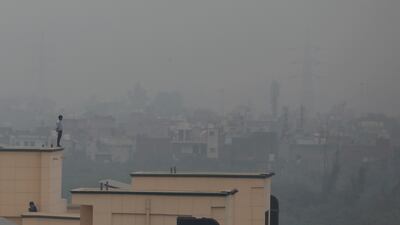
A man is seen standing on the ledge of a building as smog envelopes the horizon in New Delhi, India. AP Photo -
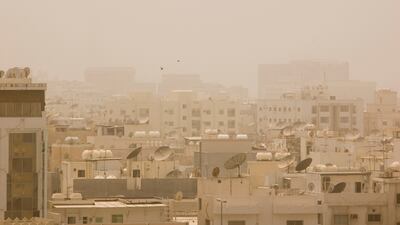
A sandstorm in Manama, capital of Bahrain. Photo: Getty Images -
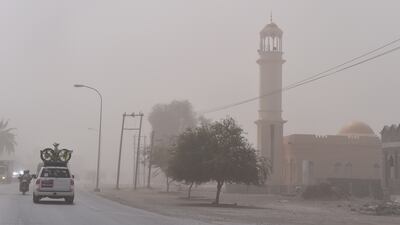
Sandstorm in Oman. Photo: Getty Images -
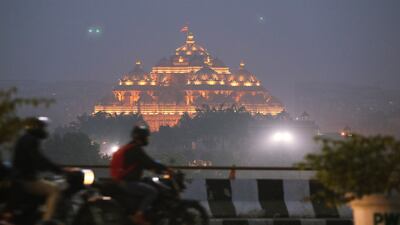
The Swaminarayan Akshardham temple is engulfed in a thick layer of smog as air quality hits the ' very poor ' category in New Delhi. EPA



