



Expo City Dubai is to be powered entirely using electricity generated from renewable sources.
Dubai's Electricity and Water Authority is to provide 100,000 megawatts of renewable energy from the Mohammed bin Rashid Al Maktoum Solar Park, the world's largest solar park.
It will be used to power homes and businesses in Expo City Dubai, as part of the country's plan to achieve net-zero emissions by 2050 and support the venue's role as a hub in the Dubai 2040 Urban Master Plan.
The move comes as Expo City Dubai prepares to host the Cop28 climate change summit on November 30.
Expo City Dubai and Dewa signed an agreement during a ceremony on Tuesday, which was witnessed by Sheikh Mohammed bin Rashid, Vice President and Ruler of Dubai, and Sheikh Hamdan bin Mohammed, Crown Prince of Dubai.
-
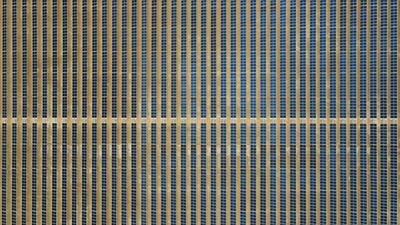
An aerial view of Mohammed bin Rashid Solar Park in Dubai in January 2022. Solar is essential to the UAE's new energy mix. All photos by Pawan Singh / The National -
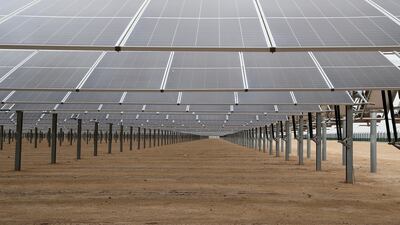
The fifth phase of a clean energy project at the Mohammed bin Rashid Solar Park will further help reduce carbon emissions. -

An aerial view of the Solar Park in the Dubai desert. -
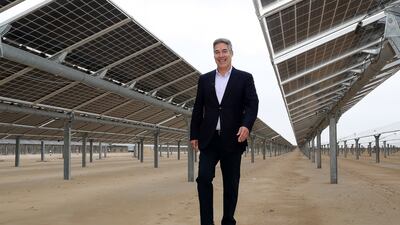
Marco Garcia, chief commercial officer of Nextracker, a US company which has provided photovoltaic technology used in the project. -
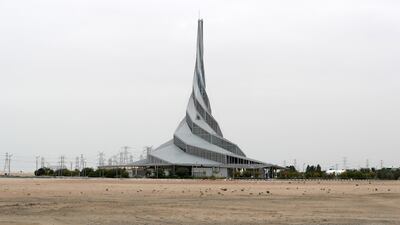
The Innovation Centre at the MBR Solar Park in Dubai, where machine learning is being utilised to track direct sunlight to maximise efficient energy capture, storage and transmission. -

The solar powered panels follow the path of the sun to help the emirate reach its clean energy transition goals. -
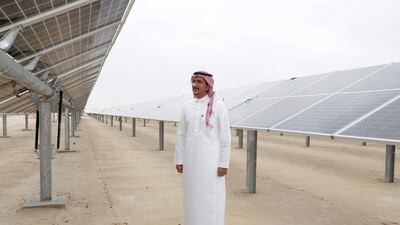
Omar Al Hassan, chief executive of Shuaa Energy 3, the company operating the scheme, says the vast project will ultimately create clean energy to power more than 250,000 houses in Dubai. -
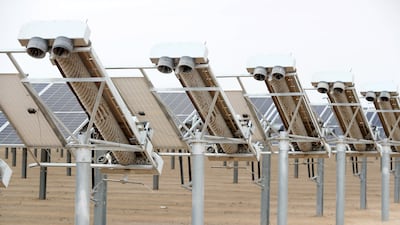
Robotic cleaning systems are installed on the solar panels. -
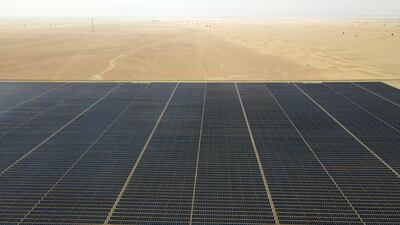
More than 2.5 million photovoltaic modules have been fitted during phase 5 of the project.


“As the global population continues to gravitate towards urban centres, it is critical these centres balance meeting the needs of their communities with environmental sustainability – a strategic priority for the UAE,” said Reem Al Hashimy, Minister of State for International Co-operation and chief executive of Expo City Dubai Authority, who was present at the ceremony.
“This agreement reflects an important step forward in our focus on sustainable development and the transition to clean energy, with Expo City being one of five urban hubs in Dubai's growth.
“It is also a timely transition as Expo City Dubai prepares to host the world once again for Cop28, supporting global climate action.”
The Mohammed bin Rashid Al Maktoum Solar Park currently has a clean energy capacity of 2,627 megawatts. Construction is under way to increase this capacity to 2,033MW, to reach 4,660MW by 2026.
By 2030, the solar park's capacity is planned to reach 5,000MW, contributing to an annual reduction of more than 6.5 million tonnes of carbon emissions.
In August, Dewa said it selected Abu Dhabi's renewable energy company Masdar to build and operate the 1,800MW sixth phase of the solar park.
“It is a significant accomplishment that Expo City Dubai, the site of Cop28, will be powered by renewable energy produced here in the UAE, made possible by the world-class scale and ambition of the Mohammed bin Rashid Al Maktoum Solar Park, with key phases developed by Masdar," said Dr Sultan Al Jaber, UAE Minister of Industry and Advanced Technology, chairman of Masdar and Cop28 President-designate.
"It is a tangible demonstration of our climate action leadership and another step forward in decarbonisation at home and abroad, as we call on the world to triple renewable energy capacity and double energy efficiency by 2030 to keep the ambition of 1.5ºC degrees within reach."
The UAE has been investing heavily in renewable energy projects to achieve net-zero emissions by 2050.
In November, it approved an updated version of the UAE Energy Strategy 2050 and the development of the National Hydrogen Strategy in July.
As part of the plan, the UAE plans to invest Dh200 billion ($54 billion) by 2030 to ensure energy demand is met while sustaining economic growth.

