


Fire-hazard cladding has been removed from the first of 40 high-risk buildings in Sharjah in the initial phase of a Dh100 million safety drive.
Authorities in April identified 203 residential towers and commercial buildings, both privately and government owned, where flammable building materials needed to be replaced.
Existing cladding will be replaced with fire-resistant materials to reduce the risk of fires spreading quickly and provide potentially life-saving additional time for emergency services to respond.
The scheme was launched under the directives of Sheikh Dr Sultan bin Muhammad Al Qasimi, Ruler of Sharjah, in an effort to cut the number of building fires and protect the public.
Safety upgrades on the remaining 163 buildings will be carried out once the initial high-priority stage of the project is complete.
The key improvement works are being funded entirely by the Sharjah government, which aims to complete all the work by the second quarter of 2024.
Sharjah Municipality is overseeing the initiative in partnership with Sharjah Civil Defence Authority and the emirate's Department of Planning and Survey.
"This project embodies the emirate's unwavering commitment to providing the highest levels of safety and security in our residential and commercial buildings,” said Obaid Al Tunaiji, director general of Sharjah Municipality.
He said all aluminium panels in the first building were removed and replaced with fire-resistant materials approved by Sharjah Civil Defence Authority.
“This has not only strengthened the building's security system but has also enhanced the overall safety and peace of mind for its residents.”
Officials shared a picture of the revamped building, but did not disclose its name or location.
Khalifa Al Suwaidi, acting director of technical services at Sharjah Municipality, said authorities are working closely with building owners to carry out the improvements.
“Before implementation begins we communicate with building owners and receive final designs for each building,” he said.
“There are great efforts by the municipality to complete the entire project during the second quarter of next year."
-
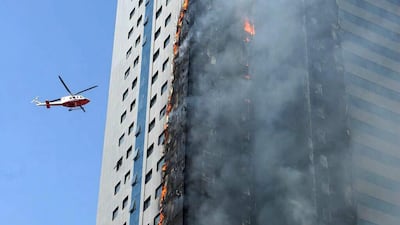
-
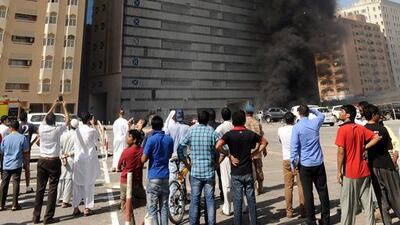
Fire engulfs Abdul Naser building, a 32-storey residential tower, on King Faisal Street in Sharjah on Thursday. AFP -
Residents were forced to flee their homes on Thursday after flames were seen spreading up outside their 32-floor tower block. Thaer Zriqat/The National -
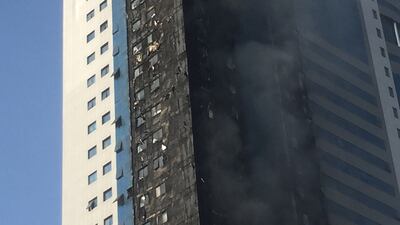
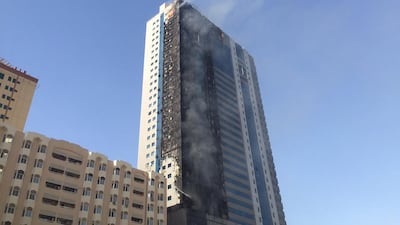
Plumes of black smoke could be seen pouring from the Abdul Naser building in King Faisal Road, Sharjah, from miles around. Thaer Zriqat/The National -
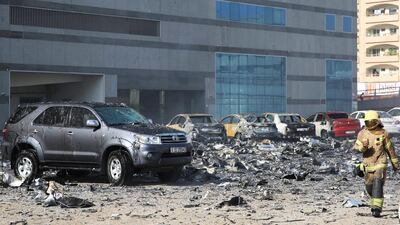
Civil defence, ambulances and police were called to the fire at 1.37pm and rescue workers immediately began to evacuate the burning building. AP Photo -
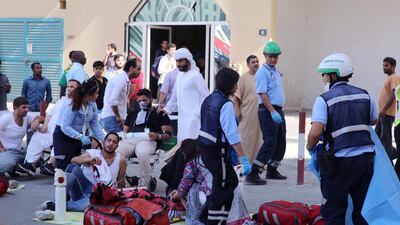
Rescue workers help the injured. AP Photo -
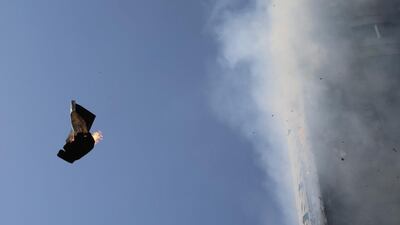
No one was badly injured in the blaze but some people were treated for panic attacks and breathing difficulties. AP Photo -
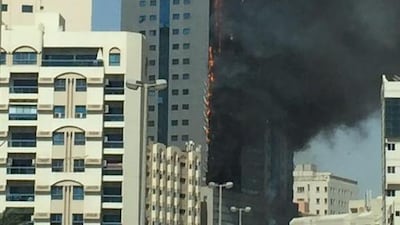
It is believed that 19 people were treated for smoke inhalation and 200 families were left homeless and are being cared for by Emirates Red Crescent. Courtesy Sharjah Civil Defence -
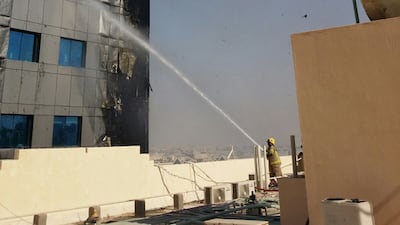
Residents were forced to flee their homes on Thursday after flames were seen spreading up outside their 32-floor tower block. Courtesy Sharjah Civil Defence


Vital safety plan
Aluminium composite-panel cladding was prohibited in the Emirates under the country's Fire and Life Safety Code of Practice, which was introduced in January 2017.
Further updates came into effect the following year.
New buildings must be fitted with advanced non-combustible cladding that is able to stop the spread of flames and is more durable under intense heat.
It is not mandatory for buildings built before the new legislation was introduced.
A high-rise Sharjah tower that was gutted in May 2020 was covered with cladding that is banned on newer buildings.
Abbco Tower was built in 2005 with an external material that was widely used in the Emirates until it was prohibited in 2017.

