

Latest: First-ever look inside the Sky Palace, the Burj Khalifa penthouse on sale for $49.5m
Several residents in Dubai posted videos of Burj Khalifa being struck by lightning on Thursday – a common phenomenon during stormy weather in the emirate.
While the world's tallest building is typically known for its visual shows, it's also a lightning rod for the city during thunderstorms.
Thunder and lightning in Dubai over the past 24 hours meant residents and visitors were treated to a different sort of light display on Thursday evening.
Sheikh Hamdan bin Mohammed, Crown Prince of Dubai, posted a video on Instagram showing lightning striking the skyscraper, as seen in the wing mirror of a car.
A social media user also captured the lightning strike, with the sound of thunder following seconds later.
At 828 metres tall, the structure is susceptible to lightning strikes during stormy weather.
Its official website describes the building as "one of the most conspicuous lightning conductors in the world".
Enough to charge the tower
So how does the building cope with strikes? Situated at the top of the tower is a lightning arrester that contains a system capable of detecting nearby electrical storms.
The arrester detects the polarity of the lightning and gives itself the opposite charge.
The tower's steel exoskeleton acts as a giant Faraday cage that discharges the electricity around the outside.
The rod at the top of the arrester can measure the intensity of the lightning strikes, while the arrester is powered by a tiny battery to isolate it from the central mains and possible surges.
Three years ago, former Top Gear presenter Richard Hammond climbed to the top of the tower with Bashar Kassab, senior director of facilities management at Burj Khalifa at the time, for his TV show Big on the Discovery Channel.
"It takes roughly 50 milliseconds for it to hit and bounce back and if we could capture it, it would be enough to power up this building for one year," Mr Kassab said, while the pair were at the top of the building to replace the arrester's battery.
Suvin Mathew, lightning protection system product specialist with JSM Energy Middle East in Dubai and Fujairah, explained that there are typically two types of systems for lightning protection – the conventional type and the advanced active ESE (early streamer emission) type.
"When lightning strikes, in a conventional system – which is British standard – there’s a mesh system on the roof using copper conductors," he told The National.
"The conventional system has copper conductors that are run on the roof and the peripherals and are placed on the side of the building. These down conductors are run vertically to the ground and connected to the earth pits."

The lightning rods are designed in such a way that charge flows down these conductors and then into the ground safely as the lightning strikes.
The advanced active type involves an air terminal or an early streamer emission system.
"ESE Air Terminals are designed to ensure that your building is covered within its arrester’s protective radius," Mr Mathew said.
"An ESE arrester is widely used in all commercial, residential, industrial sites, administrative or public buildings, monuments, and open-air sites, such as sports grounds and stadiums."
He said this type of lightning protection system is much more cost-effective, with a simple design and easy to maintain.
Global stature
Burj Khalifa is the centrepiece of New Year's Eve celebrations in Downtown Dubai. Thousands of people gather every year to see the fireworks and laser shows.
The facade of the tower acts as one of the world's largest billboards, displaying images and tributes, as well as the countdown to the new year.
Inaugurated on January 4, 2010 by Sheikh Mohammed bin Rashid, Vice President and Ruler of Dubai, the building is well established as a global landmark, attracting millions of visitors keen to ascend to the observation deck or gather at Burj Park and the Dubai Fountain.
In its 13-year history, the tower has also featured in some cinematic and viral moments.
It featured in the 2011 blockbuster Mission: Impossible – Ghost Protocol, with Tom Cruise climbing its exterior.
Two years ago, Emirates airline caused a stir when it posted a video on social media with skydiver and stuntwoman Nicole Smith-Ludvik dressed as cabin crew and standing on top of the building.
Dubai photographer captures Burj Khalifa like you’ve never seen it - in pictures
-
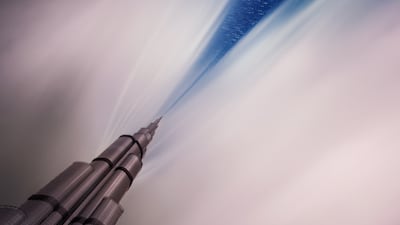
Afzal is currently showing his work in Gallery 4 in an exhibition titled The Future Past at The Foundry in downtown until October 30. -

Baber Afzal's dramatic and surreal photography captures the UAE's epic architecture. All Photos: Baber Afzal -
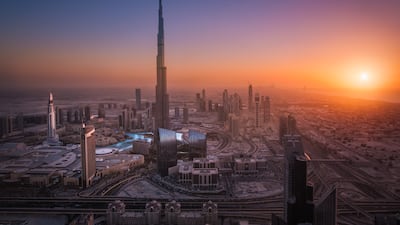
'I always tend to pre-visualise my images and how they would turn out before I set out to shoot,' the photographer says. -

Afzal combines on-site shooting and post-production techniques to create awe-inspiring images that look real and don't feel overly worked. -
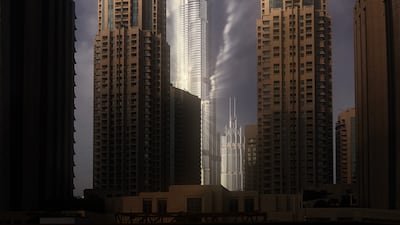
In regards to his process, Afzal says, 'Once I’ve locked what I‘ve envisioned, I scout the location and view the possible vantage points to shoot. Once I have shot it, I spend time countless hours in post-production to bring as close as possible to what I had originally envisioned.' -
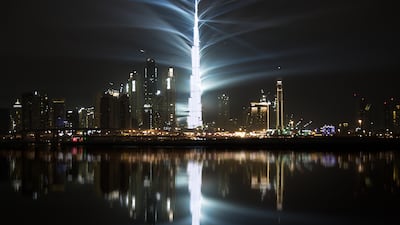
Afzal experiments with long-exposure techniques, along with various blending and compositing methods and techniques in post-production. -
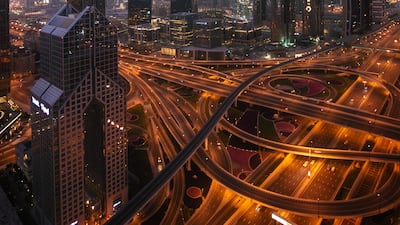
'In some instances, I capture the perfect moment and enhance it, while in other cases I enhance the surroundings to create the perfect moment,' Afzal says. -
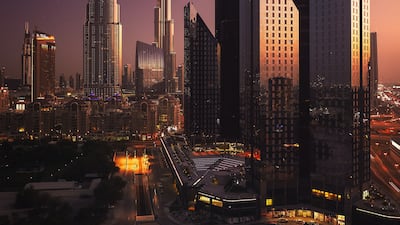
Afzal credits the way in which Dubai and the UAE were designed as to why the city and its landmarks are so photogenic. -
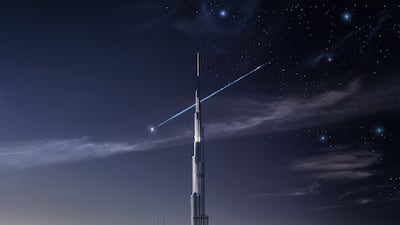
'I want people to not only be wowed by how stunning the cityscapes look but to be taken aback by how far Dubai has come,' Afzal says. -
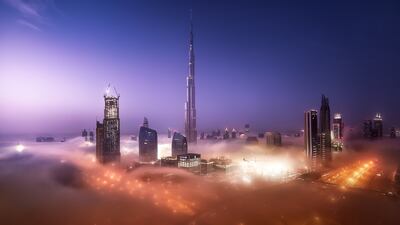
Afzal’s work captures a contemporary and futuristic vision of Dubai that is also epic and timeless.



