



It has been a mixed month for the fortunes of fast railways.
On the one hand, Indonesia has just launched “Whoosh”, South-East Asia’s first bullet train. On the other, the United Kingdom has just scrapped a key section of its HS2 project, citing prohibitive projected costs of £106 billion ($129.46 billion).
But if high-speed rail has hit the buffers in Britain, for the rest of the world it’s full speed ahead.
More than a dozen new services on five continents are in the pipeline. These include Etihad Rail’s 1,200km network that will eventually whisk passengers at 200kph from the Saudi Arabian border across all seven emirates and into Oman.
International Union of Railways
The “Whoosh” trains – an acronym in Indonesian for “timesaving, optimal operation, reliable system” – have slashed the journey time between the capital Jakarta and Bandung in West Java from three hours to 40 minutes.
The Chinese-built trains, part of Beijing’s Belt and Road initiative, travel at up to 350kph, with the whole project estimated to have cost about $10 billion. That translates to about $50 million per kilometre of track.
In contrast, Britain’s HS2, which would have run from London to Manchester via Birmingham was expected to cost £306 million for each of the 345 miles (555km) of track – with a completion date some time in the 2030s.
High-speed future
Embarrassing as this is for the country that gave the world the first passenger trains as far back as 1825, nearly 200 years later high-speed rail is seen as the future almost everywhere else.
The data website Statista estimates the Asia Pacific region, which includes Australia, has nearly 7,000km of high-speed rail in the pipeline.
For Europe, the figure is nearly 6,000 and in the Middle East nearly 5,000km. Africa is building more than 2,000km and North America about 1,500. Only South America is missing out.
This year’s International Union of Railways was held in Morocco, where its chairman, Krzysztof Maminski, said: “The number of countries making use of high-speed railways is only increasing, as additional countries are in the process of developing projects. Investment in high-speed is not an extravagance, but an investment in changing the mobility system and the system of social behaviour.”
The host country, Morocco, is one of those investing in high-speed rail, defined by the IUC as “infrastructure for new railway lines designed for speeds of 250kph and above, or upgraded existing lines for speeds of up to 200kph or even 220kph.”
HS2 rail project – in pictures
-
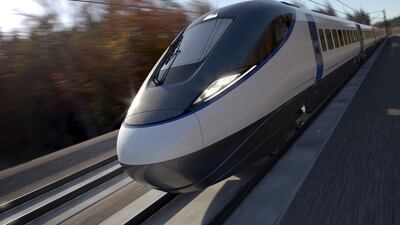
An artist's impression of an early visualisation of an HS2 train. PA -
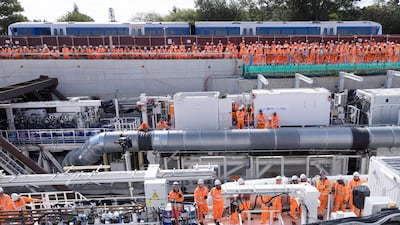
The first of the two tunnel boring machines run by HS2 Ltd begins work on the project in October 2022 in Ruislip, west London. Getty Images -
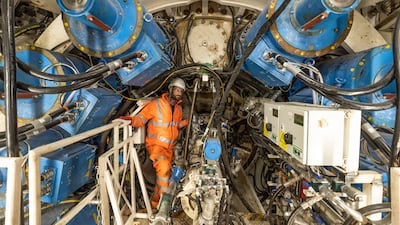
Workers help bore tunnels. Getty Images -
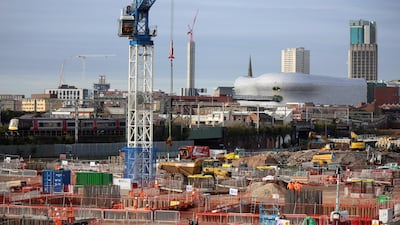
The HS2 rail Curzon Street Station construction site in Birmingham in October 2022. Reuters -
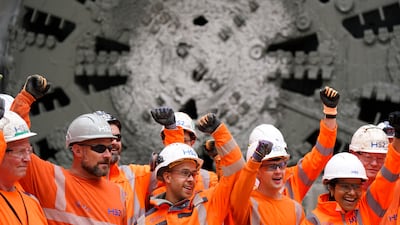
The 2,000-tonne tunnel boring machine nicknamed Dorothy completes a one-mile dig under Long Itchington Wood in Warwickshire in July 2022. PA -
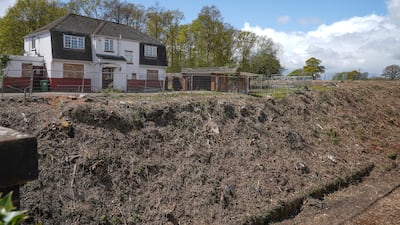
Vegetation and trees have been removed, and empty homes such as this one that was bought under compulsory purchase, lie empty having made way for HS2 tracks. Getty Images -
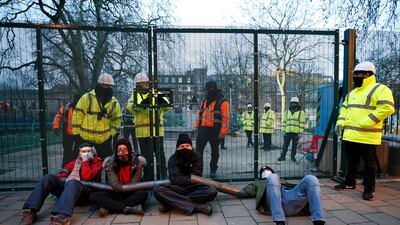
Environmental protesters lock themselves together at a Stop HS2 camp at Euston Square Gardens, London, in February 2021. Getty Images -
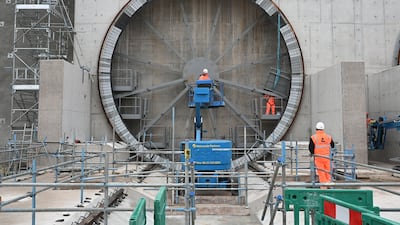
Construction workers continue work on the entrance to the HS2 Chiltern tunnels in December 2020 in Rickmansworth. Getty Images -
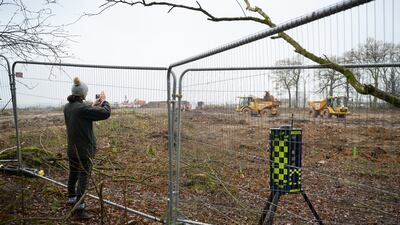
Land is cleared along the planned HS2 route, near Leamington Spa. Getty Images -

HS2 protesters are removed by police in Jones Hill Wood in October 2020 in Great Missenden. Getty Images -
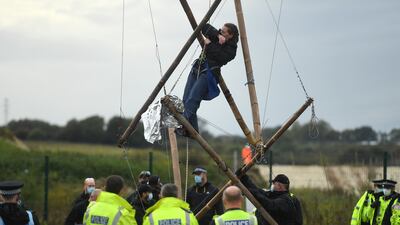
An environmental activist hangs from a bamboo structure at a protest calling for an end to infrastructure work for the proposed HS2 route in October 2020 in Denham. Getty Images -
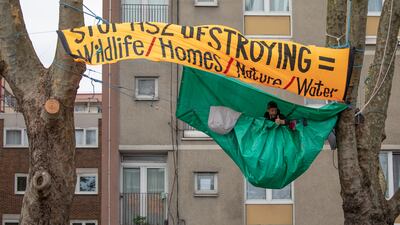
A protester sits in a hammock between trees near Euston Station in London in October 2020. Getty Images -
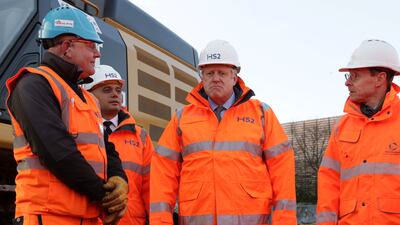
Then-prime minister Boris Johnson on a visit to Curzon Street Station in Birmingham in February 2020. Getty Images -
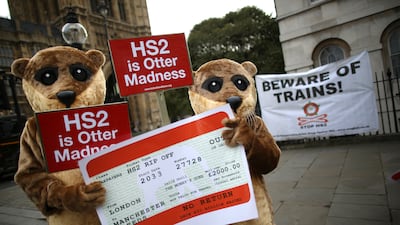
Protesters dressed as otters demonstrate against HS2 near Parliament in London in November 2013. Getty Images -
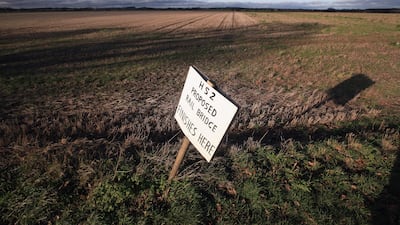
A protest placard marks the spot where a new HS2 rail bridge is proposed at the village of Middleton in Staffordshire in January 2012. Getty Images


Al Boraq, named after the mystical creature that transported the Prophet Mohammed from Makkah to Jerusalem in a single night, connects the cities of Casablanca and Tangier. Completed in 2018, it was Africa’s first high-speed train, with future plans for a Maghreb link from Rabat to Fez.
In Europe, France is building a new line from Lyon to Turin in Italy, expected to be complete in 2030. The Baltic states of Estonia, Latvia and Lithuania are planning an 870km connection with the rest of Europe, a project both political and economic given they were once client states of the Soviet Union.
For length though, nothing competes with two projects in North America. The California High Speed Rail line should connect Los Angeles and San Francisco, a distance of 1,300km, in less than three hours.
Cost overruns and environmental concerns have often threatened to derail the project, with only the central section currently under construction and unlikely to be carrying passengers before 2030.
Canada’s High Frequency Rail project will link Toronto with Quebec City. Although still in the planning stage, procurement for building has begun, with the hope that trains will run by 2030.
Australia is also late to the game, despite an experiment with tilting trains that reached a top speed of 210kph in the 1990s. Earlier this year, the country created a new High Speed Rail Authority, charged with building a network on the east coast.
The new line will connect Sydney with Newcastle, a distance of only 162km. By the time it reaches Melbourne, though, it will be the 2050s.
Longest and fastest
One country where high-speed rail is very much a thing of the present is Turkey, which in 2003 began building and now connects major cities, including Istanbul and the capital Ankara, via a flagship service that completes the 562km at speeds of up to 250kph.
By next year Turkey expects to have about 10,000km of high-speed railway, which it is building with help from a Chinese consortium.
It brings the number of countries with high-speed trains to 29, although some run only on an upgraded track, a much cheaper if slower option than purpose-built lines.
Although the world’s first high-speed service was Japan’s legendary Shinkansen, or bullet train, in the 1960s, it is China that now leads the way.
The world’s longest network has reached 42,000km, two thirds of the global total. It includes the world’s longest high-speed line, 2,298km from Beijing to Guangzhou on the border with Hong Kong, which takes just nine hours. China also has the world’s only high-speed sleeper trains.
The China Railways Harmony trains are also recorded as the world’s fastest, reaching 486 kph in testing, although the Shanghai Maglev, a levitating train that connects to the airport, has recorded a top speed of 501kph.
Three years ago, a Chinese company was reported to have put in a bid to build the UK’s HS2, saying they could complete it in five years and at half the expected price.
The offer came to nothing. Instead, Prime Minister Rishi Sunak has decided to use £8 billion ($9.76 billion) of the money saved from scrapping the link to Manchester to fill in potholes on Britain’s crumbling roads.
By coincidence, this is also almost exactly the price of Indonesia’s new high-speed rail service.

