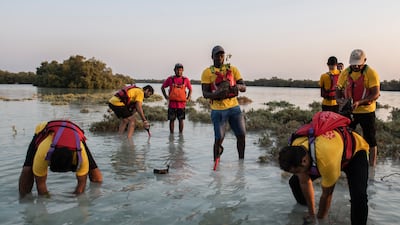
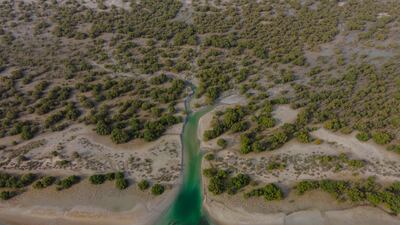
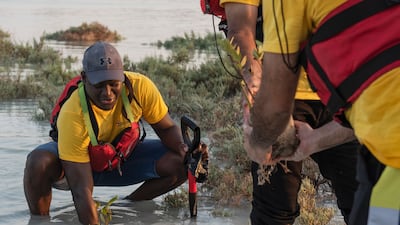
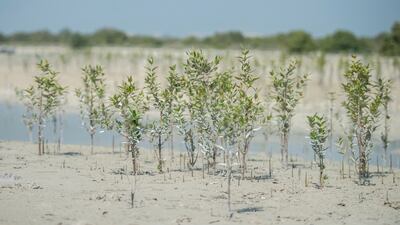
Newly planted mangrove seedlings in Jubail Mangrove Park in Abu Dhabi. Victor Besa / The National

UAE to plant 10 mangroves for every person attending Cop28


  • English
  • Arabic

Ten mangroves will be planted in Abu Dhabi for each visitor attending the Cop28 climate change summit this year, environment officials have said.

Cop28, which will be held between November 30 to December 12 at Expo City Dubai, is set to attract about 80,000 attendees from around the world for talks and conferences.

That could mean that an estimated 800,000 mangrove trees could be planted in Abu Dhabi.

The Environment Agency Abu Dhabi has pledged to plant these mangroves using drone technology in the last quarter of this year.

The mangrove trees will be planted in coastal areas such as Marawah Marine Biosphere Reserve, Al Mirfa City and Jubail Island during the winter months, which is said to be the best time for the species to grow.

Dr Shaikha Al Dhaheri, Secretary General of the agency, said the project aims to support the UAE's Year of Sustainability drive, as well as the UAE National Net Zero 2050 initiative and the UAE's goal of planting 100 million mangroves by 2030.

That pledge that was made at the Cop26 conference in Glasgow in 2021.

“This initiative also highlights the UAE's commitment to achieving climate neutrality and promoting nature-based solutions to reduce the effects and adapt to climate change and reduce the environmental footprint of conference visitors, at the rate of absorbing one tonne of carbon for every 5,000 mangrove trees,” Dr Al Dhaheri said.

The project will also serve as a platform for developing innovative solutions for mangrove conservation, climate change mitigation and raising awareness of their importance.

Al Zorah City in Ajman has pledged to expand its Natural Mangrove Reserve. Photo: Al Zorah City

The UAE is home to more than a dozen areas of mangroves and the country plans to expand and develop their presence along its coastline.

Mangroves in Abu Dhabi support a wide range of biodiversity and help protect seagrass beds and coral reefs from sedimentation.

They also enhance water quality and support ecotourism activities.

“Building a resilient, net-zero future depends on halting nature loss and restoring our natural ecosystems,” said Razan Al Mubarak, UN Climate Change High-Level Champion for Cop28.

“Nature-based solutions, including those involving mangroves, have the potential to supply over a third of our climate mitigation needs and build resilience to the effects of climate change.

“I welcome this EAD-led initiative, which both raises awareness and takes action to restore and protect mangroves in the UAE.”

Al Zorah City in Ajman is also set to double its natural mangrove reserve with hundreds of thousands of mangrove trees over the next year.

The initiative, which launched on Tuesday, is a commitment from Al Zorah City, a joint venture between the Ajman government and Solidere International PLC, a leading real estate developer in the emirate.

Al Zorah currently houses more than 500,000 trees responsible for producing millions of litres of oxygen per day, spanning more than one million square metres and harbouring more than 200 species of native and migratory birds.

"Al Zorah Mangrove Natural Reserve is a treasured part of our community in Ajman," Sheikh Rashid bin Humaid Al Nuaimi, chairman of the Al Zorah City board of directors, said in a press release.

"We are pleased to announce our initiative for 2023, which strives to increase our green footprint in the Emirate and support the UAE in its long-term sustainability targets and the upcoming highly anticipated Cop28."

Conserving mangroves in the UAE – in pictures

  • People plant mangroves during an event organised by Companies for Good on Jubail Island, Abu Dhabi. All photos: Vidhyaa Chandramohan
    People plant mangroves during an event organised by Companies for Good on Jubail Island, Abu Dhabi. All photos: Vidhyaa Chandramohan
  • To fight climate change, the UAE is carrying out projects such as reducing emissions and planting mangroves.
    To fight climate change, the UAE is carrying out projects such as reducing emissions and planting mangroves.
  • Mangroves, trees that survive in salty water, play an important part in the ecosystem.
    Mangroves, trees that survive in salty water, play an important part in the ecosystem.
  • By 2030, the UAE intends to plant 100 million mangroves.
    By 2030, the UAE intends to plant 100 million mangroves.
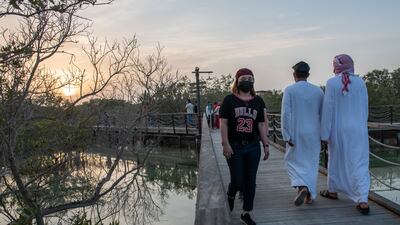
  • Visitors at Jubail Mangrove Park. Schools and businesses are planting saplings as part of the UAE's campaign.
    Visitors at Jubail Mangrove Park. Schools and businesses are planting saplings as part of the UAE's campaign.
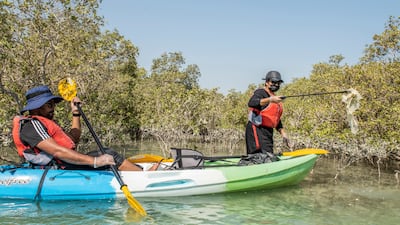
  • Volunteers during a mangrove clean-up organised by the World Wildlife Fund and Seahawk Abu Dhabi.
    Volunteers during a mangrove clean-up organised by the World Wildlife Fund and Seahawk Abu Dhabi.
  • Young mangroves can be damaged by plastic and other waste dumped into the sea.
    Young mangroves can be damaged by plastic and other waste dumped into the sea.
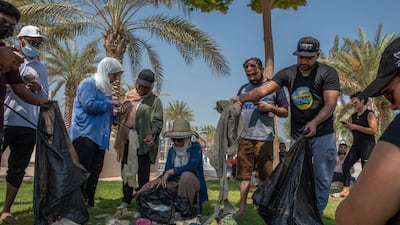
  • Volunteers sort rubbish gathered during a clean-up of mangroves in Abu Dhabi.
    Volunteers sort rubbish gathered during a clean-up of mangroves in Abu Dhabi.
  • After collecting debris from the mangroves, volunteers use an app to track their progress.
    After collecting debris from the mangroves, volunteers use an app to track their progress.
  • The grey mangrove is the species that grows extensively in UAE.
    The grey mangrove is the species that grows extensively in UAE.
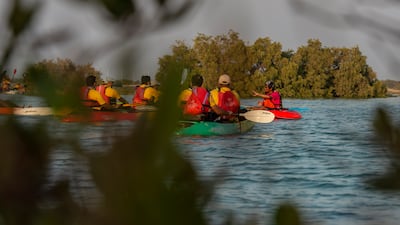
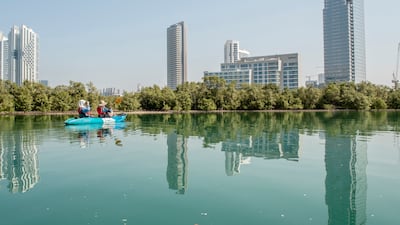
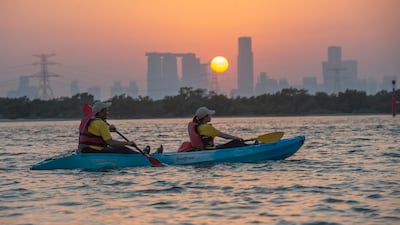
  • Visitors enjoy an evening paddle by the mangroves and a sunset view of Abu Dhabi.
    Visitors enjoy an evening paddle by the mangroves and a sunset view of Abu Dhabi.

Abdul Jabar Qahraman was meeting supporters in his campaign office in the southern Afghan province of Helmand when a bomb hidden under a sofa exploded on Wednesday.

The blast in the provincial capital Lashkar Gah killed the Afghan election candidate and at least another three people, Interior Minister Wais Ahmad Barmak told reporters. Another three were wounded, while three suspects were detained, he said.

The Taliban – which controls much of Helmand and has vowed to disrupt the October 20 parliamentary elections – claimed responsibility for the attack.

Mr Qahraman was at least the 10th candidate killed so far during the campaign season, and the second from Lashkar Gah this month. Another candidate, Saleh Mohammad Asikzai, was among eight people killed in a suicide attack last week. Most of the slain candidates were murdered in targeted assassinations, including Avtar Singh Khalsa, the first Afghan Sikh to run for the lower house of the parliament.

The same week the Taliban warned candidates to withdraw from the elections. On Wednesday the group issued fresh warnings, calling on educational workers to stop schools from being used as polling centres.

Mission%3A%20Impossible%20-%20Dead%20Reckoning%20Part%20One
%3Cp%3E%3Cstrong%3EDirector%3A%3C%2Fstrong%3E%20Christopher%20McQuarrie%3Cbr%3E%3Cstrong%3EStars%3A%3C%2Fstrong%3E%20Tom%20Cruise%2C%20Hayley%20Atwell%2C%20Pom%20Klementieff%2C%20Simon%20Pegg%3Cbr%3E%3Cstrong%3ERating%3A%3C%2Fstrong%3E%204%2F5%3C%2Fp%3E%0A
Analysis

Members of Syria's Alawite minority community face threat in their heartland after one of the deadliest days in country’s recent history. Read more

Mercer, the investment consulting arm of US services company Marsh & McLennan, expects its wealth division to at least double its assets under management (AUM) in the Middle East as wealth in the region continues to grow despite economic headwinds, a company official said.

Mercer Wealth, which globally has $160 billion in AUM, plans to boost its AUM in the region to $2-$3bn in the next 2-3 years from the present $1bn, said Yasir AbuShaban, a Dubai-based principal with Mercer Wealth.

Within the next two to three years, we are looking at reaching $2 to $3 billion as a conservative estimate and we do see an opportunity to do so,” said Mr AbuShaban.

Mercer does not directly make investments, but allocates clients’ money they have discretion to, to professional asset managers. They also provide advice to clients.

“We have buying power. We can negotiate on their (client’s) behalf with asset managers to provide them lower fees than they otherwise would have to get on their own,” he added.

Mercer Wealth’s clients include sovereign wealth funds, family offices, and insurance companies among others.

From its office in Dubai, Mercer also looks after Africa, India and Turkey, where they also see opportunity for growth.

Wealth creation in Middle East and Africa (MEA) grew 8.5 per cent to $8.1 trillion last year from $7.5tn in 2015, higher than last year’s global average of 6 per cent and the second-highest growth in a region after Asia-Pacific which grew 9.9 per cent, according to consultancy Boston Consulting Group (BCG). In the region, where wealth grew just 1.9 per cent in 2015 compared with 2014, a pickup in oil prices has helped in wealth generation.

BCG is forecasting MEA wealth will rise to $12tn by 2021, growing at an annual average of 8 per cent.

Drivers of wealth generation in the region will be split evenly between new wealth creation and growth of performance of existing assets, according to BCG.

Another general trend in the region is clients’ looking for a comprehensive approach to investing, according to Mr AbuShaban.

“Institutional investors or some of the families are seeing a slowdown in the available capital they have to invest and in that sense they are looking at optimizing the way they manage their portfolios and making sure they are not investing haphazardly and different parts of their investment are working together,” said Mr AbuShaban.

Some clients also have a higher appetite for risk, given the low interest-rate environment that does not provide enough yield for some institutional investors. These clients are keen to invest in illiquid assets, such as private equity and infrastructure.

“What we have seen is a desire for higher returns in what has been a low-return environment specifically in various fixed income or bonds,” he said.

“In this environment, we have seen a de facto increase in the risk that clients are taking in things like illiquid investments, private equity investments, infrastructure and private debt, those kind of investments were higher illiquidity results in incrementally higher returns.”

The Abu Dhabi Investment Authority, one of the largest sovereign wealth funds, said in its 2016 report that has gradually increased its exposure in direct private equity and private credit transactions, mainly in Asian markets and especially in China and India. The authority’s private equity department focused on structured equities owing to “their defensive characteristics.”

PROFILE OF SWVL

Started: April 2017

Founders: Mostafa Kandil, Ahmed Sabbah and Mahmoud Nouh

Based: Cairo, Egypt

Sector: transport

Size: 450 employees

Investment: approximately $80 million

Investors include: Dubai’s Beco Capital, US’s Endeavor Catalyst, China’s MSA, Egypt’s Sawari Ventures, Sweden’s Vostok New Ventures, Property Finder CEO Michael Lahyani

Updated: September 05, 2023, 4:27 PM