President Sheikh Mohamed received Prime Minister Masrour Barzani of the Kurdistan Regional Government of Iraq on Thursday.
During the meeting at Qasr Al Shati in Abu Dhabi, the two leaders discussed bilateral relations between the UAE and Iraq in general, and the Kurdistan Region in particular, and ways to develop them further.
The meeting was attended by Sheikh Mansour bin Zayed, Vice President, Deputy Prime Minister and Minister of the Presidential Court; Sheikh Khaled bin Mohamed, Crown Prince of Abu Dhabi; Sheikh Hamdan bin Mohamed and Sheikh Mohammed bin Hamad, adviser for special affairs at the Ministry of the Presidential Court.
President Sheikh Mohamed receives newly appointed ambassadors - in pictures
-

President Sheikh Mohamed receives newly appointed foreign ambassadors for a diplomatic credentials ceremony at Qasr Al Watan, in Abu Dhabi. Ryan Carter / Presidential Court -
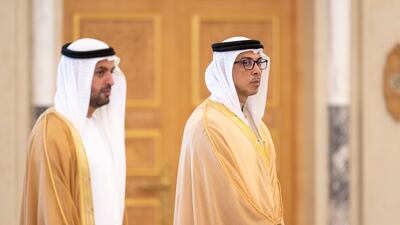
Sheikh Mansour bin Zayed, Vice President, Deputy Prime Minister and Minister of Presidential Affairs, and Sheikh Mohammed bin Hamad bin Tahnoon, Adviser of Special Affairs at the Ministry of Presidential Affairs, at Qasr Al Watan. Abdulla Al Neyadi / Presidential Court -
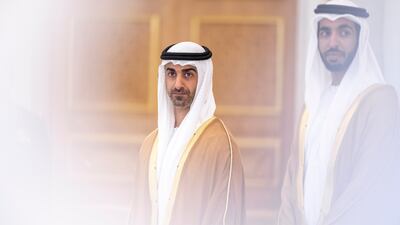
Sheikh Hamdan bin Mohamed attends the diplomatic credentials presentation ceremony, at Qasr Al Watan. Abdulla Al Neyadi / Presidential Court -
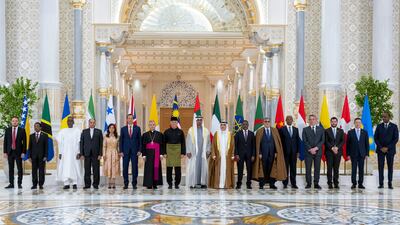
President Sheikh Mohamed stands for a photograph with the newly appointed foreign ambassadors, at Qasr Al Watan. Abdulla Al Neyadi / Presidential Court -

President Sheikh Mohamed receives Holy See ambassador Christophe Zakhia El Kassis, at Qasr Al Watan. Abdulla Al Neyadi / UAE Presidential Court -

President Sheikh Mohamed receives Panama ambassador Rebeca Sharona Perez Cervantes, at Qasr Al Watan. Abdulla Al Neyadi / Presidential Court -
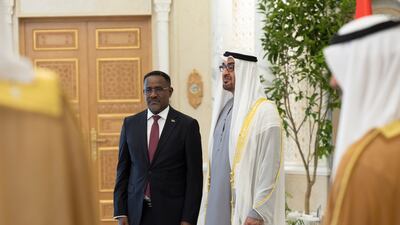
President Sheikh Mohamed receives Ethiopian ambassador Oumer Hussien Oba, at Qasr Al Watan. Ryan Carter / Presidential Court -
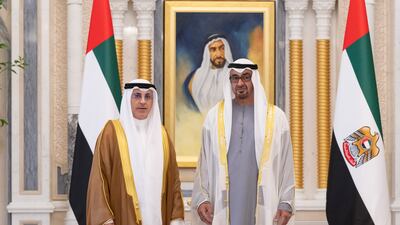
President Sheikh Mohamed receives Kuwaiti ambassador Jamal Mohammad Issa Alghunaim at the diplomatic credentials presentation ceremony for newly appointed foreign ambassadors, at Qasr Al Watan. Abdulla Al Neyadi / Presidential Court
Related
Draw:
Group A: Egypt, DR Congo, Uganda, Zimbabwe
Group B: Nigeria, Guinea, Madagascar, Burundi
Group C: Senegal, Algeria, Kenya, Tanzania
Group D: Morocco, Ivory Coast, South Africa, Namibia
Group E: Tunisia, Mali, Mauritania, Angola
Group F: Cameroon, Ghana, Benin, Guinea-Bissau
Indoor Cricket World Cup - Sept 16-20, Insportz, Dubai
COMPANY PROFILE
Ten tax points to be aware of in 2026
1. Domestic VAT refund amendments: request your refund within five years
If a business does not apply for the refund on time, they lose their credit.
2. E-invoicing in the UAE
Businesses should continue preparing for the implementation of e-invoicing in the UAE, with 2026 a preparation and transition period ahead of phased mandatory adoption.
3. More tax audits
Tax authorities are increasingly using data already available across multiple filings to identify audit risks.
4. More beneficial VAT and excise tax penalty regime
Tax disputes are expected to become more frequent and more structured, with clearer administrative objection and appeal processes. The UAE has adopted a new penalty regime for VAT and excise disputes, which now mirrors the penalty regime for corporate tax.
5. Greater emphasis on statutory audit
There is a greater need for the accuracy of financial statements. The International Financial Reporting Standards standards need to be strictly adhered to and, as a result, the quality of the audits will need to increase.
6. Further transfer pricing enforcement
Transfer pricing enforcement, which refers to the practice of establishing prices for internal transactions between related entities, is expected to broaden in scope. The UAE will shortly open the possibility to negotiate advance pricing agreements, or essentially rulings for transfer pricing purposes.
7. Limited time periods for audits
Recent amendments also introduce a default five-year limitation period for tax audits and assessments, subject to specific statutory exceptions. While the standard audit and assessment period is five years, this may be extended to up to 15 years in cases involving fraud or tax evasion.
8. Pillar 2 implementation
Many multinational groups will begin to feel the practical effect of the Domestic Minimum Top-Up Tax (DMTT), the UAE's implementation of the OECD’s global minimum tax under Pillar 2. While the rules apply for financial years starting on or after January 1, 2025, it is 2026 that marks the transition to an operational phase.
9. Reduced compliance obligations for imported goods and services
Businesses that apply the reverse-charge mechanism for VAT purposes in the UAE may benefit from reduced compliance obligations.
10. Substance and CbC reporting focus
Tax authorities are expected to continue strengthening the enforcement of economic substance and Country-by-Country (CbC) reporting frameworks. In the UAE, these regimes are increasingly being used as risk-assessment tools, providing tax authorities with a comprehensive view of multinational groups’ global footprints and enabling them to assess whether profits are aligned with real economic activity.
Contributed by Thomas Vanhee and Hend Rashwan, Aurifer
UAE v Gibraltar
What: International friendly
When: 7pm kick off
Where: Rugby Park, Dubai Sports City
Admission: Free
Online: The match will be broadcast live on Dubai Exiles’ Facebook page
UAE squad: Lucas Waddington (Dubai Exiles), Gio Fourie (Exiles), Craig Nutt (Abu Dhabi Harlequins), Phil Brady (Harlequins), Daniel Perry (Dubai Hurricanes), Esekaia Dranibota (Harlequins), Matt Mills (Exiles), Jaen Botes (Exiles), Kristian Stinson (Exiles), Murray Reason (Abu Dhabi Saracens), Dave Knight (Hurricanes), Ross Samson (Jebel Ali Dragons), DuRandt Gerber (Exiles), Saki Naisau (Dragons), Andrew Powell (Hurricanes), Emosi Vacanau (Harlequins), Niko Volavola (Dragons), Matt Richards (Dragons), Luke Stevenson (Harlequins), Josh Ives (Dubai Sports City Eagles), Sean Stevens (Saracens), Thinus Steyn (Exiles)
While you're here
Bryant Harris: What Joe Biden did during his first week as US President
Kareem Shaheen: Omar Alghabra outshines the racists who malign him
Kareem Shaheen: Canada is failing those who bear its greatest Covid-19 burdens
Chatham House Rule
A mark of Chatham House’s influence 100 years on since its founding, was Moscow’s formal declaration last month that it was an “undesirable
organisation”.
The depth of knowledge and academics that it drew on
following the Ukraine invasion had broadcast Mr Putin’s chicanery.
The institute is more used to accommodating world leaders,
with Nelson Mandela, Margaret Thatcher among those helping it provide
authoritative commentary on world events.
Chatham House was formally founded as the Royal Institute of
International Affairs following the peace conferences of World War One. Its
founder, Lionel Curtis, wanted a more scientific examination of international affairs
with a transparent exchange of information and ideas.
That arena of debate and analysis was enhanced by the “Chatham
House Rule” states that the contents of any meeting can be discussed outside Chatham
House but no mention can be made identifying individuals who commented.
This has enabled some candid exchanges on difficult subjects
allowing a greater degree of free speech from high-ranking figures.
These meetings are highly valued, so much so that
ambassadors reported them in secret diplomatic cables that – when they were
revealed in the Wikileaks reporting – were thus found to have broken the rule. However,
most speeches are held on the record.
Its research and debate has offered fresh ideas to
policymakers enabling them to more coherently address troubling issues from climate
change to health and food security.
Quick pearls of wisdom
Focus on gratitude: And do so deeply, he says. “Think of one to three things a day that you’re grateful for. It needs to be specific, too, don’t just say ‘air.’ Really think about it. If you’re grateful for, say, what your parents have done for you, that will motivate you to do more for the world.”
Know how to fight: Shetty married his wife, Radhi, three years ago (he met her in a meditation class before he went off and became a monk). He says they’ve had to learn to respect each other’s “fighting styles” – he’s a talk it-out-immediately person, while she needs space to think. “When you’re having an argument, remember, it’s not you against each other. It’s both of you against the problem. When you win, they lose. If you’re on a team you have to win together.”
Specs
Price, base: Dhs850,000
Engine: 3.9-litre twin-turbo V8
Transmission: Seven-speed automatic
Power: 591bhp @ 7,500rpm
Torque: 760Nm @ 3,000rpm
Fuel economy, combined: 11.3L / 100km



