Sheikh Mohammed bin Rashid, Vice President and Ruler of Dubai, hailed the findings of the latest Arab Youth Survey. Photo: Wam

Sheikh Mohammed bin Rashid says young Arabs can achieve dreams in UAE


  • English
  • Arabic

Sheikh Mohammed bin Rashid, Vice President and Ruler of Dubai, said the region's youth can achieve their dreams in the UAE after the country was named the most attractive place to live by young Arabs for the 12th consecutive year.

Respondents said the Emirates was the place they most wanted to call home in the Arab Youth Survey, released on Tuesday.

They hailed the country for its high levels of safety and security, its growing economy, clean environment, ease of doing business and effective leadership.

The findings were based on face-to-face interviews with 3,600 people aged 18 to 24 across 18 different countries.

“For the twelfth year in a row, a survey of Arab youth in 53 cities from 18 Arab countries reveals that most of the Arab youth consider the UAE as their preferred country to live and work, followed by the United States and Canada,” Sheikh Mohammed wrote on Twitter on Tuesday.

“They also view it as the most successful model they wish their countries to emulate.

“We continuously convey our unwavering message to Arab youth: The UAE is an Arab country. It extends its hand to all Arabs, and its land will remain open to fulfil the aspirations of Arab youth.

“Ultimately, we envision the entire region to become a place again where dreams can be realised and civilisation can be built.”

The survey authors said the UAE provided a platform for young people to harness their talent, making it an attractive proposition.

“The UAE continues to be a lodestar for Arab youth seeking jobs, opportunity and the freedom to realise their full potential,” said Sunil John, founder of Asda'a BCW, the PR agency that conducts the annual survey.

“The uncertainty elsewhere in the global economy only serves to underline the nation’s winning attributes and the sound vision of its leadership.”

Almost one in four young Arabs (24 per cent) named the UAE as their top choice for where they would most like to live.

It was followed by the US (19 per cent), Canada (19 per cent), Qatar (14 per cent) and the UK (13 per cent).

Arab Youth Survey 2023 – in pictures

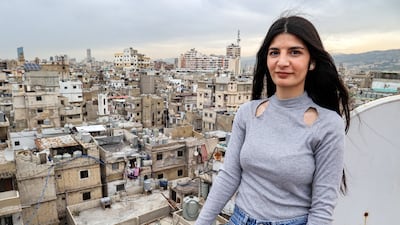
  • Nirmeen Hazineh, a Palestinian refugee in Lebanon, at the Shatila camp for refugees in Beirut. Young people in the camps say they dream of leaving the struggling country where their families took refuge generations ago. AFP
    Nirmeen Hazineh, a Palestinian refugee in Lebanon, at the Shatila camp for refugees in Beirut. Young people in the camps say they dream of leaving the struggling country where their families took refuge generations ago. AFP
  • Iraqi Sarah Nael inspects creations by Rafedin, a sewing project set up by Italians to help Iraqi refugee women in Jordan. AFP
    Iraqi Sarah Nael inspects creations by Rafedin, a sewing project set up by Italians to help Iraqi refugee women in Jordan. AFP
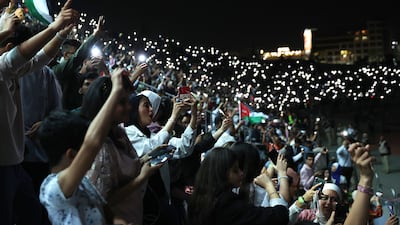
  • People enjoy a free concert to celebrate the wedding of Jordan's Crown Prince at Amman International Stadium last month. AFP
    People enjoy a free concert to celebrate the wedding of Jordan's Crown Prince at Amman International Stadium last month. AFP
  • Young men swim in the Shatt Al Arab waterway, formed at the confluence of the Euphrates and Tigris rivers, in Iraq's southern city of Basra in May. AFP
    Young men swim in the Shatt Al Arab waterway, formed at the confluence of the Euphrates and Tigris rivers, in Iraq's southern city of Basra in May. AFP
  • Protesters attacking a local bank in Beirut, Lebanon, last week, amid anger over a deepening economic crisis and hardship in the country. NurPhoto
    Protesters attacking a local bank in Beirut, Lebanon, last week, amid anger over a deepening economic crisis and hardship in the country. NurPhoto
  • Members of Tunisian dance group Urban Dance perform during Carthage Choreographer Days in Tunis. EPA
    Members of Tunisian dance group Urban Dance perform during Carthage Choreographer Days in Tunis. EPA
  • A young man sells roast sweet potato from a cart outside the walls of old Cairo in the historic district of Gamaliya. AFP
    A young man sells roast sweet potato from a cart outside the walls of old Cairo in the historic district of Gamaliya. AFP

Founders: Abdulmajeed Alsukhan, Turki Bin Zarah and Abdulmohsen Albabtain.

Based: Riyadh

Offices: UAE, Vietnam and Germany

Founded: September, 2020

Number of employees: 70

Sector: FinTech, online payment solutions

Funding to date: $116m in two funding rounds  

Investors: Checkout.com, Impact46, Vision Ventures, Wealth Well, Seedra, Khwarizmi, Hala Ventures, Nama Ventures and family offices

COMPANY PROFILE
Name: HyperSpace
 
Started: 2020
 
Founders: Alexander Heller, Rama Allen and Desi Gonzalez
 
Based: Dubai, UAE
 
Sector: Entertainment 
 
Number of staff: 210 
 
Investment raised: $75 million from investors including Galaxy Interactive, Riyadh Season, Sega Ventures and Apis Venture Partners
How to wear a kandura

Dos

  • Wear the right fabric for the right season and occasion 
  • Always ask for the dress code if you don’t know
  • Wear a white kandura, white ghutra / shemagh (headwear) and black shoes for work 
  • Wear 100 per cent cotton under the kandura as most fabrics are polyester

Don’ts 

  • Wear hamdania for work, always wear a ghutra and agal 
  • Buy a kandura only based on how it feels; ask questions about the fabric and understand what you are buying
THE BIO

Favourite car: Koenigsegg Agera RS or Renault Trezor concept car.

Favourite book: I Am Pilgrim by Terry Hayes or Red Notice by Bill Browder.

Biggest inspiration: My husband Nik. He really got me through a lot with his positivity.

Favourite holiday destination: Being at home in Australia, as I travel all over the world for work. It’s great to just hang out with my husband and family.


Ten tax points to be aware of in 2026

1. Domestic VAT refund amendments: request your refund within five years

If a business does not apply for the refund on time, they lose their credit.

2. E-invoicing in the UAE

Businesses should continue preparing for the implementation of e-invoicing in the UAE, with 2026 a preparation and transition period ahead of phased mandatory adoption. 

3. More tax audits

Tax authorities are increasingly using data already available across multiple filings to identify audit risks. 

4. More beneficial VAT and excise tax penalty regime

Tax disputes are expected to become more frequent and more structured, with clearer administrative objection and appeal processes. The UAE has adopted a new penalty regime for VAT and excise disputes, which now mirrors the penalty regime for corporate tax.

5. Greater emphasis on statutory audit

There is a greater need for the accuracy of financial statements. The International Financial Reporting Standards standards need to be strictly adhered to and, as a result, the quality of the audits will need to increase.

6. Further transfer pricing enforcement

Transfer pricing enforcement, which refers to the practice of establishing prices for internal transactions between related entities, is expected to broaden in scope. The UAE will shortly open the possibility to negotiate advance pricing agreements, or essentially rulings for transfer pricing purposes. 

7. Limited time periods for audits

Recent amendments also introduce a default five-year limitation period for tax audits and assessments, subject to specific statutory exceptions. While the standard audit and assessment period is five years, this may be extended to up to 15 years in cases involving fraud or tax evasion. 

8. Pillar 2 implementation 

Many multinational groups will begin to feel the practical effect of the Domestic Minimum Top-Up Tax (DMTT), the UAE's implementation of the OECD’s global minimum tax under Pillar 2. While the rules apply for financial years starting on or after January 1, 2025, it is 2026 that marks the transition to an operational phase.

9. Reduced compliance obligations for imported goods and services

Businesses that apply the reverse-charge mechanism for VAT purposes in the UAE may benefit from reduced compliance obligations. 

10. Substance and CbC reporting focus

Tax authorities are expected to continue strengthening the enforcement of economic substance and Country-by-Country (CbC) reporting frameworks. In the UAE, these regimes are increasingly being used as risk-assessment tools, providing tax authorities with a comprehensive view of multinational groups’ global footprints and enabling them to assess whether profits are aligned with real economic activity. 

Contributed by Thomas Vanhee and Hend Rashwan, Aurifer

UAE currency: the story behind the money in your pockets
The%20Genius%20of%20Their%20Age
%3Cp%3EAuthor%3A%20S%20Frederick%20Starr%3Cbr%3EPublisher%3A%20Oxford%20University%20Press%3Cbr%3EPages%3A%20290%3Cbr%3EAvailable%3A%20January%2024%3C%2Fp%3E%0A
Updated: June 20, 2023, 3:02 PM