


Fraudsters who ran an elaborate Bitcoin scam in Dubai worth Dh10 million have been fined more than Dh321,000 each.
The Dubai Criminal Court heard how the gang – that comprised one Pakistani national and six Bangladesh nationals – posted videos on TikTok about mining and investing in cryptocurrency.
The group – aged between 24 and 46 – targeted 180 victims in the UAE, who reported the scam to Al Muraqqabat Police Station in December.
The men, who avoided jail sentences, were fined for illegally obtaining the money.
In addition, they were each fined Dh20,000 for practising virtual assets work without obtaining a license from concerned authorities.
The court heard how the group defrauded five people out of Dh321,000 after promising to double their money by investing in a crypto wallet.
Court records show that the group made social media advertisements promoting three companies investing in Bitcoin.
Two of those convicted appeared in TikTok videos encouraging people to invest their money in Bitcoin mining and exchange.
"Around 180 people came to the police station to make complaints about being scammed by the suspects," a policeman said.
"They were promised with daily and monthly profits by investing in cryptocurrency," he added.
He said the group distributed a sum of money to the victims to make the scam seem more legitimate and lure in more victims.
The victims, who were mainly from Bangladesh, were told by the group to come to a company in Deira to get their profit. However, upon arrival, the company doors were closed.
Two of the group were arrested on the UAE-Oman border as they were trying to escape.
Police then discovered the company had a commercial license and was not authorised for cryptocurrency transactions.
"I went to the company after watching the ads and videos. I gave Dh200,000 to the company's accountant to invest in cryptocurrency and get a massive profit," said one of the victims.
"I didn't get any profit from the company."
The police said it is expecting more cases to come to court.
A report by the Anti-Economic Crime Department attached to the court records confirmed the gang defrauded 3,000 victims in Bangladesh.
The force said it is still working to gather all complaints received from the country in one file to present it to the court.
How criminals use technology to scam victims: in pictures
-
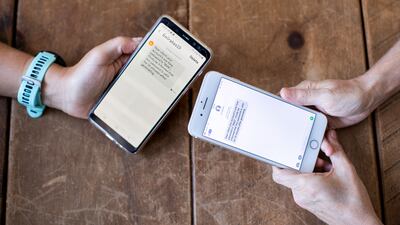
The use of technology in everyday lives has led to growth in scams and fraud. Reem Mohammed / The National -

Phishing is one of the most common methods used by fraudsters and it involves sending an unsolicited email that appears to be from a financial institution or online retailer. The National -
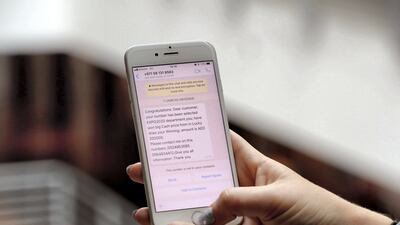
Smishing — the SMS equivalent of phishing — is where fraudsters falsify the telephone number so it appears to be a genuine text from a bank or well-known company. Chris Whiteoak / The National -

Vishing is the telephone equivalent of phishing and smishing. Fraudsters may pose as bank staff, police or government officials. Getty Images -

SIM swap involves fraudsters duplicating the SIM of your mobile number without your knowledge or authorisation, allowing them to conduct financial transactions with your bank. AP -

Identity theft is where someone illegally obtains your confidential information, through various ways such as theft of your wallet, bank and utility bill statements, computer intrusion and social networks. Getty Images -

Prize scams involve fraudsters claiming to represent well-known organisations. They contact victims to tell them they have won a cash prize and request them to share confidential banking details to transfer the prize money. -
Instagram influencer Ramon Abbas, known as Hushpuppi, used a technique known as business email compromise. -

The tax authority said some bank customers in the UAE have received phishing emails impersonating financial institutions. EPA -

Jenny Ross, Which? Money editor, says: ‘Scammers are relentless when it comes to wanting our personal information and ultimately our money.’ PA -

Netflix's The Tinder Swindler tells the story of three women who say they were conned out of $500. Photo: @simon_leviev_official via Instagram



