Runner edges closer to completing goal of pounding every street in Dubai


Nick Webster
  • English
  • Arabic

After almost five years of pounding the streets of Dubai, the end is in sight for a passionate marathon runner who aims to cover every metre of road in the city.

From the mansions of Emirates Hills to the industrial zones of Al Quoz, a voyage of discovery that began in 2018 is drawing to a close for Yasmine Salaam, 52.

On Sunday morning, an 8km run around Deira Islands was the latest area chalked off – and it followed a 16km run around Al Aweer on Friday.

People even ask me for real estate advice on where to move to as I know what these communities are like
Yasmine Salaam

It has taken her tally to 98.9 per cent of her goal, according to the map that tracks her progress and an app on which the streets she has completed turn purple.

“I am all over the map now, trying to finish off areas and improve my coverage – I’m a perfectionist,” said Ms Salaam, who goes by the name of Pink Taxi Runner on social media where she documents her progress.

“The most interesting thing has been the variety of environments, from residential, industrial, rural, in the mountains and by the sea.

“Dubai is almost like its own country, with so many different cultures and communities.

“My project is not just about informing people of the UAE but the world’s running community that is doing similar things in other countries.

“People are in tune with their communities, and hopefully I have inspired others to get out there and run.”

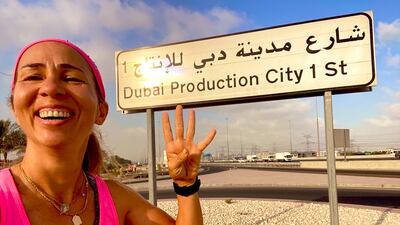
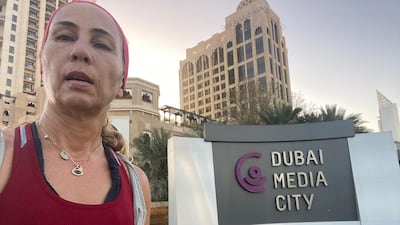
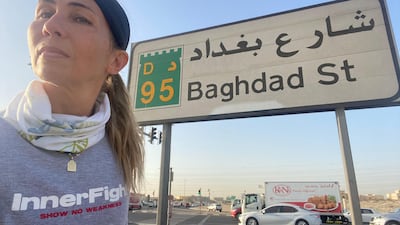
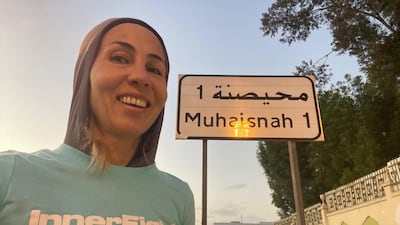
  • Yasmine Salaam has run on nearly every road in Dubai. All photos: Yasmine Salaam
    Yasmine Salaam has run on nearly every road in Dubai. All photos: Yasmine Salaam
  • She started her challenge in 2018 and runs four times a week, covering eight to 30 kilometres each day
    She started her challenge in 2018 and runs four times a week, covering eight to 30 kilometres each day
  • Ms Salaam takes photos of many of the street signs on which she has run
    Ms Salaam takes photos of many of the street signs on which she has run
  • To date, she has run on almost 98.9 per cent of the city’s streets
    To date, she has run on almost 98.9 per cent of the city’s streets
  • Ms Salaam uses an app called CityStrides to track the streets she has run, rather than the kilometres covered
    Ms Salaam uses an app called CityStrides to track the streets she has run, rather than the kilometres covered
  • She hopes to complete her challenge by October
    She hopes to complete her challenge by October

Ms Salaam’s personal best for a full 42.2km marathon is 4 hours 12 minutes recorded in Geneva, Switzerland.

She runs four days a week and during Ramadan ran every day during iftar time.

Initially, the challenge was due to take her into next year but she now expects to finish her running map well ahead of schedule by October, in time for the Dubai Fitness Challenge.

Favourite area

She has run about 1,000km every year and has pounded her way through a serious number of running shoes that are changed every six months.

A coach has been keeping tabs on Ms Salaam for the past 12 years, helping to keep her training varied and injury free.

While a running app tracks her progress, she also takes photos of street signs along her routes to make a daily diary of her efforts.

A favourite community is Jebel Ali Hills, with a set of streets with homes yet to be built, giving her a private running ground.

Other communities have been left deserted after housing projects were abandoned, leaving ghost towns behind.

“I have seen an array of cultural and socioeconomic experiences, running through depot centres and communities of truck drivers, taxi drivers, camel herders and even police compounds,” she said.

“Anyone can speak to me about Dubai and where they live or work and I can relate to them – I know it.

“People even ask me for real estate advice on where to move to as I know what these communities are like.

“No matter what time of day or night that I run, I feel safe – even in neighbourhoods that are exclusively men.

“I have not run on The Palm Jumeirah yet. I am keeping that for last.

“Some people run for a good cause or for a charity, I run because I am part of Dubai.

“I have lived here all my life and I feel part of this dynamic city.”

Mercer, the investment consulting arm of US services company Marsh & McLennan, expects its wealth division to at least double its assets under management (AUM) in the Middle East as wealth in the region continues to grow despite economic headwinds, a company official said.

Mercer Wealth, which globally has $160 billion in AUM, plans to boost its AUM in the region to $2-$3bn in the next 2-3 years from the present $1bn, said Yasir AbuShaban, a Dubai-based principal with Mercer Wealth.

Within the next two to three years, we are looking at reaching $2 to $3 billion as a conservative estimate and we do see an opportunity to do so,” said Mr AbuShaban.

Mercer does not directly make investments, but allocates clients’ money they have discretion to, to professional asset managers. They also provide advice to clients.

“We have buying power. We can negotiate on their (client’s) behalf with asset managers to provide them lower fees than they otherwise would have to get on their own,” he added.

Mercer Wealth’s clients include sovereign wealth funds, family offices, and insurance companies among others.

From its office in Dubai, Mercer also looks after Africa, India and Turkey, where they also see opportunity for growth.

Wealth creation in Middle East and Africa (MEA) grew 8.5 per cent to $8.1 trillion last year from $7.5tn in 2015, higher than last year’s global average of 6 per cent and the second-highest growth in a region after Asia-Pacific which grew 9.9 per cent, according to consultancy Boston Consulting Group (BCG). In the region, where wealth grew just 1.9 per cent in 2015 compared with 2014, a pickup in oil prices has helped in wealth generation.

BCG is forecasting MEA wealth will rise to $12tn by 2021, growing at an annual average of 8 per cent.

Drivers of wealth generation in the region will be split evenly between new wealth creation and growth of performance of existing assets, according to BCG.

Another general trend in the region is clients’ looking for a comprehensive approach to investing, according to Mr AbuShaban.

“Institutional investors or some of the families are seeing a slowdown in the available capital they have to invest and in that sense they are looking at optimizing the way they manage their portfolios and making sure they are not investing haphazardly and different parts of their investment are working together,” said Mr AbuShaban.

Some clients also have a higher appetite for risk, given the low interest-rate environment that does not provide enough yield for some institutional investors. These clients are keen to invest in illiquid assets, such as private equity and infrastructure.

“What we have seen is a desire for higher returns in what has been a low-return environment specifically in various fixed income or bonds,” he said.

“In this environment, we have seen a de facto increase in the risk that clients are taking in things like illiquid investments, private equity investments, infrastructure and private debt, those kind of investments were higher illiquidity results in incrementally higher returns.”

The Abu Dhabi Investment Authority, one of the largest sovereign wealth funds, said in its 2016 report that has gradually increased its exposure in direct private equity and private credit transactions, mainly in Asian markets and especially in China and India. The authority’s private equity department focused on structured equities owing to “their defensive characteristics.”

The nine articles of the 50-Year Charter

1. Dubai silk road

2.  A geo-economic map for Dubai

3. First virtual commercial city

4. A central education file for every citizen

5. A doctor to every citizen

6. Free economic and creative zones in universities

7. Self-sufficiency in Dubai homes

8. Co-operative companies in various sectors

­9: Annual growth in philanthropy

The biog

Profession: Senior sports presenter and producer

Marital status: Single

Favourite book: Al Nabi by Jibran Khalil Jibran

Favourite food: Italian and Lebanese food

Favourite football player: Cristiano Ronaldo

Languages: Arabic, French, English, Portuguese and some Spanish

Website: www.liliane-tannoury.com

SPECS
%3Cp%3EEngine%3A%20Twin-turbocharged%204-litre%20V8%3Cbr%3EPower%3A%20625%20bhp%3Cbr%3ETorque%3A%20630Nm%3Cbr%3EOn%20sale%3A%20Now%3Cbr%3EPrice%3A%20From%20Dh974%2C011%3C%2Fp%3E%0A
The burning issue

The internal combustion engine is facing a watershed moment – major manufacturer Volvo is to stop producing petroleum-powered vehicles by 2021 and countries in Europe, including the UK, have vowed to ban their sale before 2040. The National takes a look at the story of one of the most successful technologies of the last 100 years and how it has impacted life in the UAE.

Part three: an affection for classic cars lives on

Read part two: how climate change drove the race for an alternative 

Read part one: how cars came to the UAE

Updated: June 13, 2023, 4:08 PM