
A string of opportunities are opening up for young Emirati jobseekers who are looking to start their careers in the UAE private sector.
More than 50,000 Emiratis were employed in the private sector last year, following the government's announcement that companies would face fines of up to Dh500,000 ($136,155) for failing to hire Emiratis.
Thousands more are now set to join the sector following a huge boost in job opportunities thanks to the government's Nafis scheme, which provides a monthly salary top-up of Dh5,000 to Dh7,000.
Some Emiratis have secured jobs at checkout counters in grocery shops, while others are looking for roles online and via the Nafis job portal.
22, Ras Al Khaimah
Mohammed Al Hamadi, 22, dropped out of university to care for his sick mother. After more than a year of travelling to and from hospitals in the UAE and US, he finally found a job at OMB, an outsourcing company that serves Etisalat.
“I couldn’t leave my mother,” he told The National. “She was ill and needed me. That to me was more important than anything else in the world. I am the eldest and it is my responsibility to care for everyone. There is nothing more important than your mother.”
Mr Al Hamadi is the eldest of seven siblings and lives in Ras Al Khaimah. When he was confident his mother had recovered, he started looking for a job and tried to go back to university. However, he didn't get the required grades in his exams.

"But I am ambitious and determined, I won't give up and will try again for next term," he said.
Financial incentives have been introduced to help Emiratisation goals and Mr Al Hammadi will be getting Dh10,000 a month, including the Nafis top-up, which is an Emirati salary support scheme, for those working in the private sector.
Monthly salary top-ups from the government include Dh7,000 for those with bachelor’s degrees, Dh6,000 for diplomas and Dh5,000 for those who completed high school.
For those undergoing training for highly skilled jobs, there is a Dh8,000 monthly top-up for one year.
Ras Al Khaimah resident Abdulla Al Shehhi believes there is no such thing as an “unsuitable job” for an Emirati.
“I have friends who work at LuLu and others at Ansari Exchange,” he told The National. “There is no shame in working. They are proud and happy to have joined the job market. Some might disagree but I don’t know why.”
The 23 year old is currently in his second year at Higher Colleges of Technology (HCT) and had previously worked part-time at Sharjah Museum. He is now looking for a new job but has yet to receive an offer.
“I guess I’ve applied late and many of the jobs have already been taken,” he said. “But with Nafis and the government support, I’m confident I’ll find a job soon.”
Like Mr Shehhi, 23-year-old chemical engineer Jihan Al Ali has applied for more than 60 jobs online and through the Nafis portal in the private and government sector.
-
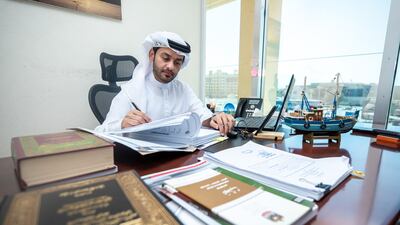
Rashed Abdulla Al Sumaity, an associate at Galadari Advocates & Legal Consultants in Dubai. The legal and banking professions have the highest Emiratisation in the private sector. All photos by Victor Besa / The National -

Official announcements show the UAE government’s resolve to encourage citizens to take on private sector jobs and persuade companies to take Emiratis on board. -

Raka Roy (R), partner at Galadari Advocates & Legal Consultants and Eslam Oraif, legal counsel, break down the government announcements that offer extra salary and benefits to UAE citizens taking jobs in the private sector. -
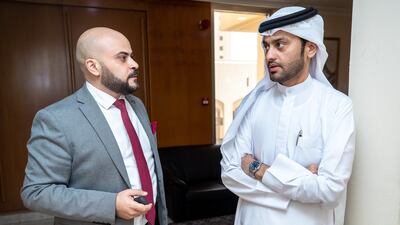
Rashed Abdulla Al Sumaity (R) with Eslam Oraif of Galadari Advocates & Legal Consultants. The UAE government's Nafis scheme has set a target of 75,000 Emiratis in private sector jobs by 2026. -
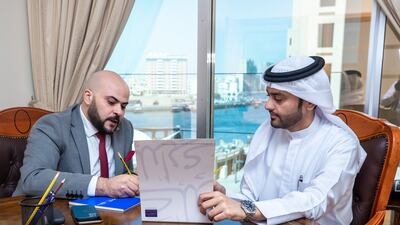
The UAE Cabinet approved that private companies with more than 50 employees should have at least a 2 per cent Emirati workforce by 2021. -
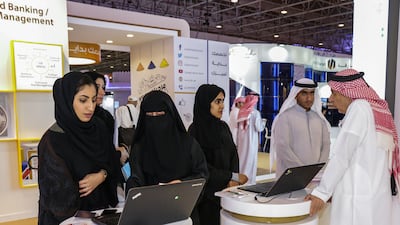
UAE government support programmes will empower and protect Emirati employees in the private sector. -
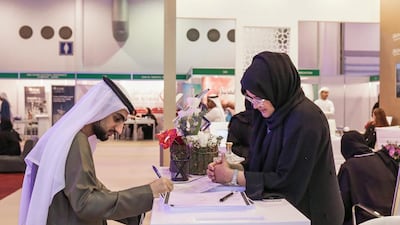
Salary incentives are being offered to Emirati university graduates and UAE citizens in training for skilled jobs.


“I studied at UAE University, which is government funded, so the government has spent a lot on my education,” she said. “I would like to give back and contribute. It would be a shame if I worked in a different field."
The Ajman resident said of the few job offers she has received, they are not what she wants to do long-term. Her chief requirement is that she works in her field of study.
“I’m not diminishing those roles, but I studied chemical engineering. I am neither qualified nor have the training for such jobs,” she said.
However, Ms Al Ali believes that some private companies could be taking advantage of Nafis when hiring Emiratis simply to meet the 2 per cent quota. “They offer Emiratis the lowest-paid jobs because they know they receive the Nafis top-up, and even if there are available posts, they will offer it to a non-national.”
June 30 is the next deadline for private sector companies with 50 employees or more to hit their six-month Emiratisation target.
Employers last year were directed to ensure 2 per cent of roles were taken up by Emiratis by the end of 2022, and then increase the proportion of Emiratis in the workforce by 1 per cent every six months.
Three per cent of skilled jobs must also be occupied by Emiratis by July 1 and 4 per cent by the end of the year, under the government’s Emiratisation drive.
The Ministry of Human Resources and Emiratisation also reminded companies that they faced half-yearly fines of Dh42,000 for every Emirati not hired.
Sharjah University graduate Shamma Khamis has been looking for a job for over a year. However, she feels that most employers prefer hiring men.
“It does feel like there are limited jobs available and that employers prefer younger candidates,” the 23 year old said. “Many of my friends have not found jobs but there are also those that did. I will just keep applying and hope for the best.”
The job search for 21-year-old Shouq Mohammed, however, has been more fruitful. The fourth year HCT student works for Dubai-based Indian company Meena Jewellery, and commutes from RAK where she lives with her family.
“I can’t say that I’m tired,” she told The National. “I love working and having my own independence. I want to finish my studies to eventually find a better job because everyone wants a new experience at a different place.”
Ms Mohammed earns about Dh11,000 a month with a Nafis top-up. However, she added that it took her a while to find her current job.
“There are available jobs in the private sector but I guess we all need patience and the time to improve our skills so we can have a good CV,” she said.

