
A Dubai-bound plane is continuing its flight as normal after a bird strike during take-off in Nepal.
The incident occurred at Kathmandu airport on Monday evening.
An airline representative said standard procedures were followed to determine whether it was safe for the plane to continue its journey.
Flydubai's FZ 576 is scheduled to arrive at Dubai International Airport at 12.14am on Tuesday.
“Flydubai flight FZ 576 from Kathmandu Airport (KTM) to Dubai International (DXB) experienced a bird strike during take-off from Kathmandu,” said the flydubai representative.
“After following standard procedure, the flight will continue as normal to Dubai and is scheduled to land in DXB at 00:14 local time.”
_____________________________
World's safest low-cost airlines - in pictures
-
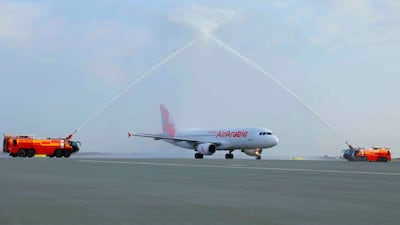
AirlineRatings.com has released its 2022 top 10 of the world's safest low-cost airlines. First on the alphabetical list is Air Arabia, the first budget carrier in the UAE. -
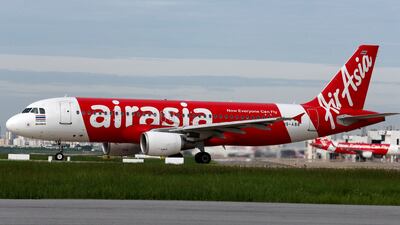
A Thai Air Asia Airbus A320-200 plane at Don Mueang International Airport, Bangkok. Reuters -

Allegiant Air operates in the US and is North America's 14th biggest airline. AFP -
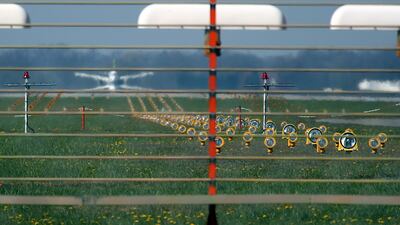
An airBaltic Airbus A220-300 at Munich International Airport -
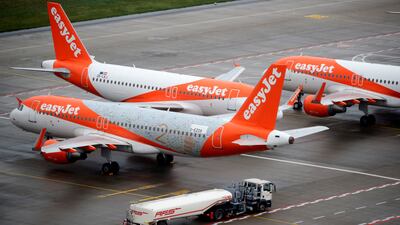
Incident records, crash records and fleet age were among the factors used to compile the list. UK operator easyJet has 31 planes in a fleet that flies throughout Europe. AFP -

flydubai operates to more than 90 destinations from its Dubai hub. Jeff Topping for The National -

Colorado carrier Frontier Airlines flies to more than 100 US destinations and employs more than 3,000 staff. Getty -

Jetstar Group, launched by Australia's flag carrier Qantas, has operated out of Melbourne since 2017. AFP -
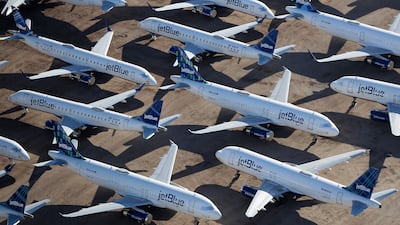
JetBlue, which has its headquarters in New York, is North America's seventh-biggest airline by passengers carried. AFP -
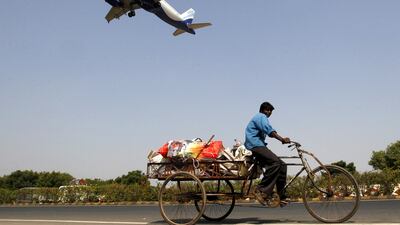
An IndiGo Airlines aircraft in Ahmedabad, India. The low-cost carrier is the country's largest passenger airline. Reuters -
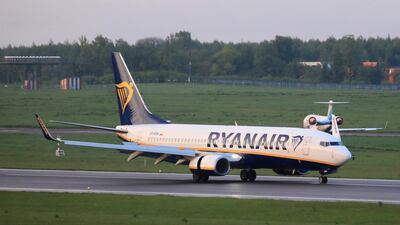
Since its formation in 1984, Irish carrier Ryanair has grown to be one of the giants of low-cost travel, with a fleet of more than 400 and bases at Dublin and London Stansted airports. AFP -
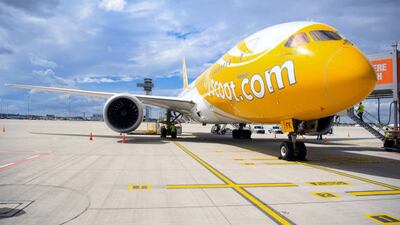
Singapore Airlines' low-cost subsidiary Scoot Airlines ranks in the top 20. Getty Images -
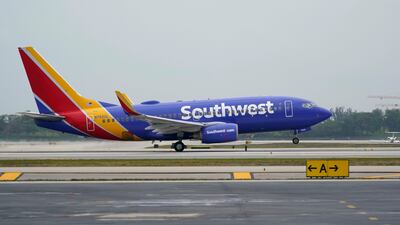
Southwest is the world's largest low-cost airline. AP -
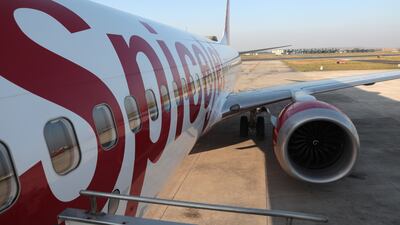
India's SpiceJet flies to 64 destinations, including 52 domestic and 12 international routes. EPA -
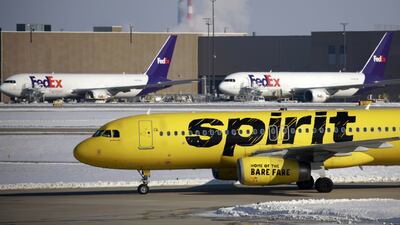
Spirit Airlines, one of the largest low-cost carriers in the US. Bloomberg -
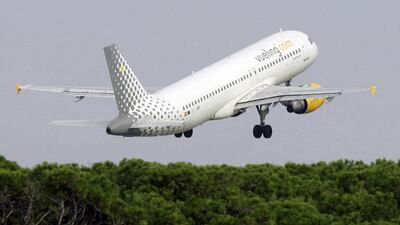
Vueling, Spain's largest airline, has hubs in Barcelona and Rome. AFP -
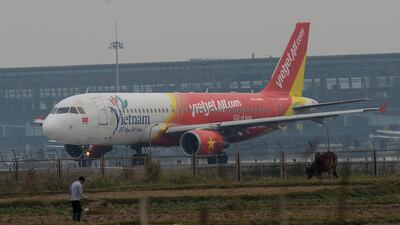
VietJet Air flies to 46 destinations from Hanoi in Vietnam. AFP -

Volaris Airlines is the second largest airline in Mexico after flag carrier Aeromexico and the main operator for domestic flights. AFP -

Canada's WestJet airlines operates more than 700 North American flights a day, carrying more than 66,000 passengers. AFP -
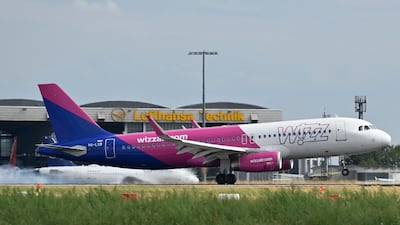
Wizz Air, a Hungarian airline that flies to 44 countries in Europe, Africa and the Middle East, and that has a subsidiary in the UAE, Wizz Air Abu Dhabi, rounded the original top 10 list and is one of the world's safest budget airlines. AFP
On Women's Day
Dr Nawal Al-Hosany: Why more women should be on the frontlines of climate action
Samar Elmnhrawy: How companies in the Middle East can catch up on gender equality
The National Editorial: Is there much to celebrate on International Women's Day 2021?
Justin Thomas: Challenge the notion that 'men are from Mars, women are from Venus'
ANDROID%20VERSION%20NAMES%2C%20IN%20ORDER
SNAPSHOT
While Huawei did launch the first smartphone with a 50MP image sensor in its P40 series in 2020, Oppo in 2014 introduced the Find 7, which was capable of taking 50MP images: this was done using a combination of a 13MP sensor and software that resulted in shots seemingly taken from a 50MP camera.
Mohammed bin Zayed Majlis
Read more from Kareem Shaheen
Know your cyber adversaries
Cryptojacking: Compromises a device or network to mine cryptocurrencies without an organisation's knowledge.
Distributed denial-of-service: Floods systems, servers or networks with information, effectively blocking them.
Man-in-the-middle attack: Intercepts two-way communication to obtain information, spy on participants or alter the outcome.
Malware: Installs itself in a network when a user clicks on a compromised link or email attachment.
Phishing: Aims to secure personal information, such as passwords and credit card numbers.
Ransomware: Encrypts user data, denying access and demands a payment to decrypt it.
Spyware: Collects information without the user's knowledge, which is then passed on to bad actors.
Trojans: Create a backdoor into systems, which becomes a point of entry for an attack.
Viruses: Infect applications in a system and replicate themselves as they go, just like their biological counterparts.
Worms: Send copies of themselves to other users or contacts. They don't attack the system, but they overload it.
Zero-day exploit: Exploits a vulnerability in software before a fix is found.
While you're here
Haemoglobin disorders explained
Thalassaemia is part of a family of genetic conditions affecting the blood known as haemoglobin disorders.
Haemoglobin is a substance in the red blood cells that carries oxygen and a lack of it triggers anemia, leaving patients very weak, short of breath and pale.
The most severe type of the condition is typically inherited when both parents are carriers. Those patients often require regular blood transfusions - about 450 of the UAE's 2,000 thalassaemia patients - though frequent transfusions can lead to too much iron in the body and heart and liver problems.
The condition mainly affects people of Mediterranean, South Asian, South-East Asian and Middle Eastern origin. Saudi Arabia recorded 45,892 cases of carriers between 2004 and 2014.
A World Health Organisation study estimated that globally there are at least 950,000 'new carrier couples' every year and annually there are 1.33 million at-risk pregnancies.
Mercer, the investment consulting arm of US services company Marsh & McLennan, expects its wealth division to at least double its assets under management (AUM) in the Middle East as wealth in the region continues to grow despite economic headwinds, a company official said.
Mercer Wealth, which globally has $160 billion in AUM, plans to boost its AUM in the region to $2-$3bn in the next 2-3 years from the present $1bn, said Yasir AbuShaban, a Dubai-based principal with Mercer Wealth.
“Within the next two to three years, we are looking at reaching $2 to $3 billion as a conservative estimate and we do see an opportunity to do so,” said Mr AbuShaban.
Mercer does not directly make investments, but allocates clients’ money they have discretion to, to professional asset managers. They also provide advice to clients.
“We have buying power. We can negotiate on their (client’s) behalf with asset managers to provide them lower fees than they otherwise would have to get on their own,” he added.
Mercer Wealth’s clients include sovereign wealth funds, family offices, and insurance companies among others.
From its office in Dubai, Mercer also looks after Africa, India and Turkey, where they also see opportunity for growth.
Wealth creation in Middle East and Africa (MEA) grew 8.5 per cent to $8.1 trillion last year from $7.5tn in 2015, higher than last year’s global average of 6 per cent and the second-highest growth in a region after Asia-Pacific which grew 9.9 per cent, according to consultancy Boston Consulting Group (BCG). In the region, where wealth grew just 1.9 per cent in 2015 compared with 2014, a pickup in oil prices has helped in wealth generation.
BCG is forecasting MEA wealth will rise to $12tn by 2021, growing at an annual average of 8 per cent.
Drivers of wealth generation in the region will be split evenly between new wealth creation and growth of performance of existing assets, according to BCG.
Another general trend in the region is clients’ looking for a comprehensive approach to investing, according to Mr AbuShaban.
“Institutional investors or some of the families are seeing a slowdown in the available capital they have to invest and in that sense they are looking at optimizing the way they manage their portfolios and making sure they are not investing haphazardly and different parts of their investment are working together,” said Mr AbuShaban.
Some clients also have a higher appetite for risk, given the low interest-rate environment that does not provide enough yield for some institutional investors. These clients are keen to invest in illiquid assets, such as private equity and infrastructure.
“What we have seen is a desire for higher returns in what has been a low-return environment specifically in various fixed income or bonds,” he said.
“In this environment, we have seen a de facto increase in the risk that clients are taking in things like illiquid investments, private equity investments, infrastructure and private debt, those kind of investments were higher illiquidity results in incrementally higher returns.”
The Abu Dhabi Investment Authority, one of the largest sovereign wealth funds, said in its 2016 report that has gradually increased its exposure in direct private equity and private credit transactions, mainly in Asian markets and especially in China and India. The authority’s private equity department focused on structured equities owing to “their defensive characteristics.”
Red flags
- Promises of high, fixed or 'guaranteed' returns.
- Unregulated structured products or complex investments often used to bypass traditional safeguards.
- Lack of clear information, vague language, no access to audited financials.
- Overseas companies targeting investors in other jurisdictions - this can make legal recovery difficult.
- Hard-selling tactics - creating urgency, offering 'exclusive' deals.
Courtesy: Carol Glynn, founder of Conscious Finance Coaching
What can victims do?
Always use only regulated platforms
Stop all transactions and communication on suspicion
Save all evidence (screenshots, chat logs, transaction IDs)
Report to local authorities
Warn others to prevent further harm
Courtesy: Crystal Intelligence
Dubai Rugby Sevens
November 30, December 1-2
International Vets
Christina Noble Children’s Foundation fixtures
Thursday, November 30:
10.20am, Pitch 3, v 100 World Legends Project
1.20pm, Pitch 4, v Malta Marauders
Friday, December 1:
9am, Pitch 4, v SBA Pirates
LOVE%20AGAIN
The schedule
December 5 - 23: Shooting competition, Al Dhafra Shooting Club
December 9 - 24: Handicrafts competition, from 4pm until 10pm, Heritage Souq
December 11 - 20: Dates competition, from 4pm
December 12 - 20: Sour milk competition
December 13: Falcon beauty competition
December 14 and 20: Saluki races
December 15: Arabian horse races, from 4pm
December 16 - 19: Falconry competition
December 18: Camel milk competition, from 7.30 - 9.30 am
December 20 and 21: Sheep beauty competition, from 10am
December 22: The best herd of 30 camels

