

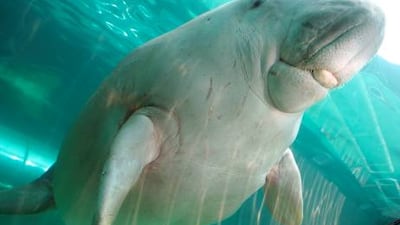
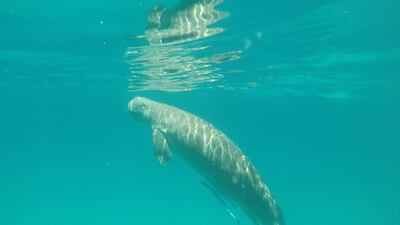
The Environment Agency Abu Dhabi has completed a rare and complex operation to rescue and rehabilitate a young male dugong calf that was lost at sea.
The young marine mammal, a relative of the manatee, was found in 2019, separated from his mother and alone, but since then has been nurtured back to full health.
He has been named Malqout – "saved" in Arabic - and "whose owner is not known", while the agency said discussions were ongoing about a permanent home. According to the EAD, there is only one other case in the world of a dugong being rescued and rehabilitated.
“Malqout’s story is a story we want to share with the world. It is a unique and rare occasion because dugongs are fragile animals and rely on their mother during the first two years of their life,” said Dr Shaikha Al Dhaheri, the agency’s secretary general.

“This made us realise the task ahead and that Malqout would need round-the-clock monitoring and rearing to ensure his survival. During his rehabilitation Malqout has grown profoundly and is doing very well and his case is a perfect example of how local and international collaboration can help save species around the world.”
EAD rangers found Malqout from the herd in the Marawah Biosphere Reserve. It is thought that several days of strong winds may have contributed to his situation.
When he was rescued, the dugong was suffering from dehydration and malnutrition. The EAD, assisted by the Conservation of Migratory Species of Wild Animals regional office, transferred him to a centre in Abu Dhabi because of his condition. After discussions with experts from Worldwide Zoo Consultants, it was decided to keep Malqout under round-the-clock human supervision because of his poor health.
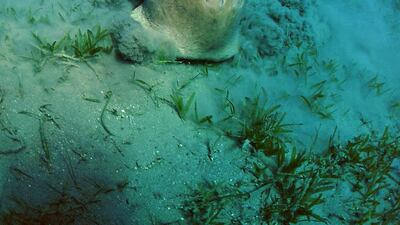
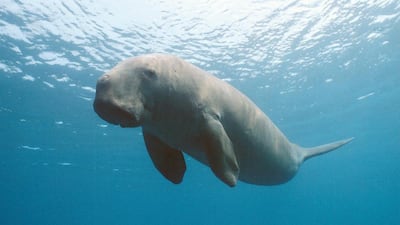
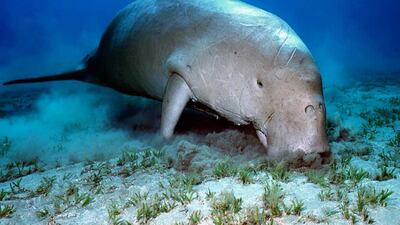
Dugongs are shy creatures known as “sea cows” because they love ocean sea grass. They are effectively wiped out in many parts of the world as a result of pollution, getting tangled in fishing gear, hit by propellers or loss of food. Steller's sea cow – the dugong's nearest modern relative – was hunted to extinction in the 18th century. According to the International Union for Conservation of Nature, dugongs are classed as vulnerable.
But there are about 3,000 dugongs in Abu Dhabi’s waters, and they are mostly found near Bu Tinah Island, which forms part of the Marawah Biosphere Reserve and Al Yasat Marine Protected Area. It is the second-largest population of dugongs in the world, after Australia, and EAD leads efforts to protect the species.
The operation was a challenge, the EAD said, because dugongs generally do not respond well in captivity. But Malqout was trained to eat seaweed, provided with proper facilities and given formula food to treat dehydration and malnutrition. Since then, he has grown from 60 centimetres to nearly two metres in length and has been given a clean bill of health.

The EAD said, according to the Secretariat of the Conservation and Management of Dugongs and previous attempts made around the world, to date no dugong successfully rehabilitated in captivity has been released back into its natural environment. Because Malqout lacks the natural survival instinct, the agency decided not to release him.
“Being young and reared in a controlled environment, he has not developed normal immunity and has adapted to receiving specialist human care, which hinders his ability to interact with other species and avoid predators,” the EAD said.
The agency said he would remain under supervision and will be given the best care until a decision is taken on a permanent home.
“Rescuing and rehabilitating stranded juvenile dugongs is a notoriously difficult task,” said Rouba Abou-Atieh, executive co-ordinator of the Conservation of Migratory Species of Wild Animals' regional office.
“Except for Malqout, there has been only one other documented instance of successful long-term care of a neonate dugong rescued in 1998, which currently resides at Sydney Aquarium. There are no records of successfully releasing hand-reared dugongs back into the wild.”
Tommy Wilken, chief executive of Worldwide Zoo Consultants said: “We are proud of this exceptional accomplishment. The lessons Malqout has taught us during our rescue and rehabilitation efforts will most certainly be beneficial to future rescue efforts for others of his species.”
The EAD, meanwhile, is leading efforts to support and boost the dugong population. It was reported in 2020 that Abu Dhabi's ban on surface fishing nets had halved the dugong mortality rate. The EAD said it is committed to doing everything in its power to ensure the preservation of the dugong population and reduce mortality rates as well as any risks that threaten them.
The gentle animal that is under threat - in pictures
-
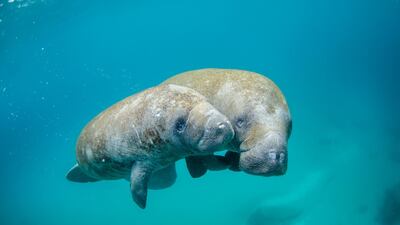
Dugongs and their environment need protection. Photo: Azraq -

A dugong after it was found dead on a beach at Koh Lanta island, in Krabi province, southern Thailand. The female animal was about three metres long and weighed 300 kilograms. EPA -
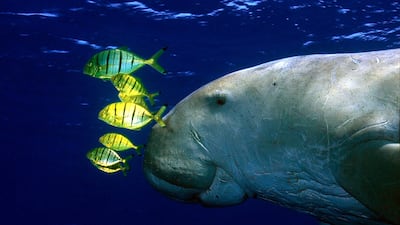
New research by the Zoological Society of London and the Chinese Academy of Sciences has led researchers to declare that one of the ocean's most gentle giants, the dugong, is now functionally extinct in China. PA -
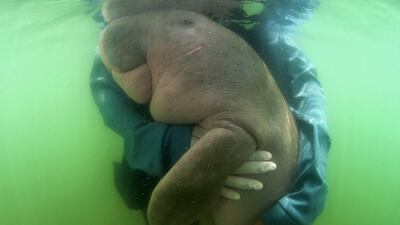
Marium, a baby dugong whose fight for recovery at Phuket Marine Biological Centre in Thailand won hearts and cast a spotlight on ocean conservation, died from an infection aggravated by bits of plastic lining her stomach. AFP -

Dugong skull and mandibles. Victor Besa / The National -
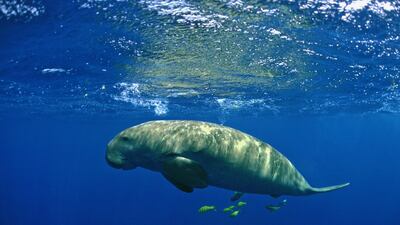
Dugong feed primarily on seagrass, which restricts their habitat to those places where seagrass meadows are found. PA -

Thai Navy rescuers inspect a female dugong found dead on the beach at Koh Lanta island, southern Thailand. EPA -
The dugong has been hunted for thousands of years and its population is fragmented and threatened as a result. PA -
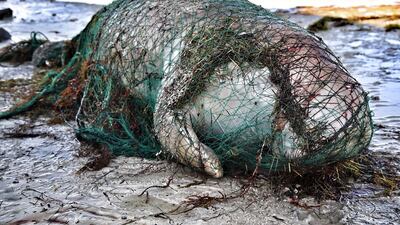
A dead dugong caught in a fisherman's net near Al Rideem, west of Abu Dhabi. Photo: Abu Dhabi Marine Conservation Group -
The UAE environment agency's latest report revealed that 17 dugongs died last year, despite being protected under UAE law since 1999. AP -
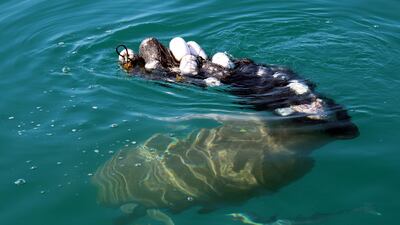
A rare dugong rescued by an Adnoc team after becoming entangled in an illegal fishing net. Photo: Adnoc -
Residents of the UAE want the laws to protect marine species such as the dugong to be strictly enforced. Photo: Environment Agency Abu Dhabi -
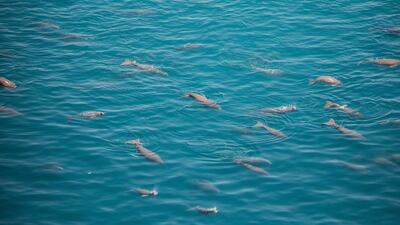
Abu Dhabi has the second-largest dugong population in the world. Photo: Environment Agency Abu Dhabi -
About 2,500 dugongs live off the coast of Abu Dhabi. AFP -
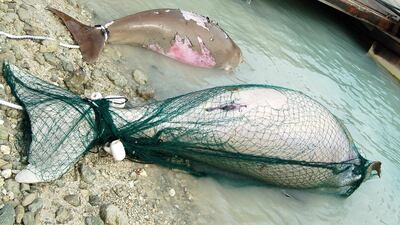
About 80 dugong have been killed by illegal fishing practices in Abu Dhabi over the past four years. Photo: Environment Agency Abu Dhabi -
Australia has the world's largest dugong population, but the mammals' low rate of reproduction means the species is vulnerable to extinction. PA



