The star Wolf-Rayet 124, centre, captured by the James Webb Space Telescope. AP

James Webb Space Telescope captures star just before explosion


  • English
  • Arabic

The rare sight of a dying star 15,000 light years away has been captured by Nasa’s James Webb Space Telescope to provide astronomers with valuable scientific insight.

The shimmering purple bloom of a Wolf-Rayet star — one of the biggest and brightest — was one of the first observations made by the space telescope in June last year.

New images have been released at the South by Southwest Conference in Austin, Texas.

“We’ve never seen it like that before. It’s really exciting,” said Macarena Garcia Marin, a European Space Agency scientist who is part of the project.

The huge star is 30 times the size of our Sun and sits in the Sagittarius constellation. Officially known as WR 124, it has already shed enough material to account for 10 suns, according to Nasa.

The telescope’s infrared eyes observed gas and dust flung into space from the hot star as it passes through a brief Wolf-Rayet phase before going supernova and exploding.

The glow from the cosmic dust was picked up by Webb, 15,000 light years in the distance. One light year is around 5.8 trillion miles.

It is not the first time that WR 124 has been spotted from Earth.

The same star was picked up by the Hubble Space Telescope a few decades ago, but appeared more as a fireball without the detail framed by Webb.

Images of WR 124 will help astronomers understand a crucial period in the early history of the universe.

Similar dying stars first seeded the young universe with heavy elements forged in their cores — elements that are now common in the current era, including on Earth.

What is the James Webb Space Telescope?

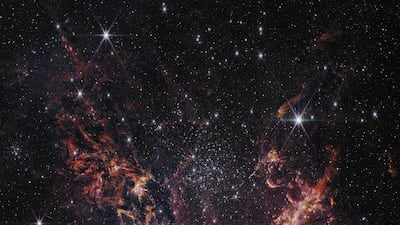
  • A cluster of stars in the Small Magellanic Cloud in an image taken by the James Webb Space Telescope. PA
    A cluster of stars in the Small Magellanic Cloud in an image taken by the James Webb Space Telescope. PA
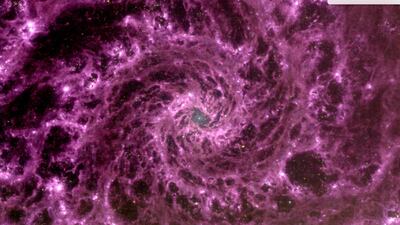
  • A colour composite image of the Messier 74 galaxy. Photo: Gabriel Brammer (Cosmic Dawn Center, Niels Bohr Institute, University of Copenhagen) / James Webb Space Telescope
    A colour composite image of the Messier 74 galaxy. Photo: Gabriel Brammer (Cosmic Dawn Center, Niels Bohr Institute, University of Copenhagen) / James Webb Space Telescope
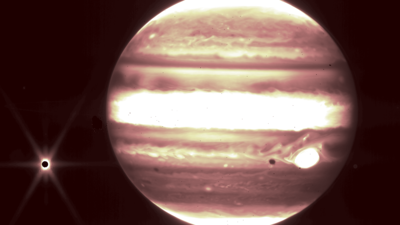
  • Jupiter and its moon Europa, left, are seen through the James Webb Space Telescope. Photo: Nasa
    Jupiter and its moon Europa, left, are seen through the James Webb Space Telescope. Photo: Nasa
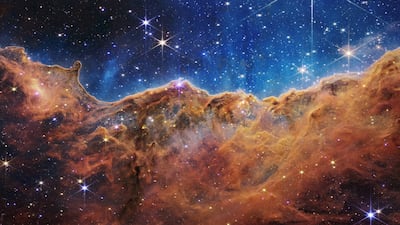
  • Captured in infrared light by Nasa's new James Webb Space Telescope, this image reveals areas of star birth in Carina Nebula. All photos: James Webb Space Telescope
    Captured in infrared light by Nasa's new James Webb Space Telescope, this image reveals areas of star birth in Carina Nebula. All photos: James Webb Space Telescope
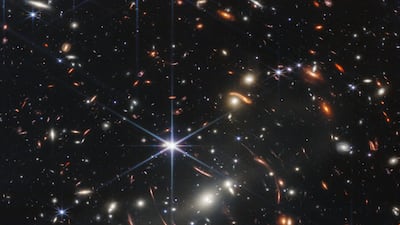
  • Known as Webb's First Deep Field, the picture showcases a galaxy cluster called SMACS 0723 as it appeared 4.6 billion years ago. The image was revealed by US President Joe Biden on July 11 during an event at the White House.
    Known as Webb's First Deep Field, the picture showcases a galaxy cluster called SMACS 0723 as it appeared 4.6 billion years ago. The image was revealed by US President Joe Biden on July 11 during an event at the White House.
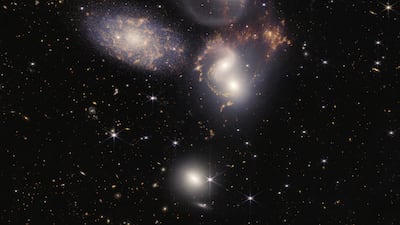
  • An image of Stephan's Quintet, an area in space with a group of five galaxies.
    An image of Stephan's Quintet, an area in space with a group of five galaxies.
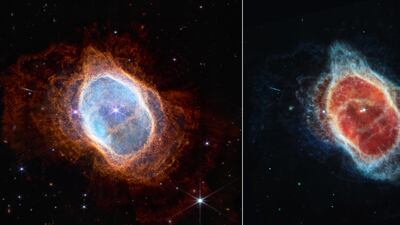
  • Side-by-side comparison shows observations of the Southern Ring Nebula in near-infrared light (left) and mid-infrared light.
    Side-by-side comparison shows observations of the Southern Ring Nebula in near-infrared light (left) and mid-infrared light.
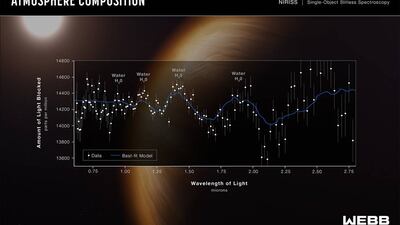
  • The telescope has captured the distinct signature of water, along with evidence for clouds and haze, in the atmosphere surrounding a hot, puffy gas giant planet orbiting a distant Sun-like star, called WASP-96 b. Photo: James Webb Space Telescope
    The telescope has captured the distinct signature of water, along with evidence for clouds and haze, in the atmosphere surrounding a hot, puffy gas giant planet orbiting a distant Sun-like star, called WASP-96 b. Photo: James Webb Space Telescope

The James Webb Space Telescope is the largest optical telescope in space, equipped with high-resolution and high-sensitivity instruments to conduct infrared astronomy, allowing objects that were previously too old or far away to be seen.

Among its discoveries, an image beamed back to Earth from the telescope in January last year offered clues about how the first stars were born.

Astronomers believe the image shows a young cluster of stars more than 200,000 light years from Earth, in a dwarf galaxy called the Small Magellanic Cloud, could help shed light on how the first stars formed during the “cosmic noon” period, about two or three billion years after the Big Bang.

That same month, it found an Earthlike exoplanet outside the solar system. The planet, called LHS 475 b, is almost exactly the same size as the Earth.


COMPANY%20PROFILE
%3Cp%3E%3Cstrong%3EName%3A%3C%2Fstrong%3E%20PlanRadar%3Cbr%3E%3Cstrong%3EStarted%3A%20%3C%2Fstrong%3E2013%3Cbr%3E%3Cstrong%3ECo-founders%3A%20%3C%2Fstrong%3EIbrahim%20Imam%2C%20Sander%20van%20de%20Rijdt%2C%20Constantin%20K%C3%B6ck%2C%20Clemens%20Hammerl%2C%20Domagoj%20Dolinsek%3Cbr%3E%3Cstrong%3EBased%3A%20%3C%2Fstrong%3EVienna%2C%20Austria%3Cbr%3E%3Cstrong%3ESector%3A%20%3C%2Fstrong%3EConstruction%20and%20real%20estate%3Cbr%3E%3Cstrong%3ECurrent%20number%20of%20staff%3A%20%3C%2Fstrong%3E400%2B%3Cbr%3E%3Cstrong%3EInvestment%20stage%3A%20%3C%2Fstrong%3ESeries%20B%3Cbr%3E%3Cstrong%3EInvestors%3A%3C%2Fstrong%3E%20Headline%2C%20Berliner%20Volksbank%20Ventures%2C%20aws%20Gr%C3%BCnderfonds%2C%20Cavalry%20Ventures%2C%20Proptech1%2C%20Russmedia%2C%20GR%20Capital%3C%2Fp%3E%0A
COMPANY PROFILE

Name: Lamsa

Founder: Badr Ward

Launched: 2014

Employees: 60

Based: Abu Dhabi

Sector: EdTech

Funding to date: $15 million

Our legal consultant

Name: Dr Hassan Mohsen Elhais

Position: legal consultant with Al Rowaad Advocates and Legal Consultants.

The biog

Favourite hobby: taking his rescue dog, Sally, for long walks.

Favourite book: anything by Stephen King, although he said the films rarely match the quality of the books

Favourite film: The Shawshank Redemption stands out as his favourite movie, a classic King novella

Favourite music: “I have a wide and varied music taste, so it would be unfair to pick a single song from blues to rock as a favourite"

Find the right policy for you

Don’t wait until the week you fly to sign up for insurance – get it when you book your trip. Insurance covers you for cancellation and anything else that can go wrong before you leave.

Some insurers, such as World Nomads, allow you to book once you are travelling – but, as Mr Mohammed found out, pre-existing medical conditions are not covered.

Check your credit card before booking insurance to see if you have any travel insurance as a benefit – most UAE banks, such as Emirates NBD, First Abu Dhabi Bank and Abu Dhabi Islamic Bank, have cards that throw in insurance as part of their package. But read the fine print – they may only cover emergencies while you’re travelling, not cancellation before a trip.

Pre-existing medical conditions such as a heart condition, diabetes, epilepsy and even asthma may not be included as standard. Again, check the terms, exclusions and limitations of any insurance carefully.

If you want trip cancellation or curtailment, baggage loss or delay covered, you may need a higher-grade plan, says Ambareen Musa of Souqalmal.com. Decide how much coverage you need for emergency medical expenses or personal liability. Premium insurance packages give up to $1 million (Dh3.7m) in each category, Ms Musa adds.

Don’t wait for days to call your insurer if you need to make a claim. You may be required to notify them within 72 hours. Gather together all receipts, emails and reports to prove that you paid for something, that you didn’t use it and that you did not get reimbursed.

Finally, consider optional extras you may need, says Sarah Pickford of Travel Counsellors, such as a winter sports holiday. Also ensure all individuals can travel independently on that cover, she adds. And remember: “Cheap isn’t necessarily best.”

Updated: March 15, 2023, 2:08 PM