

A futuristic flying bike unveiled in Abu Dhabi is expected to deliver life-saving support in crucial search and rescue operations.
The Xturismo Hoverbike, which can soar 20 metres into the sky and hit speeds of up to 80 kph, is being tipped as the next cutting-edge tool for emergency services confronted by challenging conditions such as desert terrain.
The vehicle has been developed by Bayanat, a unit of Abu Dhabi's artificial intelligence company G42, in partnership with Japanese aerial mobility company Aerwins Technologies.
It was put on display at an event in Yas Bay on Monday, with representatives from Abu Dhabi Police, the Department of Culture and Tourism and the Ministry of Health on hand.
The agile hoverbike is made of high-strength carbon fibre used in aviation and the space industry. It weighs 300kg and can fly at 80 kph for up to 40 minutes before it needs to refuel.
Trials have already been held in Japan with plans in place to roll bikes off the production line in the Emirates.
“The hovering bike has been successfully trialled in Japan through our partner”, said Hasan Al Hosani, chief executive of Bayanat.
“Our plan is to start a manufacturing unit in the UAE and customise it into our specific needs in the UAE”.
-
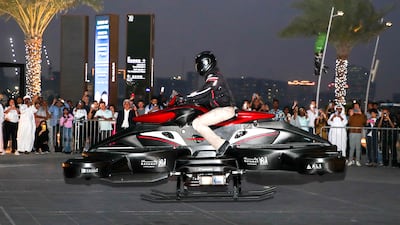
Xturismo Hoverbike, the futuristic flying bike, was unveiled at Yas Bay, in Abu Dhabi. All photos: Victor Besa / The National -
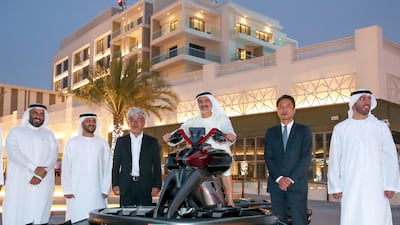
Saleh Mohamed Al Geziry, director general of Abu Dhabi's Department of Culture and Tourism, tries the Xturismo Hoverbike -
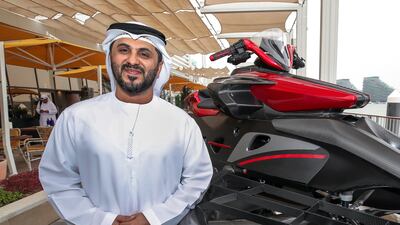
Hasan Al Hosani, chief executive of Bayanat, a part of Abu Dhabi's artificial intelligence company G42, which developed the flying bike with Japan's aerial mobility firm, Aerwins Technologies -

The piloted vehicle on display at Yas Bay -
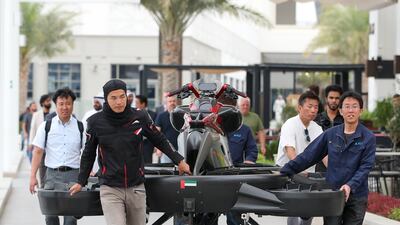
A Japanese team of engineers and a pilot arrive at the hover bike demonstration -
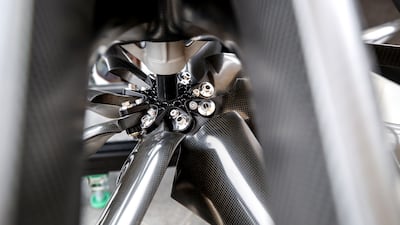
The vehicle is being prepared for multiple purposes, including search and rescue missions -

It can soar 20 metres into the sky and hit speeds of up to 80kph -
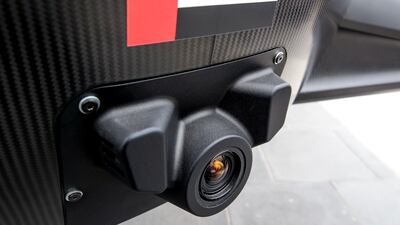
It has a turbo charged 4-stroke Kawasaki gasoline motor bike racing engine, delivering 230 horsepower -
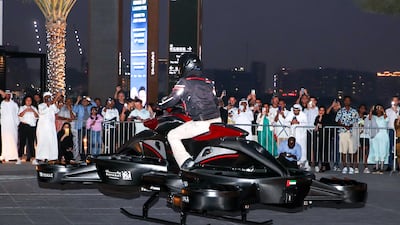
Trials have already been held in Japan with plans in place to roll bikes off the production line in the Emirates -
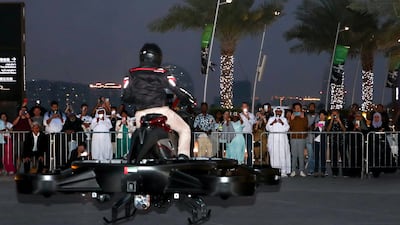
It is being tipped as the next cutting-edge tool for emergency services confronted by challenging conditions such as desert terrain


Bayanat is well versed in developing advanced transportation, having recently launched driverless cars and trams on Yas Island and Saadiyat, called TXAIs.
Mr Hosani said the hoverbike is an extension of the company’s smart mobility programme.
“The plan is to utilise it for multiple sectors such as search and rescue and security, especially considering our desert terrain”.
He said the bike could be used in remote areas for the oil and gas industry, to deliver emergency help to remote areas, and even to support civil defence operations or the construction sector.
The bike has a turbocharged four-stroke Kawasaki gasoline motorbike racing engine, delivering 230 horsepower.
Four electrically-powered side fans control the vehicle during flying.
It has been designed with rescue missions in mind, to help emergency services reach remote locations by flying over deserts and lakes, cutting response times.
It is also expected to be used to transport urgent supplies and for data gathering, as well as being used in joint operations with drones.
Rise of aerial technology
Sharjah Police uses drones to assist crews on the ground battling fires in the emirate.
Mavic 2, one of the force's high-tech drones, was sent through smoke and flames to find people in danger after a large fire broke out at the 190-metre, 48-storey Abbco Tower in Sharjah in May 2020.
Firefighters took three hours to put out the blaze but residents and staff survived thanks to the drone, which provided rescuers with a constant stream of data.
It located three trapped tenants, giving emergency services the information they needed to reach them.
“Being a time-sensitive matter, the device was deployed to locate any tenants who were not able to make it out of the tower”, said Capt Omran Al Matrooshi, head of the drone unit at Sharjah Police.
“It was able to find all three people, who were taken out to safety”.
Another drone, the state-of-the-art Matrice M300RTK, entered service in 2020 and has helped in several drug cases.
It has been also used to detect traffic offences and to find missing people.
When it detects a car, a suspect or a person in distress, it sends co-ordinates to a central or mobile operations room.

