
Dubai Police's elite canine unit played a crucial role in the search for survivors in the wake of the deadly Turkey-Syria earthquake.
Six trainers and four dogs were sent to Turkey to assist rescue teams facing a race against time to find people trapped under rubble after thousands of buildings were flattened during the natural disaster.
The keen sense of smell of the highly-trained animals is viewed as a valuable asset in search and rescue operations, and proved especially useful amid scenes of such large-scale destruction.
More than 50,000 died as a result of the powerful earthquake which struck on February 6, with millions more affected.
Capt Khalifa Al Suwaidi, who headed the K9 team in the quake zone, said he was proud of their life-saving efforts in challenging circumstances.
“I’m proud of being part of the UAE rescue team that went to Turkey during the earthquake. We had new experiences that developed our skills,” Capt Al Suwaidi told The National.
-
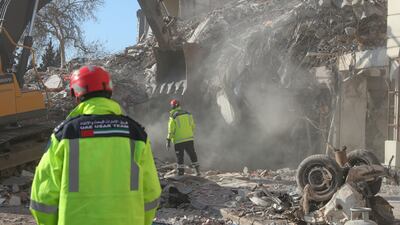
The Emirati search-and-rescue teams that helped earthquake survivors involved 134 rescue workers. All photos: Wam -

Operation The Gallant Knight 2 took place in Syria and Turkey -

Rescuers raced against time to save those trapped under the rubble -

The operation was part of UAE efforts to mitigate the effects of the earthquake that struck areas of Turkey and Syria -
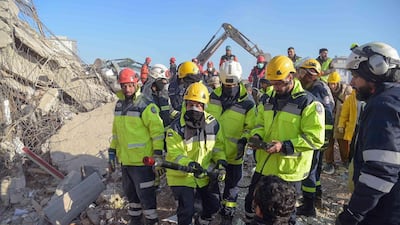
The Joint Operations Command of the Ministry of Defence revealed that the UAE search-and-rescue teams were sent to several affected areas -

The rescuers were equipped with special equipment for clearing rubble


“The weather is different as temperatures dropped to minus 10°C.
"It was hard and challenging but we managed to help people despite all the odds.”
The team spent about two weeks in Turkey.
A different breed of crime fighter
The earthquake rescue mission served to highlight the versatility of the K9 unit.
The four-legged task force was established in March 1976 with six dogs and six trainers.
Today, it can call on more than 90 dogs — including German shepherds, Dutch shepherds, Belgian Malinois, English springer spaniels, Labrador retrievers and cocker spaniels, as well as 70 trainers.
The unit carried out more than 2,841 missions last year.
“The dogs assisted the force in conducting security checks, guard duty posts, security patrols, anti-drug operations, raids, fire detections and searching for people trapped after disasters," said Maj Salah Al Mazrouei, director of the unit.
-
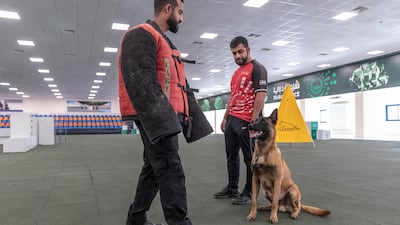
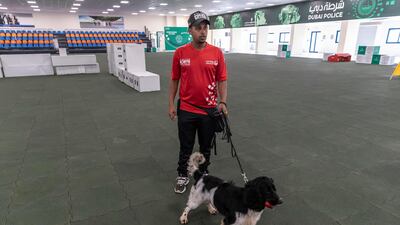
First Sergeant Mohammed Abdul Fattha trains with Togo, a Belgian Malinois. All photos: Antonie Robertson/The National -
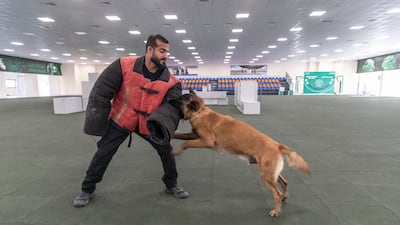
Togo is one of many specially trained dogs in the Dubai Police K9 Unit -
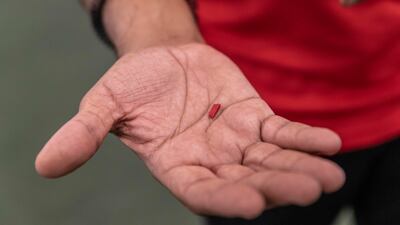
A small piece of cocker spaniel Kevin's chew toy is used to train his sniffing technique for finding illegal substances -
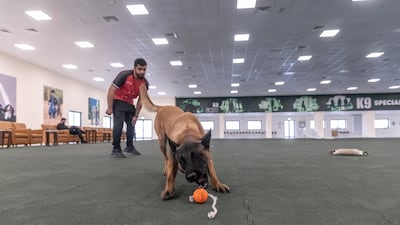
Togo in training -
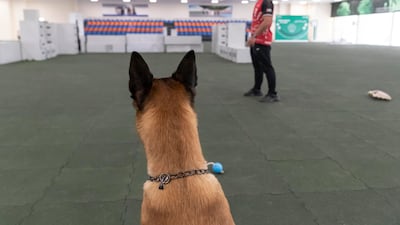
The K9 unit has been helping rescue missions after the earthquake in Turkey -
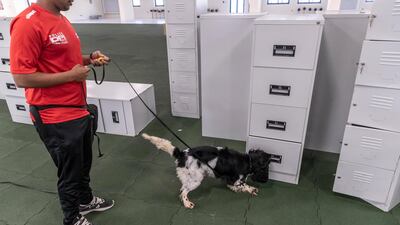
Kevin learns how to sniff out illegal substances -
The four-legged task force was established in March 1976 with six dogs and six trainers -
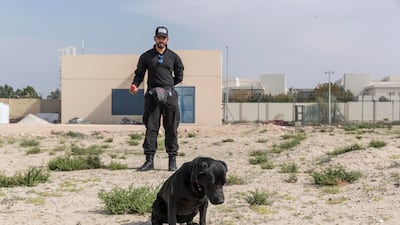
Today, it can call on more than 90 dogs -
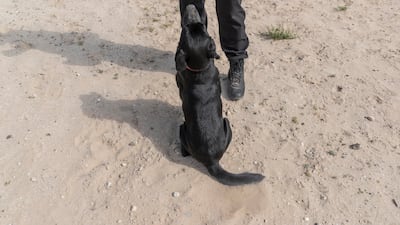
First Corporal Ali Alsebeyi trains Sheba, a Labrador that will help locate dead bodies -
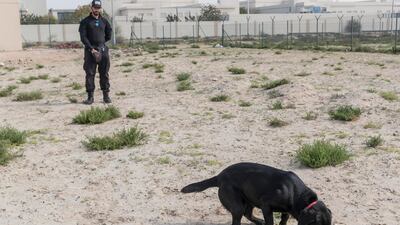
Sheba makes progress in training -
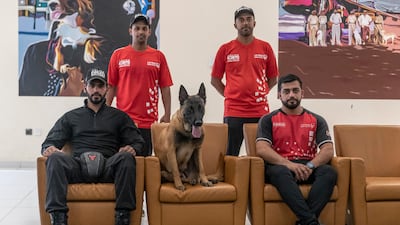
Team members


Laying the groundwork
Much like their human colleagues, the dogs must complete key training before they can be let off the leash at a crime scene.
In the first two weeks on the team they are taught to respond to basic commands and played with to help build confidence and trust and make them more comfortable in their surroundings.
Then the instincts of the new recruits — known as green dogs — are evaluated before they are trained to specialise in one area.
“The dogs receive daily training that is targeted at helping them to differentiate between the different substances they are required to track according to their specialism,” said Maj Al Mazrouei.
The dogs typically train for two hours each day to remain in peak physical and mental condition for their duties.
Lt Nasser Al Falasi, who joined the force in 2019, said different breeds bring their own specialist skills to the table.

"German and Dutch shepherds and Malinois dogs handle guarding duties, lead tracking and detection of all kinds as they are known for being more resilient,” he said.
English springer, Labrador retriever and cocker spaniels specialise in recovering hidden narcotics and explosives, uncovering dead bodies, searching for missing people and tracking possessions and flammable materials.
“We also train the dogs to secure major events such as New Year celebrations as well as demonstrate the dogs' skills in schools and social events,” Lt Al Falasi said.
During their years of service, the dogs undergo medical checkups and performance tests to assess their capabilities to carry out police work.
Once they are ready to put their paws up, the police work to ensure they are set for a happy retirement.
“When the dog reaches a certain age, we put them for adoption for free," Lt Al Falasi said.
"We receive requests from people in Europe and we have dogs adopted by Europeans.”
Sgt Fatma Al Jasmi has built up a strong connection with her faithful canine companion, Pablo.
“The police dog is a unique animal and should have special treatment. With Pablo, I managed to build a strong bond to be able to train him. He is a loyal friend to me and we can’t be separated,” she said.
She travelled to France with Pablo to take part in studies on the abilities of dogs to screen for Covid-19 cases.
“During Covid-19, sniffing dogs in Dubai Police were able to make screening for passengers to identify the patients. I went to France to present what we had achieved.”

