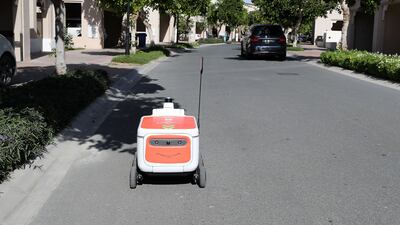
Food delivery robots hit the streets of Dubai


Nick Webster
  • English
  • Arabic

There are new arrivals on the streets of Dubai Silicon Oasis this week as the UAE’s first food delivery robots take their first orders.

After a successful trial during Expo2020, seven of the “talabot” autonomous robots will serve about 300 homes across a specific residential district for the first time.

The project is part of a three-month pilot programme by online food ordering company Talabat, Dubai Roads and Transport Authority and Dubai Integrated Economic Zones Authority to improve options for delivery services.

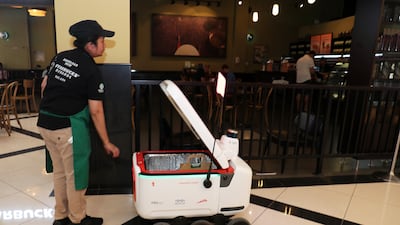
Collecting from Starbucks, Oregano and Lebanese restaurant On the Wood at Cedre Villas community centre, customers can now order robot-delivered food which typically takes up to 15 minutes to arrive.

“We have had to start small as we can’t serve all the homes and restaurants, but this is the next test outside of Expo,” said Maria Estevan, director of special projects at Talabat.

“The technology showed people were engaging with the robots but now we need to take it outside of a controlled environment.”

  • A delivery robot picking up an order from Starbucks in Dubai. All photos: Pawan Singh / The National
    A delivery robot picking up an order from Starbucks in Dubai. All photos: Pawan Singh / The National
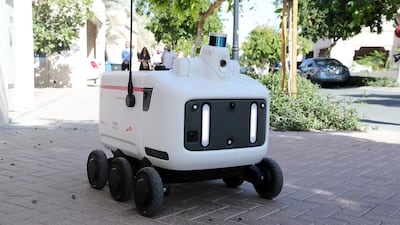
  • Seven ‘talabots’ will serve about 300 homes, delivering food and drink
    Seven ‘talabots’ will serve about 300 homes, delivering food and drink
  • Ordering from Starbucks, Oregeno and Lebanese restaurant On the Wood at Cedre Villas community centre, customers can look forward to delivery within 15 minutes
    Ordering from Starbucks, Oregeno and Lebanese restaurant On the Wood at Cedre Villas community centre, customers can look forward to delivery within 15 minutes
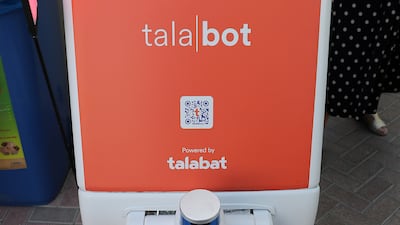
  • Customers can order through the Talabat app and track their delivery
    Customers can order through the Talabat app and track their delivery
  • The robots have sensors and algorithms that gauge surroundings and detect barriers in their path, keeping a safe distance from toddlers and pets
    The robots have sensors and algorithms that gauge surroundings and detect barriers in their path, keeping a safe distance from toddlers and pets

Fitted with radar and lidar operating systems, the delivery robots are well equipped to deal with other vehicles, kerbs and even an inquisitive stray cat.

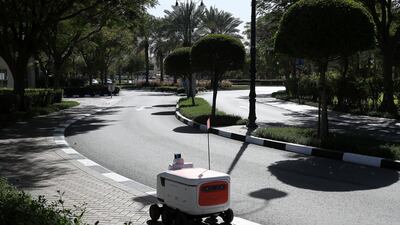
Talabots will only operate inside a gated community within a 4.8km radius of the restaurants, but will share road space with other everyday traffic.

Customers can order via the Talabat app and track their delivery.

Stored securely inside a temperature-controlled unit, the robots can operate in all weathers and withstand the extreme summer heat of the UAE.

Once delivered, customers can open the robot to collect their order by using a unique access code.

If all goes well, it is hoped the service can be expanded and contribute to Dubai’s plan for one in four of all road trips to be autonomous by 2030.

The project is a direct result of the RTA’s Dubai World Challenge for Self-Driving Transport, under the category of “Self-driving Logistical Services”, which includes ground transport and drones.

Artificial Intelligence deployed in the talabots safeguards people’s identity by blurring faces, with no facial recognition detection.

To blend in peacefully within the community, the robots are fitted with multiple inbuilt sensors and algorithms that gauge surroundings and detect barriers in their path, keeping a safe distance from toddlers and pets.

Plans to expand fleet

The robots do not belong to Talabat, but are fully insured in the unlikely event of a collision or damage to property.

“If someone accidentally hits the robot, there will be a usual insurance claim as if two cars hit each other,” said Ms Estevan.

“Our customers will get used to seeing the talabots on the streets every day.

“We are serious about scaling this up, it is not branding and we are looking at how we can optimise our fleet.

“It will cover short, medium and long distances with robots, delivery riders and drones.

“DSO has notified residents about this, and we are collaborating together for this to work.

“This will last at least three months, and then we will see.”

Brief scores:

QPR 0

Watford 1

Capoue 45' 1

21 Lessons for the 21st Century

Yuval Noah Harari, Jonathan Cape
 

History's medical milestones

1799 - First small pox vaccine administered

1846 - First public demonstration of anaesthesia in surgery

1861 - Louis Pasteur published his germ theory which proved that bacteria caused diseases

1895 - Discovery of x-rays

1923 - Heart valve surgery performed successfully for first time

1928 - Alexander Fleming discovers penicillin

1953 - Structure of DNA discovered

1952 - First organ transplant - a kidney - takes place 

1954 - Clinical trials of birth control pill

1979 - MRI, or magnetic resonance imaging, scanned used to diagnose illness and injury.

1998 - The first adult live-donor liver transplant is carried out

Mercer, the investment consulting arm of US services company Marsh & McLennan, expects its wealth division to at least double its assets under management (AUM) in the Middle East as wealth in the region continues to grow despite economic headwinds, a company official said.

Mercer Wealth, which globally has $160 billion in AUM, plans to boost its AUM in the region to $2-$3bn in the next 2-3 years from the present $1bn, said Yasir AbuShaban, a Dubai-based principal with Mercer Wealth.

Within the next two to three years, we are looking at reaching $2 to $3 billion as a conservative estimate and we do see an opportunity to do so,” said Mr AbuShaban.

Mercer does not directly make investments, but allocates clients’ money they have discretion to, to professional asset managers. They also provide advice to clients.

“We have buying power. We can negotiate on their (client’s) behalf with asset managers to provide them lower fees than they otherwise would have to get on their own,” he added.

Mercer Wealth’s clients include sovereign wealth funds, family offices, and insurance companies among others.

From its office in Dubai, Mercer also looks after Africa, India and Turkey, where they also see opportunity for growth.

Wealth creation in Middle East and Africa (MEA) grew 8.5 per cent to $8.1 trillion last year from $7.5tn in 2015, higher than last year’s global average of 6 per cent and the second-highest growth in a region after Asia-Pacific which grew 9.9 per cent, according to consultancy Boston Consulting Group (BCG). In the region, where wealth grew just 1.9 per cent in 2015 compared with 2014, a pickup in oil prices has helped in wealth generation.

BCG is forecasting MEA wealth will rise to $12tn by 2021, growing at an annual average of 8 per cent.

Drivers of wealth generation in the region will be split evenly between new wealth creation and growth of performance of existing assets, according to BCG.

Another general trend in the region is clients’ looking for a comprehensive approach to investing, according to Mr AbuShaban.

“Institutional investors or some of the families are seeing a slowdown in the available capital they have to invest and in that sense they are looking at optimizing the way they manage their portfolios and making sure they are not investing haphazardly and different parts of their investment are working together,” said Mr AbuShaban.

Some clients also have a higher appetite for risk, given the low interest-rate environment that does not provide enough yield for some institutional investors. These clients are keen to invest in illiquid assets, such as private equity and infrastructure.

“What we have seen is a desire for higher returns in what has been a low-return environment specifically in various fixed income or bonds,” he said.

“In this environment, we have seen a de facto increase in the risk that clients are taking in things like illiquid investments, private equity investments, infrastructure and private debt, those kind of investments were higher illiquidity results in incrementally higher returns.”

The Abu Dhabi Investment Authority, one of the largest sovereign wealth funds, said in its 2016 report that has gradually increased its exposure in direct private equity and private credit transactions, mainly in Asian markets and especially in China and India. The authority’s private equity department focused on structured equities owing to “their defensive characteristics.”

The specs

Engine: four-litre V6 and 3.5-litre V6 twin-turbo

Transmission: six-speed and 10-speed

Power: 271 and 409 horsepower

Torque: 385 and 650Nm

Price: from Dh229,900 to Dh355,000

Updated: February 18, 2023, 5:44 AM