Technological advances mean robots are being increasingly trained and programmed to do the jobs of humans. Getty Images

Rise of AI creates job worries, UAE survey finds


Nick Webster
  • English
  • Arabic

More than half of UAE workers worry they will lose their jobs to robots or artificial intelligence over the next 10 years, a survey found.

The poll of about 1,000 residents revealed younger people are more concerned about how advancing technology will influence their career prospects.

The study, carried out by communications advisers duke+mir, in association with YouGov, asked people how they believed AI will affect their lives.

Fifty-five per cent said they worried their roles would be replaced by AI or robots by 2033.

It has opened our eyes to a new challenge, but it will depend on who is teaching the AI to determine if it will become smart, or stupid
Arif Aljanahi,
Security Industry Regulatory Industry, Dubai Government

About 24 per cent people were unsure and 21 per cent were not afraid of their roles being replaced by technology.

Sixty per cent Emiratis were concerned by AI and robots replacing their roles as compared to 45 per cent of their western expatriates.

“With such a strong focus from the UAE government on providing and protecting Emirati jobs both now and in the future, it’s quite unexpected to see the youth and Emiratis of the UAE being the most concerned about future technological advancements,” said Jonathan Ivan-Duke, co-founder and partner at duke+mir.

“As one of the world’s most forward-thinking nations when it comes to innovation, citizens and residents are used to new technologies being unveiled within the Emirates. They just want to make sure that it’s not going to replace them.”

The survey found 66 per cent of people under 25 were fearful AI and robots will come for their jobs in the next decade, compared to 57 per cent of those in the age-group of 25 to 44 and just 43 per cent of those aged 45 and older were concerned.

The surveyors pointed at the opportunity for the private sector and public institutions to offer more education on the potential benefits of AI and robotics.

.
.

It is not just the much discussed ChatGPT text generator bot that is utilising AI to bypass human involvement.

The Stockimg AI app creates images and posters in seconds, while the runwayml.com website can create an AI powered video out of a simple idea.

The UAE government is driving ambitious plans to establish the country as a global AI hub.

In 2017, the UAE appointed Omar Al Olama as its first Minister of State for Artificial Intelligence and later adopted the National Artificial Intelligence Strategy 2031 to promote the growth of the cutting-edge technology.

The Mohamed bin Zayed University of Artificial Intelligence in Abu Dhabi was established in 2019 to develop the skills of top talent from across the world to lead workplaces of the future.

At the start of the year, Sheikh Mohammed bin Rashid, Vice President and Ruler of Dubai, announced the D33 Dubai Economic Agenda.

It aims to double Dubai’s economy over the next decade, with a key objective of generating new economic value from the digital transformation and a shift towards increasing the use of AI.

The plan aims to sustain growth of Dh100 billion a year.

As cities become more intelligent by utilising technology, they become more efficient and generate huge amounts of data to enable governments to improve services.

Human interaction remains crucial

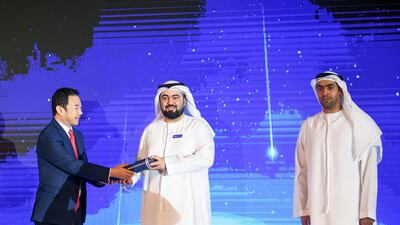
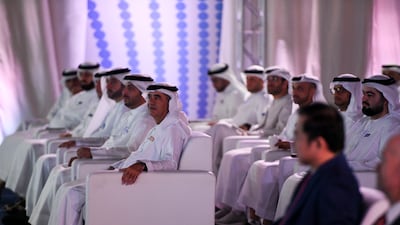
  • A graduation ceremony at the Mohamed bin Zayed University of Artificial Intelligence in Abu Dhabi. All photos: Khushnum Bhandari / The National
    A graduation ceremony at the Mohamed bin Zayed University of Artificial Intelligence in Abu Dhabi. All photos: Khushnum Bhandari / The National
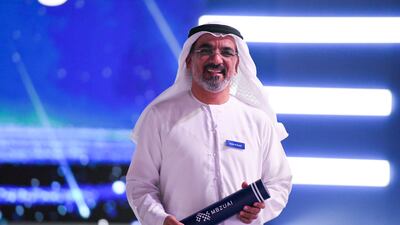
  • Jamal Al Kaabi ,undersecretary at the Department of Health in Abu Dhabi.
    Jamal Al Kaabi ,undersecretary at the Department of Health in Abu Dhabi.
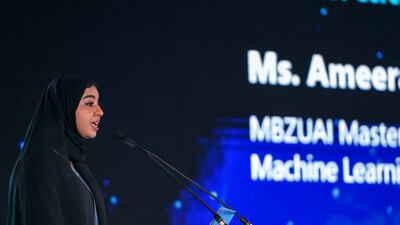
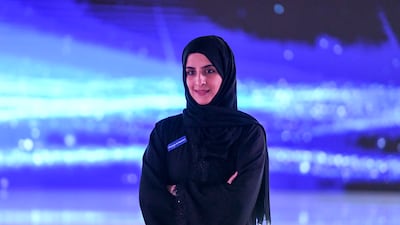
  • Ameera Ali Bawazir, a master's student of machine learning, speaks at the event.
    Ameera Ali Bawazir, a master's student of machine learning, speaks at the event.
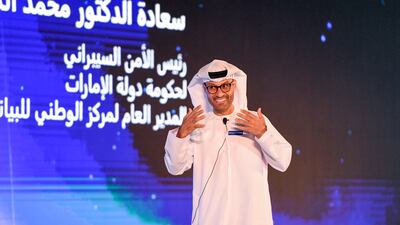
  • Dr Mohamed Al Kuwaiti, head of cybersecurity for the UAE Government.
    Dr Mohamed Al Kuwaiti, head of cybersecurity for the UAE Government.
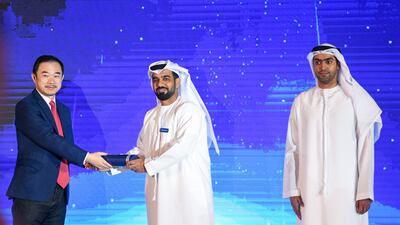
  • Graduates at the ceremony in Masdar City, Abu Dhabi.
    Graduates at the ceremony in Masdar City, Abu Dhabi.
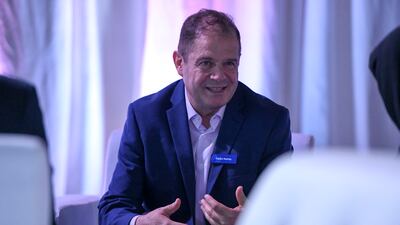
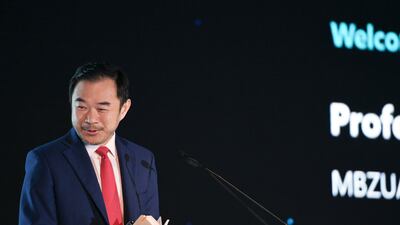
  • Professor Fakhri Karray, provost at the Mohamed bin Zayed University of Artificial Intelligence.
    Professor Fakhri Karray, provost at the Mohamed bin Zayed University of Artificial Intelligence.
  • The graduation ceremony.
    The graduation ceremony.
  • Thuraya Al Hashimi, executive director of the digital data enabling sector at the Ministry of Cabinet Affairs.
    Thuraya Al Hashimi, executive director of the digital data enabling sector at the Ministry of Cabinet Affairs.
  • Eric Xing, president of the Mohamed bin Zayed University of Artificial Intelligence.
    Eric Xing, president of the Mohamed bin Zayed University of Artificial Intelligence.

Although AI is playing a key role in how data from smart cities is used, human interaction will play a critical role according to Arif Aljanahi, security engineering department director of the Security Industry Regulatory Agency, which was set up by the Dubai government.

“A key point that people do not consider about AI is that it depends on the information that is being fed to the algorithm,” said Mr Aljanahi at the Security Leaders summit at the Intersec conference in Dubai.

“The biggest challenge we have is converting the meta data.

“The success of AI depends on who is teaching the system. AI can be used in a good way, and also in a bad way.

“We do not know yet what is going to happen with it in the future.

“It has opened our eyes to a new challenge, but it will depend on who is teaching the AI to determine if it will become smart, or stupid.

“It is like a small child, if you give it the wrong information, it will start on the wrong path," he said.


From Zero

Artist: Linkin Park

Label: Warner Records

Number of tracks: 11

Rating: 4/5

The%20specs
%3Cp%3E%3Cstrong%3EEngine%3A%20%3C%2Fstrong%3E3.6-litre%2C%20V6%0D%3Cbr%3E%3Cstrong%3ETransmission%3A%20%3C%2Fstrong%3Eeight-speed%20auto%0D%3Cbr%3E%3Cstrong%3EPower%3A%20%3C%2Fstrong%3E285hp%0D%3Cbr%3E%3Cstrong%3ETorque%3A%20%3C%2Fstrong%3E353Nm%0D%3Cbr%3E%3Cstrong%3EPrice%3A%20%3C%2Fstrong%3EDh159%2C900%0D%3Cbr%3E%3Cstrong%3EOn%20sale%3A%20%3C%2Fstrong%3Enow%3C%2Fp%3E%0A
Company profile

Name: Back to Games and Boardgame Space

Started: Back to Games (2015); Boardgame Space (Mark Azzam became co-founder in 2017)

Founder: Back to Games (Mr Azzam); Boardgame Space (Mr Azzam and Feras Al Bastaki)

Based: Dubai and Abu Dhabi 

Industry: Back to Games (retail); Boardgame Space (wholesale and distribution) 

Funding: Back to Games: self-funded by Mr Azzam with Dh1.3 million; Mr Azzam invested Dh250,000 in Boardgame Space  

Growth: Back to Games: from 300 products in 2015 to 7,000 in 2019; Boardgame Space: from 34 games in 2017 to 3,500 in 2019

DIVINE%20INTERVENTOIN
%3Cp%3EStarring%3A%20Elia%20Suleiman%2C%20Manal%20Khader%2C%20Amer%20Daher%3C%2Fp%3E%0A%3Cp%3EDirector%3A%20Elia%20Suleiman%3C%2Fp%3E%0A%3Cp%3ERating%3A%204.5%2F5%3C%2Fp%3E%0A
Ten tax points to be aware of in 2026

1. Domestic VAT refund amendments: request your refund within five years

If a business does not apply for the refund on time, they lose their credit.

2. E-invoicing in the UAE

Businesses should continue preparing for the implementation of e-invoicing in the UAE, with 2026 a preparation and transition period ahead of phased mandatory adoption. 

3. More tax audits

Tax authorities are increasingly using data already available across multiple filings to identify audit risks. 

4. More beneficial VAT and excise tax penalty regime

Tax disputes are expected to become more frequent and more structured, with clearer administrative objection and appeal processes. The UAE has adopted a new penalty regime for VAT and excise disputes, which now mirrors the penalty regime for corporate tax.

5. Greater emphasis on statutory audit

There is a greater need for the accuracy of financial statements. The International Financial Reporting Standards standards need to be strictly adhered to and, as a result, the quality of the audits will need to increase.

6. Further transfer pricing enforcement

Transfer pricing enforcement, which refers to the practice of establishing prices for internal transactions between related entities, is expected to broaden in scope. The UAE will shortly open the possibility to negotiate advance pricing agreements, or essentially rulings for transfer pricing purposes. 

7. Limited time periods for audits

Recent amendments also introduce a default five-year limitation period for tax audits and assessments, subject to specific statutory exceptions. While the standard audit and assessment period is five years, this may be extended to up to 15 years in cases involving fraud or tax evasion. 

8. Pillar 2 implementation 

Many multinational groups will begin to feel the practical effect of the Domestic Minimum Top-Up Tax (DMTT), the UAE's implementation of the OECD’s global minimum tax under Pillar 2. While the rules apply for financial years starting on or after January 1, 2025, it is 2026 that marks the transition to an operational phase.

9. Reduced compliance obligations for imported goods and services

Businesses that apply the reverse-charge mechanism for VAT purposes in the UAE may benefit from reduced compliance obligations. 

10. Substance and CbC reporting focus

Tax authorities are expected to continue strengthening the enforcement of economic substance and Country-by-Country (CbC) reporting frameworks. In the UAE, these regimes are increasingly being used as risk-assessment tools, providing tax authorities with a comprehensive view of multinational groups’ global footprints and enabling them to assess whether profits are aligned with real economic activity. 

Contributed by Thomas Vanhee and Hend Rashwan, Aurifer

Director: Laxman Utekar

Cast: Vicky Kaushal, Akshaye Khanna, Diana Penty, Vineet Kumar Singh, Rashmika Mandanna

Rating: 1/5

COMPANY%20PROFILE
%3Cp%3E%3Cstrong%3ECompany%20name%3A%3C%2Fstrong%3E%20Sav%3Cbr%3E%3Cstrong%3EStarted%3A%3C%2Fstrong%3E%202021%3Cbr%3E%3Cstrong%3EFounder%3A%3C%2Fstrong%3E%20Purvi%20Munot%3Cbr%3E%3Cstrong%3EBased%3A%3C%2Fstrong%3E%20Dubai%3Cbr%3E%3Cstrong%3EIndustry%3A%3C%2Fstrong%3E%20FinTech%3Cbr%3E%3Cstrong%3EFunding%3A%3C%2Fstrong%3E%20%24750%2C000%20as%20of%20March%202023%3Cbr%3E%3Cstrong%3EInvestors%3A%3C%2Fstrong%3E%20Angel%20investors%3C%2Fp%3E%0A
Who was Alfred Nobel?

The Nobel Prize was created by wealthy Swedish chemist and entrepreneur Alfred Nobel.

  • In his will he dictated that the bulk of his estate should be used to fund "prizes to those who, during the preceding year, have conferred the greatest benefit to humankind".
  • Nobel is best known as the inventor of dynamite, but also wrote poetry and drama and could speak Russian, French, English and German by the age of 17. The five original prize categories reflect the interests closest to his heart.
  • Nobel died in 1896 but it took until 1901, following a legal battle over his will, before the first prizes were awarded.
Updated: February 06, 2023, 8:57 AM