

Space is no place for politics and should remain a peaceful domain, UAE minister Sarah Al Amiri has said.
Ms Al Amiri was speaking at a space-themed panel at the World Economic Forum in Davos on Thursday, which discussed the use of anti-satellite tests (ASAT), an exercise in which military technology is used to destroy spacecraft.
Russia was the most recent country to perform the test in 2021, creating thousands of pieces of orbital debris, which could endanger satellites and astronauts.
But experts are also worried this technology could also be used during conflict and wars.
“This is a space — pun intended — required for the long run, then it should not be in the repertoire of political movements,” said Ms Al Amiri, Minister of State for Public Education and Future Technology and the chairwoman of the UAE Space Agency.
“We’ve got enough tools to address global skirmishes, we cannot create a further problem to solve a current problem.
“And this is what's happening in the space sector. We need to remain actively, consciously and transparent that space is for peaceful use.
“The low-Earth orbit, which is the orbit that we will require the most, is a finite commodity that needs to be accessible for everyone.”

China was first to carry out such a test in 2007, followed by the US a year later.
India ordered an ASAT test in 2019 in an operation called Mission Shakti, resulting in a dangerous level of space debris.
Last year the US government banned the tests and encouraged other nations to follow.
New Zealand, Japan, Germany, Canada, South Korea and the UK have joined.
Dava Newman, director of the Massachusetts Institute of Technology Media Laboratory, was also speaking on the panel and said that a global policy was needed.
“We do a policy and regulation that’s global and not one country for sure, because it's very damaging,” she said.
“Let’s call it what it is — the US, Russia, China and India have all done anti-satellite manoeuvres and it’s not OK for the future because it compromises everyone.
“So, we have to have a serious discussion.”
Apart from ASAT tests, there are overall concerns of the increasing militarisation of space.
That includes using weapons in space, carrying out cyber attacks on satellites, using technology that jams communications and possessing a large fleet of intelligence, surveillance and reconnaissance satellites.
Orbital debris was also in focus during the panel session, particularly how it could endanger spacecraft and astronauts.
Reports suggest that there will be more than 100,000 satellites added to Earth’s orbit, which is already very crowded.
And a swathe of spacecraft debris is still floating in space, some of it decades old.
Several companies have plans to operate mega satellite constellations, including Elon Musk’s SpaceX. It wants to have 30,000 Starlink satellites providing internet access.
Rajeev Suri, chief executive of satellite service provider Inmarsat, said that regulators should ask companies what their debris removal plan is before giving them market access.
“I think there is no place for 100,000 or 200,000 satellites in the next few years,” he said.
“I think that's economically overcapacity. I think the industry will get to overcapacity by maybe even 2025 … and 2030 will be an excessive overcapacity situation.
“So, while I like the new investment coming into the sector, there are too many mega constellations being planned at the moment.
“I'm not against innovation. I want innovation to happen, I believe in a multi-orbit race, but it just can’t be indiscriminate.”
Anti-satellite weapons - in pictures
-

The ASM-135 ASAT anti-satellite missile is part of the US F15 Eagle aircraft's arsenal. Photo: Lorax -
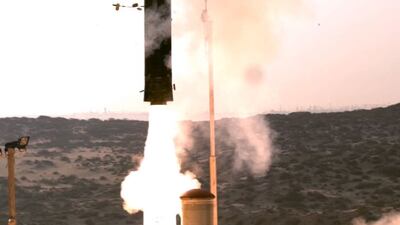
The Israel Missile Defence Organisation and the US Missile Defence Agency jointly developed the Arrow-3 interceptor. Photo: Public Domain -
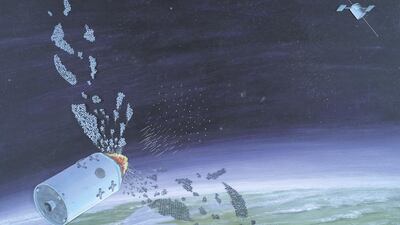
An artist's impression of a Russian anti-satellite weapon. Photo: Public Domain -
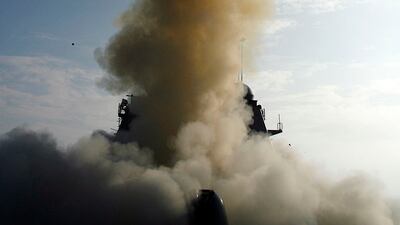
The US fired a modified SM-3 missile to destroy the failing NRO-L 21 satellite. Photo: Public Domain -
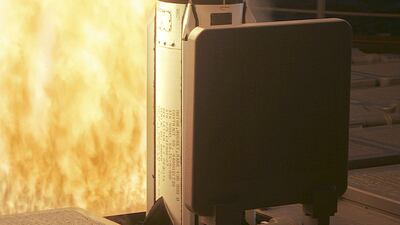
An SM-3 being launched from the Pearl Harbor-based Aegis cruiser 'USS Lake Erie' during a ballistic missile flight test. The missile intercepted a separating ballistic missile threat target, launched from the Pacific Missile Range Facility in Barking Sands, Hawaii. The test was the sixth intercept, in seven flight tests, by Aegis Ballistic Missile Defence. Photo: Public Domain -

The Soviet Strategic Defence Programme involved extensive research on advanced technologies in the 1980s. The USSR already had ground-based lasers, conceptually illustrated here, capable of interfering with some US satellites. Photo: Public Domain -
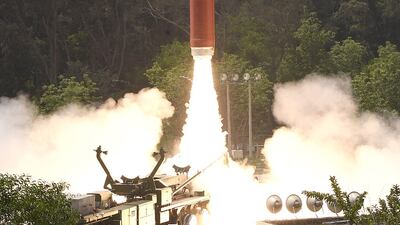
The Defence Research and Development Organisation launched a ballistic missile defence interceptor missile in a test – Mission Shakti – engaging an Indian orbiting target satellite in low Earth orbit on March 27, 2019. Photo: Ministry of Defence India -
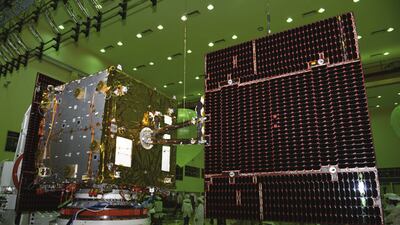
A Microsat-R satellite was launched by India on January 24, 2019 and served as a target for the Mission Shakti test on March 27, 2019. Photo: Ministry of Defence India -
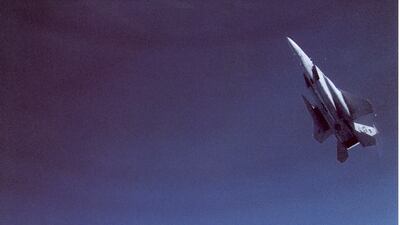
The airborne launch of an ASAT missile in September 1985, which destroyed an orbiting satellite. Photo: Public Domain



