• A family ride their motorcycle on a flooded road during the monsoon season in Karachi, Pakistan. Reuters
    A family ride their motorcycle on a flooded road during the monsoon season in Karachi, Pakistan. Reuters
  • Balochistan and Sindh provinces have been hit by heavy rains that have killed more than 300 in Pakistan during this year's monsoon. EPA
    Balochistan and Sindh provinces have been hit by heavy rains that have killed more than 300 in Pakistan during this year's monsoon. EPA
  • A child plays in a flooded road as a bus passes by in Manila in August. Reuters
    A child plays in a flooded road as a bus passes by in Manila in August. Reuters
  • People wade through floodwater in Manila. Reuters
    People wade through floodwater in Manila. Reuters
  • A car submerged by a flash flood in Zayegan village, in the Iranian city of Fasham, north of Tehran. EPA
    A car submerged by a flash flood in Zayegan village, in the Iranian city of Fasham, north of Tehran. EPA
  • The floods swept mud and debris into this home in Zayegan, Iran. EPA
    The floods swept mud and debris into this home in Zayegan, Iran. EPA
  • Rain flooded Death Valley National Park, California this month. Reuters
    Rain flooded Death Valley National Park, California this month. Reuters
  • A rockslide on Route 39 in the San Gabriel Mountains of California, US, after a major storm in December. Reuters
    A rockslide on Route 39 in the San Gabriel Mountains of California, US, after a major storm in December. Reuters
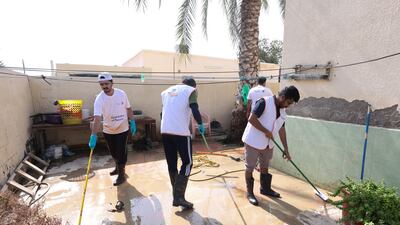
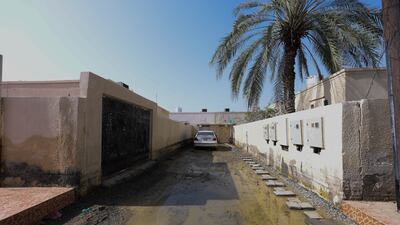
  • Community service group volunteers help to clean a road after the heavy rainfall in Fujairah, UAE. Khushnum Bhandari / The National
    Community service group volunteers help to clean a road after the heavy rainfall in Fujairah, UAE. Khushnum Bhandari / The National
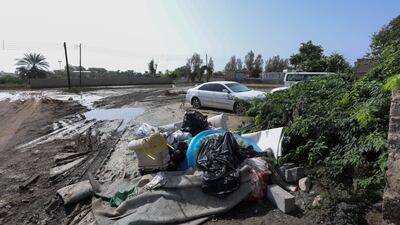
  • Vehicles trapped by the floods in Fujairah. Khushnum Bhandari / The National
    Vehicles trapped by the floods in Fujairah. Khushnum Bhandari / The National
  • The flooded streets of Fujairah. Khushnum Bhandari / The National
    The flooded streets of Fujairah. Khushnum Bhandari / The National
  • People make their way through Fujairah's floodwaters. EPA
    People make their way through Fujairah's floodwaters. EPA
  • A construction vehicle in a flooded tunnel in Fujairah. EPA
    A construction vehicle in a flooded tunnel in Fujairah. EPA

Is climate change making floods more likely - and what can be done about it?


Daniel Bardsley
  • English
  • Arabic

The floods that hit the Northern Emirates recently had tragic consequences, killing seven people and forcing thousands into temporary shelters.

In recent weeks other parts of the Middle East also faced the worst effects of flooding, including Iran, where at least 80 people were killed in late July.

This came only three years after heavy rains in southern Iran caused the deaths of 76 people and an estimated $2 billion worth of damage.

In parts of the Middle East and North Africa, rainfall is becoming concentrated in shorter bursts, even if overall levels are often decreasing, said Dr Nasser Karami, a researcher in Norway who analyses the region's climate.

Added to this, he said, are the effects of development, with buildings constructed in areas that are prone to flooding.

“So the possibility of floods occurring has increased, and the possibility of damage from floods has increased,” he said.

“Big damage from flooding in the Middle East previously was about once per 10 years. Now it's every year.”

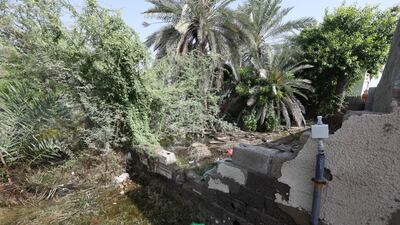
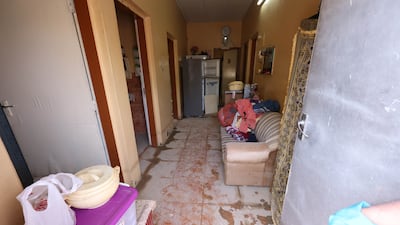
  • Many residents lost appliances and cars in the floods that hit Fujairah in July. All photos: Aster
    Many residents lost appliances and cars in the floods that hit Fujairah in July. All photos: Aster
  • Homes across Fujairah and Sharjah were damaged due to floodwaters.
    Homes across Fujairah and Sharjah were damaged due to floodwaters.
  • Mud left behind by floodwater has been a challenge for volunteers helping families in Fujairah with the clean up.
    Mud left behind by floodwater has been a challenge for volunteers helping families in Fujairah with the clean up.
  • Aster Volunteers arrived from Dubai to help with the clean-up in Fujairah.
    Aster Volunteers arrived from Dubai to help with the clean-up in Fujairah.
  • Many residents were without insurance so are facing huge repair bills.
    Many residents were without insurance so are facing huge repair bills.
  • Work from 15 young people from the Youth India Fujairah group, operated by Aster healthcare, helped families get back into their homes.
    Work from 15 young people from the Youth India Fujairah group, operated by Aster healthcare, helped families get back into their homes.
  • Floodwaters posed a potential health hazard to families hoping to move back home.
    Floodwaters posed a potential health hazard to families hoping to move back home.
  • Aster Volunteers helped with the clean up to allow families like the Kumars move back in.
    Aster Volunteers helped with the clean up to allow families like the Kumars move back in.

Global issue

Look further afield and a similar picture is seen.

In Seoul, the South Korean capital, rain recently fell at the fastest rate since records began more than a century ago, killing 13 people, some of whom were trapped in basements.

Parts of the Philippines, including the capital, Manila, and the island of Cebu, have been under as many as 1.2 metres of water this month.

Meanwhile, Death Valley in California not long ago experienced, in just a few hours, 43mm of rainfall, almost as much as falls in an average year.

It is no wonder that palm trees were uprooted and dozens of cars were swept away and ended up partially buried in debris.

While extreme weather events and flooding are nothing new, experts say the disturbances caused by climate change mean they are happening more often.

One reason is that a warmer atmosphere holds more moisture: a 1°C average temperature rise increases the amount of moisture by about seven per cent.

“That's basic physics,” said Bob Ward, of the Grantham Research Institute on Climate Change and the Environment, part of the London School of Economics and Political Science.

“When it does rain, you tend to get heavier rainfall, which can lead to river flooding and surface-water flooding.”

As well as intensifying rainfall, climate change is causing some storms to move more slowly, so more rain falls on a particular area and flash floods become more likely.

Research published last year by Newcastle University and the University of Bristol in the UK suggested that “slow-moving intense rainstorms” could be 14 times more common in Europe by the end of the century if little was done to reduce emissions.

An unwelcome preview of this was seen in July 2021, when lingering storms meant that Germany, Belgium and other European nations suffered devastating flooding that killed nearly 250 people.

Multiple factors

There are many other ways in which floods are becoming more of a risk in particular environments.

In some mountainous regions, such as the Appalachians of eastern and north-eastern North America, several factors are at play.

As well as an upward trend in intensity, researchers have found that more precipitation is in the form of rain, which is more likely than snow to cause flooding.

In addition, wildfires are more frequent because of climate change, and they increase the risk of mudslides and debris flows when there is heavy rain.

Vulnerable seaside populations

For coastal areas, sea-level rises caused by climate change increase the risk of floods, especially due to storm surges. Building higher and stronger sea defences can protect some, but not all, areas.

“This may be economically viable where you have concentrations of population, such as cities,” Mr Ward said. “But in less populated areas there will have to be a calculation as to whether it's worth staying there or giving up coastal population to rising sea levels.

“There are many parts of the world where we're starting to get these conversations.”

Many coastal cities, such as New Orleans, Mumbai and Shanghai, are built on river deltas, which makes them especially vulnerable.

Cities are often at risk of flooding because large areas of the ground are made from impermeable materials that do not allow the water to soak in, but things can be done to make them more resilient.

Individual buildings can be protected by what the industry calls property flood resilience measures.

Rain flooded Death Valley National Park in California earlier this month. Reuters

These may consist of aperture barriers, such as waterproof metal barriers in front of external doors, to prevent water entering.

Another approach is to design buildings in such a way that, if they are flooded, damage is reduced. Mr Ward highlights measures such as using tiles, which will not be spoilt if water gets into a room, and placing electrical sockets higher up. It may also be preferable for the electrics to run down from the ceiling rather than up from the ground.

On a wider level, and among many other measures, governments may have to invest in improved drainage systems so that, when rains come, more water escapes.

“You have cities like London with Victorian drainage, which cannot cope,” Mr Ward said. “You need to overhaul the drainage system.”

As the world struggles to meet greenhouse gas emission targets that would limit average temperature increases to 1.5°C above pre-industrial levels, a key goal of the 2015 Paris Agreement, extreme rainfall events are set to become ever more common, and sea levels are forecast to continue to rise.

“The climate is changing because we've altered the atmosphere in a way we haven't seen in more than one million years,” Mr Ward said. “There's going to be lots of nasty shocks because of this.”


Sukuk

An Islamic bond structured in a way to generate returns without violating Sharia strictures on prohibition of interest.

Avatar: Fire and Ash

Director: James Cameron

Starring: Sam Worthington, Sigourney Weaver, Zoe Saldana

Rating: 4.5/5

Stage 2 results

Caleb Ewan (AUS) Lotto Soudal 04:18:18

Sam Bennett (IRL) Deceuninck-QuickStep 00:00:02

Arnaud Demare (FRA) Groupama-FDJ 00:00:04

4 Diego Ulissi (ITA) UAE Team Emirates

5 Rick Zabel (GER) Israel Start-Up Nation

General Classification

Caleb Ewan (AUS) Lotto Soudal 07:47:19

2 Sam Bennett (IRL) Deceuninck-QuickStep 00:00:12

3 Arnaud Demare (FRA) Groupama-FDJ 00:00:16

4 Nikolai Cherkasov (RUS) Gazprom-Rusvelo 00:00:17

5 Alexey Lutsensko (KAZ) Astana Pro Team 00:00:19

About%20My%20Father
%3Cp%3E%3Cstrong%3EDirector%3A%20%3C%2Fstrong%3ELaura%20Terruso%3C%2Fp%3E%0A%3Cp%3E%3Cstrong%3EStars%3A%20%3C%2Fstrong%3ERobert%20De%20Niro%2C%20Sebastian%20Maniscalco%2C%20Kim%20Cattrall%3C%2Fp%3E%0A%3Cp%3E%3Cstrong%3ERating%3A%3C%2Fstrong%3E%202%2F5%26nbsp%3B%3C%2Fp%3E%0A
The specs

Engine: Turbocharged four-cylinder 2.7-litre

Power: 325hp

Torque: 500Nm

Transmission: 10-speed automatic

Price: From Dh189,700

On sale: now

Where to donate in the UAE

The Emirates Charity Portal

You can donate to several registered charities through a “donation catalogue”. The use of the donation is quite specific, such as buying a fan for a poor family in Niger for Dh130.

The General Authority of Islamic Affairs & Endowments

The site has an e-donation service accepting debit card, credit card or e-Dirham, an electronic payment tool developed by the Ministry of Finance and First Abu Dhabi Bank.

Al Noor Special Needs Centre

You can donate online or order Smiles n’ Stuff products handcrafted by Al Noor students. The centre publishes a wish list of extras needed, starting at Dh500.

Beit Al Khair Society

Beit Al Khair Society has the motto “From – and to – the UAE,” with donations going towards the neediest in the country. Its website has a list of physical donation sites, but people can also contribute money by SMS, bank transfer and through the hotline 800-22554.

Dar Al Ber Society

Dar Al Ber Society, which has charity projects in 39 countries, accept cash payments, money transfers or SMS donations. Its donation hotline is 800-79.

Dubai Cares

Dubai Cares provides several options for individuals and companies to donate, including online, through banks, at retail outlets, via phone and by purchasing Dubai Cares branded merchandise. It is currently running a campaign called Bookings 2030, which allows people to help change the future of six underprivileged children and young people.

Emirates Airline Foundation

Those who travel on Emirates have undoubtedly seen the little donation envelopes in the seat pockets. But the foundation also accepts donations online and in the form of Skywards Miles. Donated miles are used to sponsor travel for doctors, surgeons, engineers and other professionals volunteering on humanitarian missions around the world.

Emirates Red Crescent

On the Emirates Red Crescent website you can choose between 35 different purposes for your donation, such as providing food for fasters, supporting debtors and contributing to a refugee women fund. It also has a list of bank accounts for each donation type.

Gulf for Good

Gulf for Good raises funds for partner charity projects through challenges, like climbing Kilimanjaro and cycling through Thailand. This year’s projects are in partnership with Street Child Nepal, Larchfield Kids, the Foundation for African Empowerment and SOS Children's Villages. Since 2001, the organisation has raised more than $3.5 million (Dh12.8m) in support of over 50 children’s charities.

Noor Dubai Foundation

Sheikh Mohammed bin Rashid Al Maktoum launched the Noor Dubai Foundation a decade ago with the aim of eliminating all forms of preventable blindness globally. You can donate Dh50 to support mobile eye camps by texting the word “Noor” to 4565 (Etisalat) or 4849 (du).

SPECS
%3Cp%3EEngine%3A%20Supercharged%203.5-litre%20V6%0D%3Cbr%3EPower%3A%20400hp%0D%3Cbr%3ETorque%3A%20430Nm%0D%3Cbr%3EOn%20sale%3A%20Now%0D%3Cbr%3EPrice%3A%20From%20Dh450%2C000%0D%3Cbr%3E%3C%2Fp%3E%0A

Mercer, the investment consulting arm of US services company Marsh & McLennan, expects its wealth division to at least double its assets under management (AUM) in the Middle East as wealth in the region continues to grow despite economic headwinds, a company official said.

Mercer Wealth, which globally has $160 billion in AUM, plans to boost its AUM in the region to $2-$3bn in the next 2-3 years from the present $1bn, said Yasir AbuShaban, a Dubai-based principal with Mercer Wealth.

Within the next two to three years, we are looking at reaching $2 to $3 billion as a conservative estimate and we do see an opportunity to do so,” said Mr AbuShaban.

Mercer does not directly make investments, but allocates clients’ money they have discretion to, to professional asset managers. They also provide advice to clients.

“We have buying power. We can negotiate on their (client’s) behalf with asset managers to provide them lower fees than they otherwise would have to get on their own,” he added.

Mercer Wealth’s clients include sovereign wealth funds, family offices, and insurance companies among others.

From its office in Dubai, Mercer also looks after Africa, India and Turkey, where they also see opportunity for growth.

Wealth creation in Middle East and Africa (MEA) grew 8.5 per cent to $8.1 trillion last year from $7.5tn in 2015, higher than last year’s global average of 6 per cent and the second-highest growth in a region after Asia-Pacific which grew 9.9 per cent, according to consultancy Boston Consulting Group (BCG). In the region, where wealth grew just 1.9 per cent in 2015 compared with 2014, a pickup in oil prices has helped in wealth generation.

BCG is forecasting MEA wealth will rise to $12tn by 2021, growing at an annual average of 8 per cent.

Drivers of wealth generation in the region will be split evenly between new wealth creation and growth of performance of existing assets, according to BCG.

Another general trend in the region is clients’ looking for a comprehensive approach to investing, according to Mr AbuShaban.

“Institutional investors or some of the families are seeing a slowdown in the available capital they have to invest and in that sense they are looking at optimizing the way they manage their portfolios and making sure they are not investing haphazardly and different parts of their investment are working together,” said Mr AbuShaban.

Some clients also have a higher appetite for risk, given the low interest-rate environment that does not provide enough yield for some institutional investors. These clients are keen to invest in illiquid assets, such as private equity and infrastructure.

“What we have seen is a desire for higher returns in what has been a low-return environment specifically in various fixed income or bonds,” he said.

“In this environment, we have seen a de facto increase in the risk that clients are taking in things like illiquid investments, private equity investments, infrastructure and private debt, those kind of investments were higher illiquidity results in incrementally higher returns.”

The Abu Dhabi Investment Authority, one of the largest sovereign wealth funds, said in its 2016 report that has gradually increased its exposure in direct private equity and private credit transactions, mainly in Asian markets and especially in China and India. The authority’s private equity department focused on structured equities owing to “their defensive characteristics.”

How to watch Ireland v Pakistan in UAE

When: The one-off Test starts on Friday, May 11
What time: Each day’s play is scheduled to start at 2pm UAE time.
TV: The match will be broadcast on OSN Sports Cricket HD. Subscribers to the channel can also stream the action live on OSN Play.

In numbers: PKK’s money network in Europe

Germany: PKK collectors typically bring in $18 million in cash a year – amount has trebled since 2010

Revolutionary tax: Investigators say about $2 million a year raised from ‘tax collection’ around Marseille

Extortion: Gunman convicted in 2023 of demanding $10,000 from Kurdish businessman in Stockholm

Drug trade: PKK income claimed by Turkish anti-drugs force in 2024 to be as high as $500 million a year

Denmark: PKK one of two terrorist groups along with Iranian separatists ASMLA to raise “two-digit million amounts”

Contributions: Hundreds of euros expected from typical Kurdish families and thousands from business owners

TV channel: Kurdish Roj TV accounts frozen and went bankrupt after Denmark fined it more than $1 million over PKK links in 2013 

Updated: August 13, 2022, 10:30 AM